The United Arab Emirates aims to become a global artificial intelligence powerhouse, and its latest investment is a new research lab in Silicon Valley.
The state-run Mohamed bin Zayed University of Artificial Intelligence, named after the president of the UAE, has opened a satellite lab in Sunnyvale, California, recruiting researchers from top U.S. universities and major tech firms to build AI models that rival American and Chinese systems.
The outpost is part of the UAE’s national AI strategy, under which the country is investing billions of dollars through G42, an all-purpose company led by its tech-savvy national security adviser Sheikh Tahnoon bin Zayed Al Nahyan. MBZUAI, established only six years ago, aims to cultivate a local AI workforce as the “Stanford of the Middle East.”
It’s a prestige play in itself to show that [the UAE] can build these models.”
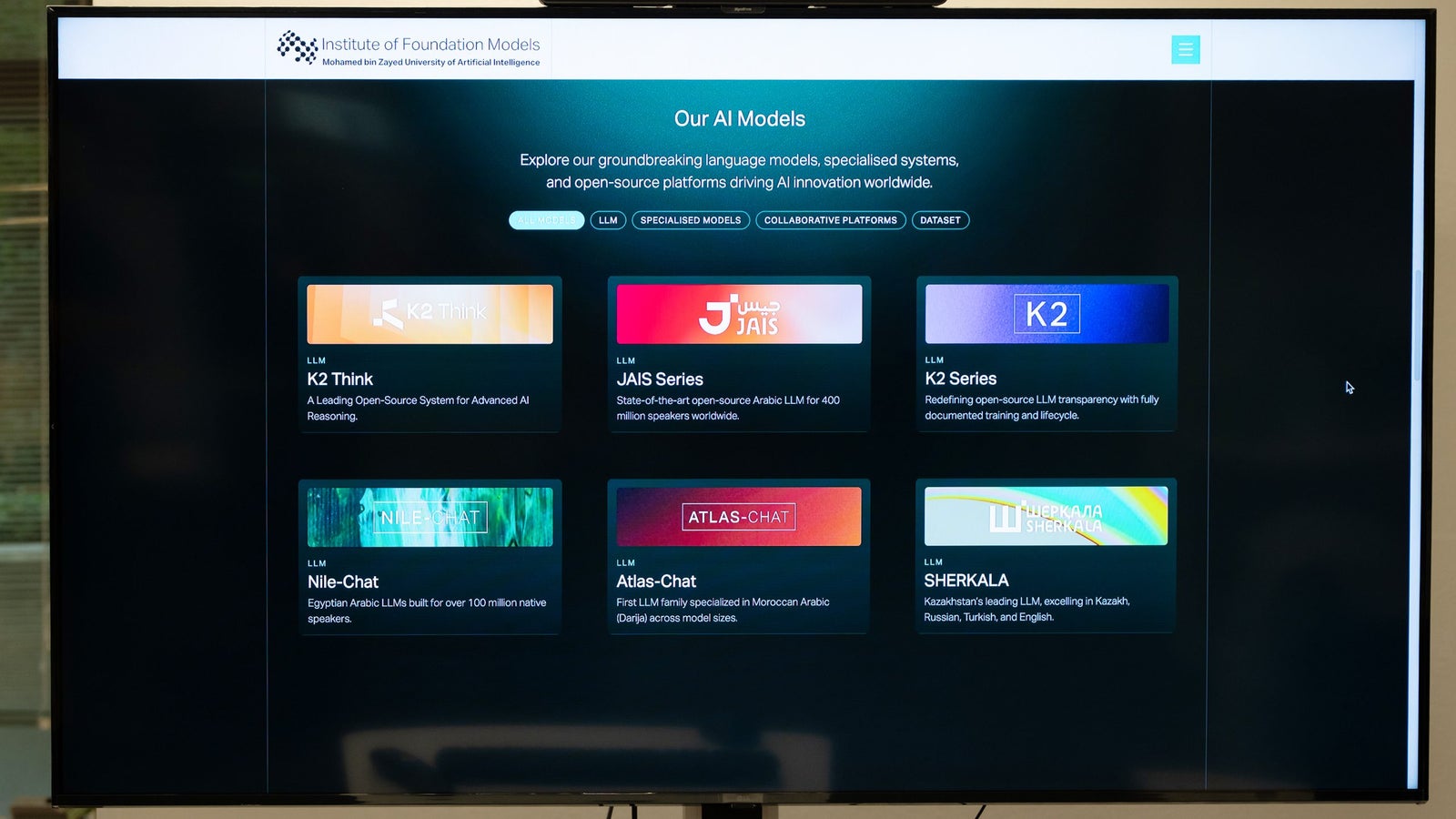
In Silicon Valley, MBZUAI has assembled a 40-strong research team that continues to expand. Together with an additional 40 researchers in Paris and Abu Dhabi, the lab has produced models including the K2 Think, a modest-sized model that the university says matches the performance of much larger systems from OpenAI and DeepSeek on certain benchmarks. This month, the lab released a world model called PAN, capable of predicting future world states through video simulation. Several major AI labs in the U.S. and China are also racing to develop world models, seen as the next frontier in AI research.
In comparison, U.S. academia has taken a back seat in frontier AI research. Training AI models requires large amounts of computing resources that most universities cannot afford. Academia has also been losing researchers to tech giants that offer compensation ranging from hundreds of thousands to several million dollars, amid a fierce race for AI talent.
The UAE lab operates more like a tech startup than an academic institution. Researchers are not expected to teach, nor do they have wide latitude to pursue varied scientific questions. They work under the mandate of training models and, thanks to the Gulf state’s deep pockets, are provided with industry-level salaries and ample graphics processing units.
MBZUAI says it pays researchers higher salaries than those in regular academia. It accesses chips through U.S.-based cloud service providers, and the compute available varies depending on training needs. K2 Think was trained with a few hundred GPUs.
Mike Kai Chen for Rest of World
“We don’t treat ourselves as an academic lab,” Hector Liu, the Silicon Valley lab’s director, told Rest of World. “Our number one job responsibility is to train these models and release them. … [The UAE] will be happy to see these models be used in practice.”
Liu said the lab is committed to an open-source approach and publishes its training data sets, source code, and model weights. A group of AI companies, including many in China, have adopted similar open-model strategies to expand their user base and narrow the gap with industry leaders. Open models developed by Chinese companies like Alibaba’s Qwen and Moonshot AI’s Kimi K2 are now used by some Silicon Valley firms as cheaper alternatives to OpenAI and Anthropic’s proprietary systems.
The UAE is eyeing a similar route to influence. “It’s a prestige play in itself to show that [the UAE] can build these models,” Sam Winter-Levy, a fellow at the think tank Carnegie Endowment for International Peace, told Rest of World. “It’s also a way of planting a flag to try to attract users, companies, and researchers.”
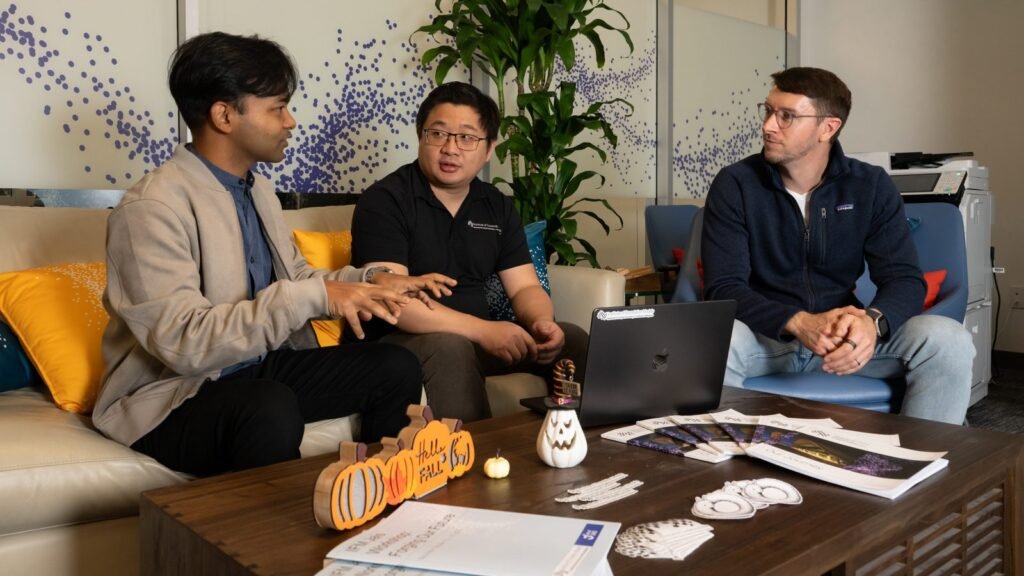
When Rest of World visited the Sunnyvale lab on a Thursday afternoon, about a dozen workers from the U.S., China, India, South Korea, and elsewhere were quietly working at their computers. The lab has also recruited student interns from schools including the Massachusetts Institute of Technology, University of California San Diego, and Carnegie Mellon University.
Liu himself is from China, and earned his doctorate at Carnegie Mellon University, where he worked with MBZUAI’s current president, Eric Xing. The lab’s new program manager, John Maggs, worked for the U.S. Air Force and later on the Gemini team at Google DeepMind. At MBZUAI, Maggs said he ensures researchers move as quickly and iteratively as teams at other Silicon Valley companies.
Another researcher, Rupesh Srivastava from India, joined from a financial AI startup to lead work in agentic AI. Srivastava said he was drawn by the lab’s blend of open-source research and abundant computing resources. “The [open-source] commitment plus resources — other people have one or the other,” he said.
-

Lab director Hector Liu said UAE leadership is focused on integrating the models into real-world applications such as energy planning, financial analysis, and education. -

Mike Kai Chen for Rest of World
So far, MBZUAI’s models have not gained broad adoption. Some academics have questioned whether MBZUAI overstated its model’s performance for publicity. Following the release of K2 Think, AI researchers at ETH Zurich university published a blog post accusing its developers of using overlapping training and test data, relying on an unspecified external model during evaluation, and comparing K2 Think against weaker versions of leading industry models.
“[K2 Think] is not used anywhere because basically the claims didn’t hold up,” Niels Mündler, a Ph.D. candidate and co-author of the blog, told Rest of World. In the month leading up to November 18, K2 Think recorded fewer than 10,000 downloads on the developer platform Hugging Face. In comparison, OpenAI’s open model, gpt-oss-120b, had more than 4 million downloads, and DeepSeek V3.1 recorded more than 328,000 downloads in the same period.
Liu said the criticisms stemmed from differences in evaluation methods and acknowledged that some gaps in the model release report could have been addressed with more time. He said that rather than chasing benchmark scores, UAE leadership is focused on integrating the models into real-world applications such as energy planning, financial analysis, and education.
For the UAE, long-term AI development hinges on securing access to coveted AI chips, said Winter-Levy. U.S. AI companies are keen to work with the UAE, which has the funding, land, and energy resources to power massive AI infrastructure projects. But only the U.S. has the most advanced AI chips.
The U.S. government this month said it had authorized both G42 and Humain, Saudi Arabia’s AI company, to purchase the equivalent of up to 35,000 Nvidia Blackwell chips. The sales of AI chips to the two countries has raised concerns in Washington about China gaining access to the chips via the Gulf. Security agencies have previously investigated G42’s ties with China. G42 said in 2023 that it had cut its China relationships to comply with U.S. security standards.
Shipments are moving along for UAE-based data centers operated by American firms as well. In September, Microsoft was allowed to ship additional Nvidia chips to the UAE for its data centers there — for the first time under the current Trump administration.
Companies including OpenAI, Nvidia, and Oracle are also partnering with G42 to build a data cluster called “Stargate UAE.” OpenAI chief executive Sam Altman recently accepted an honorary doctorate from MBZUAI, the first such title the university has awarded.
The UAE will seek to utilize the chips, talent, and know-how from U.S. companies to cultivate its own AI industry, according to Winter-Levy. “The UAE’s pathway to being a major player in the AI race essentially depends on the U.S.,” he said.