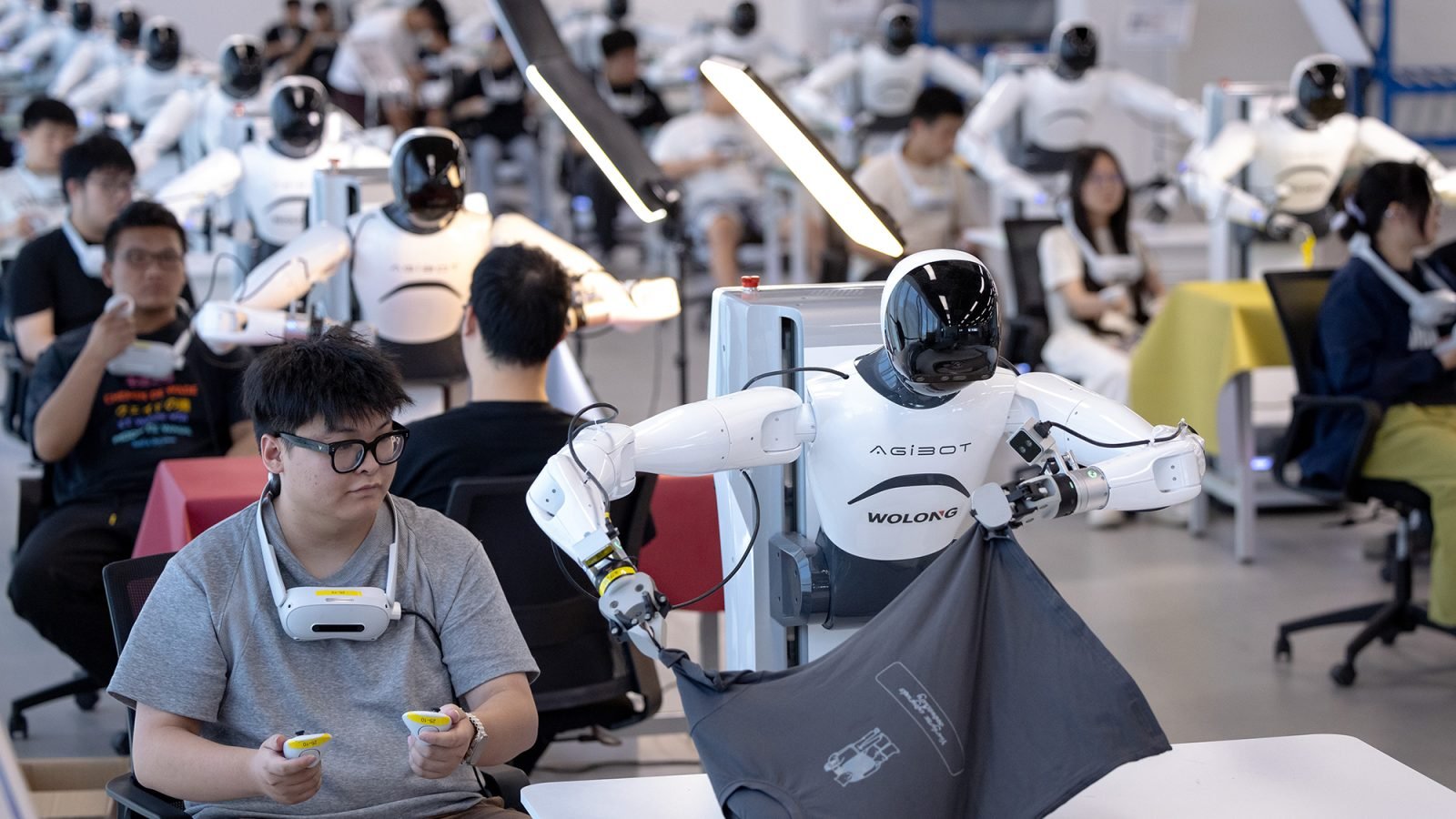
Inside a brightly lit office in Shanghai, Kim’s task for the week was to pretend he was opening the door of a microwave. Wearing a virtual reality headset and exoskeletons on his arms, he repeated the movement hundreds of times a day so that the humanoid robot next to him could learn it. On other days, Kim mimics folding clothes, or stacking wooden blocks.
Kim, a 20-year-old computer science major, works as a trainer at a leading robotics startup. He is one of hundreds of robot trainers across China, whose job is to generate movement data for robots, which the government sees as key to increasing productivity, addressing labor shortages, and cementing its technological edge.
“We call ourselves cyber-laborers,” Kim told Rest of World, speaking under a pseudonym because he is not authorized to talk to the media. “It’s a fine gig, though a bit boring.”
Kim is an essential part of China’s strategy to grow into a powerhouse of robotics, seen as the next front in the U.S.-China tech race. In early 2025, the Chinese government highlighted embodied intelligence — or artificial intelligence in the physical form — as a priority for the country, sparking an investment frenzy in the development of robots, including humanoids, which can one day think and act like humans.
The global success in training large language models with massive data sets has fueled the belief that a similar scaling approach could work for robots. But robotics requires far more complex data sets — including visual information, joint motions, rotations — which cannot be easily scraped from the internet or produced synthetically.
150 The number of humanoid robot companies currently operating in China.
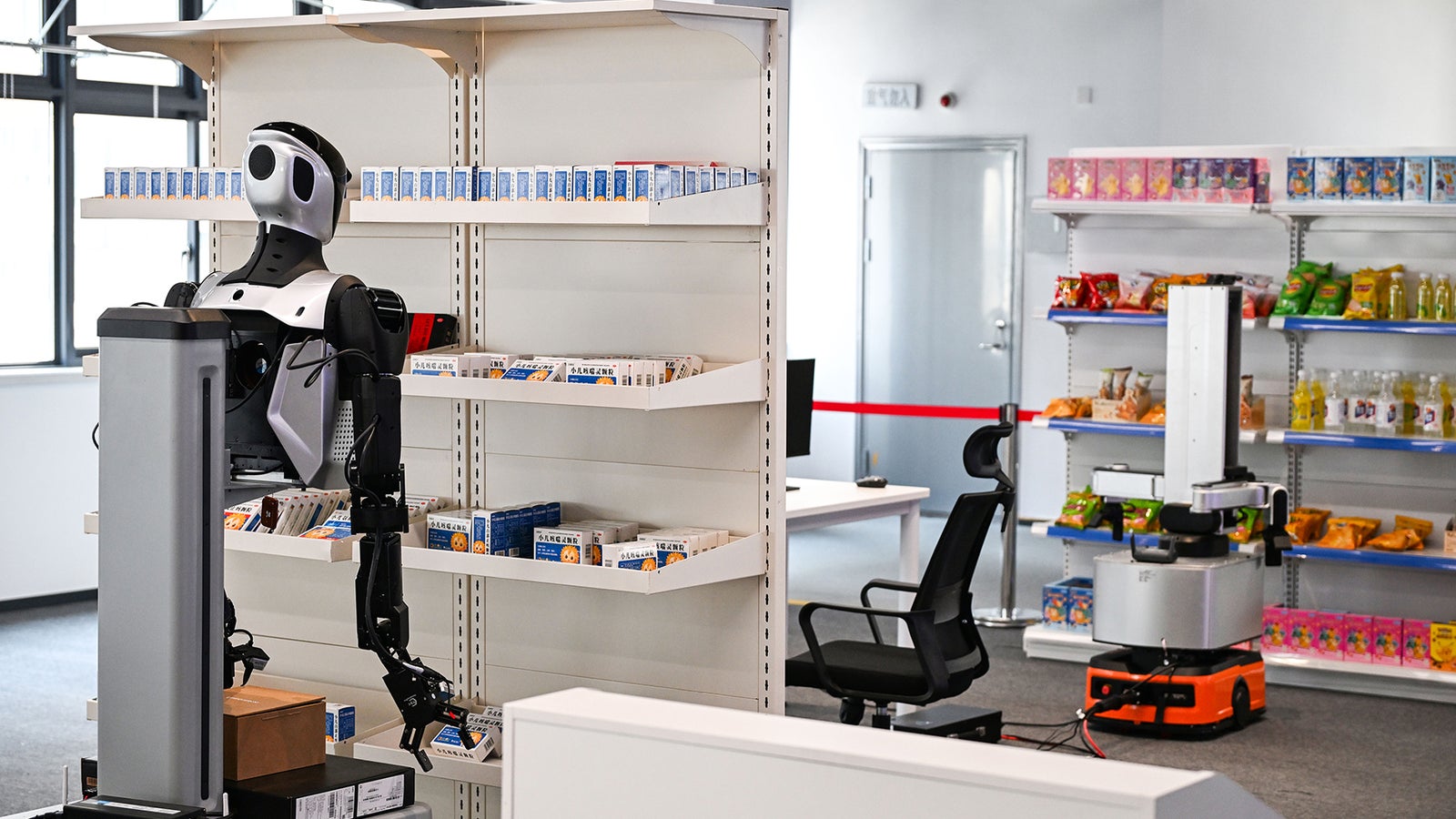
Local governments in China are addressing this data crunch with state-funded “robot training centers.” These facilities are commonly built by local governments and operated by robotics companies. They typically occupy a few thousand square meters of office space, and are equipped with dozens of robots, according to state media reports. In some of them, trainers like Kim act out everyday tasks repetitively to generate critical movement data.
By December, more than 40 state-owned robot data collection centers had been announced in the country, according to the intelligence firm Interact Analysis. About two dozen are already in operation.
One of the largest facilities, a training camp in suburban Beijing, was launched by the local Shijingshan government in collaboration with humanoid company Leju. It covers an area of more than 10,000 square meters (108,000 square feet), and provides 16 specific scenarios for humanoid robot training, including settings that mimic a car assembly line, a smart home, and an elder-care facility, according to a government statement.
Getty Images
“It’s like teaching children how to walk with lots of practice,” according to a spokesperson for the project cited in the statement. “The training camp is aimed at solving the data shortage problem.” The standardized, large-scale data produced can be shared across the entire industry, addressing the uneven quality of data produced by companies on their own.
In another government data collection center in Hubei province, nearly 100 humanoids, controlled by humans, practice movements like folding clothes, ironing, and wiping the table hundreds of times a day.
While these facilities can provide data for smaller startups that cannot afford their own training space, the infrastructure buildup also risks causing overcapacity, Marco Wang, an analyst with Interact Analysis, told Rest of World. “There are some potential bubbles,” he said.
The worldwide market for humanoid robots could be worth $38 billion by 2035, with some 250,000 shipments as early as 2030, according to estimates by Goldman Sachs. Chinese and American companies are leading the race to develop intelligent robots that can live with humans and perform manual labor, as well as household chores.
The leading players include U.S.-based Figure — recently valued at $39 billion — 1X, and Tesla. Top Chinese humanoid makers such as Unitree Technology, Galbot, and AgiBot have been valued at over $1 billion each, with Unitree planning a listing this year. U.S. companies have also recruited humans to produce data for robotic training, though on a much smaller scale. Tesla has dozens of workers acting out motions to train its Optimus humanoid robots.
While venture capital investments are driving the robotics boom in Silicon Valley, the Chinese industry has been turbocharged by government support. China regularly uses industrial policies to boost strategic industries, although it has also led to wasted resources, overproduction, and price wars. After the central government directed the country to grow the electric vehicle industry in the 2000s, several provinces and cities jostled to introduce subsidies, tax breaks, and loans. Government agencies and state-owned bus companies bought the first EVs before they became good enough for consumers.
The country is now counting on a similar approach to grow its robotics industry. Besides data collection centers, local governments have established embodied AI funds, introduced subsidies for firms to access computing resources, and launched courses on embodied AI in universities.
Tang Yanjun/Getty Images
“The central government is sending clear signals to local governments, expecting them to provide on-the-ground, tangible support to local companies,” Pavlo Zvenyhorodskyi, an analyst at think tank Carnegie Endowment for International Peace, told Rest of World. “Every local government is being creative [in coming up with] support measures.”
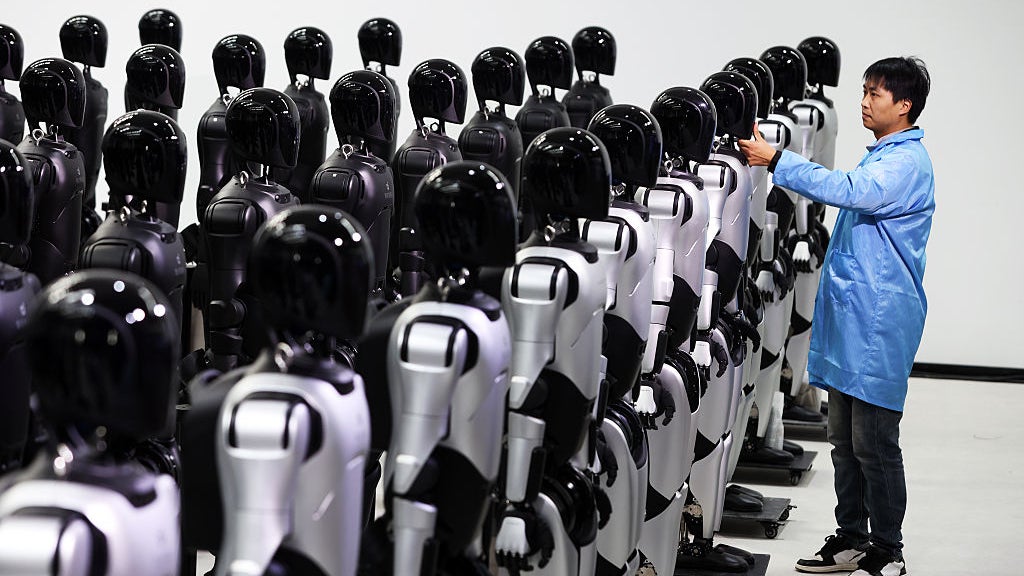
With commercial use likely far in the future, some of the biggest orders for humanoid robots in China have come from the public sector, including the training facilities. Recently, Shenzhen-based firm UBTech Robotics sold 566 million yuan ($80 million) worth of humanoid robots to three data collection centers in the provinces of Jiangxi, Guangxi, and Sichuan.
China Mobile, a state-owned telecom operator, placed 124 million yuan ($17.6 million) worth of orders with leading robot makers Unitree and AgiBot in July. The humanoids will be used in research, customer service, and security patrols.
Worries about overcapacity are growing. In November, China’s economic-planning agency, the National Development and Reform Commission, issued a rare warning about the risks of a bubble in the humanoid robotics industry. More than 150 humanoid companies currently operate in China, said Li Chao, a spokesperson for the agency.
The proliferation of data collection facilities comes as robotics researchers still debate whether recording human movement data — a labor-intensive, time-consuming process — is the best way to build fully intelligent robots. Researchers are exploring alternative approaches, such as using digital simulation or collecting data from robots that are already at work.
The cost effectiveness of China’s data factories is unknown, Ken Goldberg, a robotics researcher at the University of California, Berkeley, told Rest of World.
“It’s a noble effort, and there’s a lot of hope right now that this will succeed,” Goldberg said. “But it’s slow. Even if you have hundreds of people working, it’s going to take a long time to get enough data.”