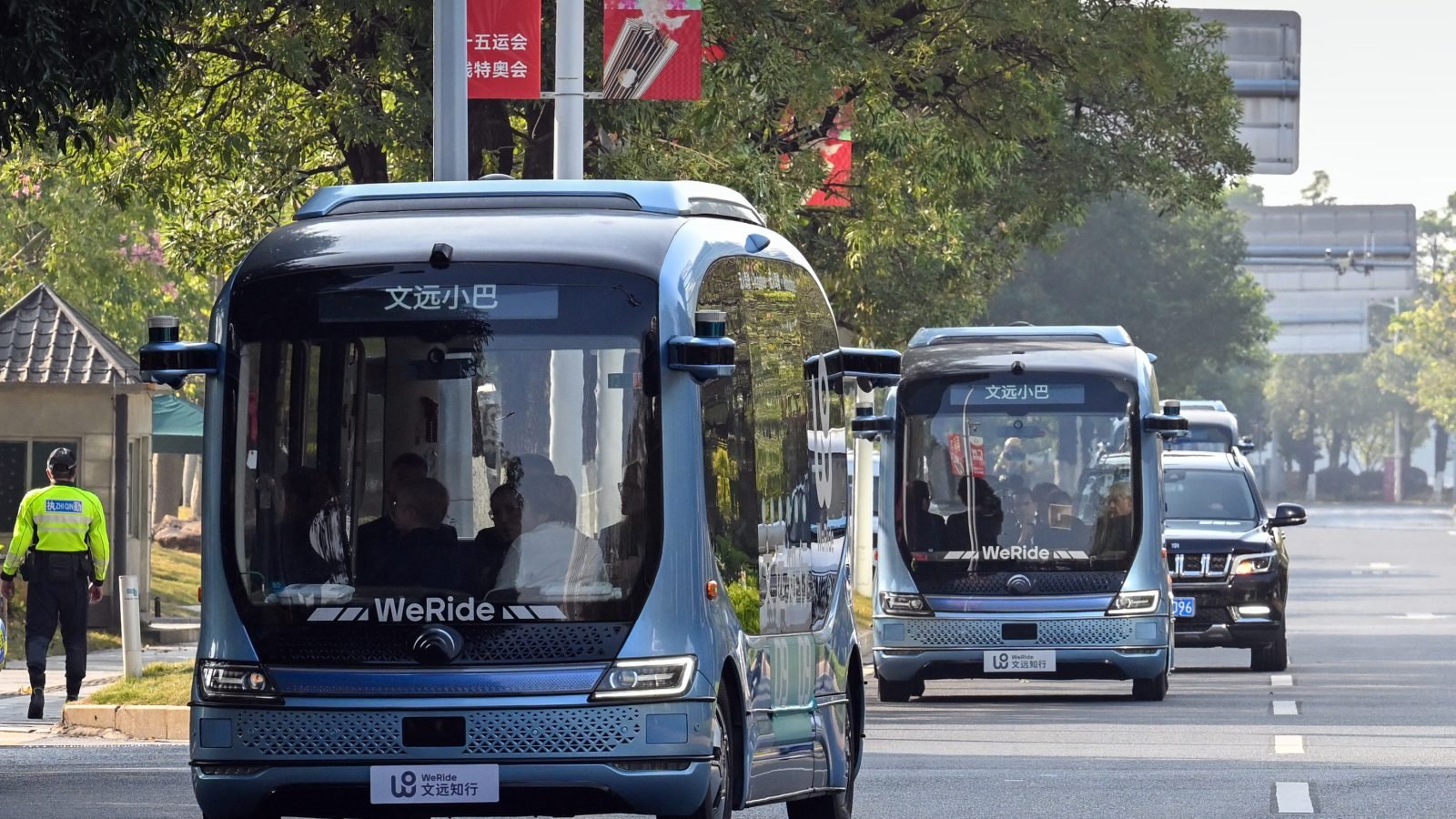
China is beating the United States in the race to control the Gulf’s driverless car market.
The latest win came last month when Chinese company WeRide secured an exclusive deal with Ras Al Khaimah, the northernmost of the United Arab Emirates, to build its entire transport system around driverless cars. The sleepy emirate — preparing to become the Gulf’s Las Vegas — is betting on Chinese technology instead of traditional metros and buses.
Ras Al Khaimah, which expects millions of visitors when the UAE’s first casino opens in 2027, recently granted WeRide an exclusive partnership as its sole autonomous-vehicle technology provider. The Guangzhou-based company already operates robotaxis — autonomous EVs that provide ride-hailing services without a human driver — on the Uber platform in Riyadh since October 2025, a first for Saudi Arabia.
Chinese autonomous vehicle companies are winning the race to deploy commercial robotaxis across the Middle East, outpacing U.S. rivals that have pulled back from international expansion. WeRide, Baidu’s Apollo Go, and Pony.ai are scaling operations across the region, while U.S. firms Cruise and Waymo remain locked in their domestic markets, shackled by safety incidents, regulatory pressure, and litigation risks.
“It’s a race now,” Tu Le, founder of market research firm Sino Auto Insights, told Rest of World. “Not being able to quickly add more robotaxis to your global fleet could quickly move you from a leader to a laggard.”
The Gulf governments want to move past their oil-country reputations.”
Autonomous vehicles are the latest addition to China’s growing technological footprint in the Gulf. Chinese companies have already captured the region’s data-center contracts, consumer electronics, and EV markets.
WeRide, which received the world’s first autonomous driving license in the UAE for all types of self-driving vehicles in July 2023, holds a commanding first-mover advantage. In November 2025, the company began fully driverless commercial operations through TXAI, its Abu Dhabi robotaxi service on Yas Island, becoming the first Level 4 autonomous service available on Uber outside the U.S.
“This reflects the country’s strong support for innovation and deployment of AVs,” Ryan Zhan, WeRide’s regional general manager for the Middle East and Africa, told Rest of World.
The company’s Middle East fleet now comprises more than 100 robotaxis, with plans to reach more than 500 next year and scale into tens of thousands by 2030, Zhan said. WeRide supplies AV technology, while partners such as Uber handle fleet operations, maintenance, and customer interfaces.
Since December 2024, WeRide and Uber have tripled their Abu Dhabi fleet, expanding into major islands and routes connecting Zayed International Airport. In Ras Al Khaimah, the partnership recently launched the first robobus pilot on Al Marjan Island, linking resorts and attractions.
Early rider adoption “has been encouraging,” Zhan said.
The Middle East offers near-perfect conditions for training self-driving algorithms, according to industry experts. Predictable weather with minimal rain and no snow allows testing year-round, while well-maintained roads and strict traffic enforcement create the rule-based environment autonomous systems need.
“A rule-based roads and infrastructure system is mandatory for autonomous vehicles,” Shoaib Mohamed, managing director at Dubai-based automotive safety solutions provider Resolute Dynamics, told Rest of World. “The region might be the best-equipped place for the same to thrive.”
Gulf governments are also eager buyers. Saudi Arabia’s Vision 2030 calls for 25% of goods transport and 15% of public transport to be autonomous within five years, while Abu Dhabi and Dubai aim for 36% of all trips to be driverless by 2040.
“The Gulf governments also want to move past their oil-country reputations,” Le said. “They see embracing robotaxis as a way to do that.”
The contrast with the U.S. is stark. General Motors’ Cruise paused almost all driverless operations in late 2023 after a series of safety incidents and regulatory pressure in California, according to S&P Global Mobility, an automotive intelligence company. The company has since focused on rebuilding safety systems rather than expanding abroad.
Having hundreds of robotaxis deployed is a huge step towards becoming a long-term leader in the region.”
Waymo, despite strong technical credibility, has kept operations limited to Phoenix, San Francisco, and Los Angeles, even as it conducts early testing in Tokyo, and plans a London launch this year.
While U.S firms have been more cautious in expanding robotaxi services beyond domestic markets, Chinese players have moved in the opposite direction. They are expanding into markets where regulators are supportive and public-sector partners are available, forming joint ventures and adapting business models to local conditions.
In March 2025, Baidu’s Apollo Go partnered with Dubai’s Roads and Transport Authority to launch its first international fleet outside China. It plans to introduce 100 fully autonomous robotaxis by the end of 2026, and 1,000 by 2028.
Pony.ai recently signed an agreement with Dubai’s RTA to begin supervised robotaxi trials later this year. In 2023, the company had joined Abu Dhabi’s Smart and Autonomous Vehicles Industry — a government-backed initiative to accelerate the development of AV technology — to run tests at Yas Island. Pony.ai aims for fully driverless operations next year.
Chinese AV companies bring several advantages that Gulf nations increasingly prioritize, Le said. They guarantee data sovereignty, offer financing through joint ventures instead of demanding upfront payments, and localize operations extensively.
“Working very closely with local and federal governments is vital to revise laws, policies, and determine pilot locations,” Le said. “Also, trying to find out how much can be subsidized by local partners and government agencies, since Chinese AV companies have very limited capital to invest entirely on their own.”
Ras Al Khaimah illustrates the opportunity and the stakes. The emirate has no metro and only a few public buses, yet expects millions of visitors when its Wynn casino-resort opens in 2027. It is betting on Chinese autonomous vehicles to transport them.
“WeRide continuously seeks to expand into global markets that make business sense,” Zhan said. “We aim to bring advanced autonomous driving technology to markets where we can deliver maximum social value and long-term value to our stakeholders.”
Even with supportive governments, AV companies face hurdles. Public trust remains essential, and Chinese firms are still building broader acceptance of driverless vehicles for daily use, Zhan said. Technical, operational, and geopolitical challenges persist, along with ongoing investment needs, according to S&P Global Mobility.
As Gulfwide deployments expand across Abu Dhabi, Dubai, Ras Al Khaimah, and Riyadh, the region is becoming a global test-bed for autonomous mobility and a proving ground for Chinese technological ambition. If Ras Al Khaimah’s strategy succeeds, it could leapfrog legacy transport models entirely, experts said.
“From a technology standpoint, having hundreds of robotaxis deployed that can run most of the day in most conditions across multiple cities is a huge step towards becoming a long-term leader in the region,” Le said.