Kyle Enero, a call-center employee, was at work one night on the 11th floor of an office tower in the Philippine city of Cebu, when the building began to shake violently. He and the others were directed to go to one evacuation site, then another, and told to wait to resume work, even as emergency vehicles rushed to rescue people.
The Cebu earthquake last September, measuring 6.9 on the Richter scale, was one of the most powerful in the region, killing about 80 and injured hundreds. While local residents huddled with family in the streets or rushed to evacuation centers, some call-center workers were ordered to resume work after 30 minutes, Enero told Rest of World.
The Philippines tops a global index of 193 nations ranked on their vulnerability to extreme weather events. Besides earthquakes, cyclones and floods are frequent, and have become more intense due to climate change. They are threatening the country’s business process outsourcing industry, which counts on uninterrupted service. It employs about 1.9 million people, and generated some $40 billion in revenue last year, accounting for nearly 10% of the country’s gross domestic product.
The sector, which has long provided call-center services to multinational firms, is rapidly adding artificial intelligence jobs such as prompt engineering, data annotation, and content moderation for companies including Meta, Microsoft, ScaleAI, and OnlyFans. Natural disasters threaten the industry’s business model because of potential outages that can disrupt work, according to Global Sourcing Risk Index, an analysis of global supply chain vulnerability.
There are also increased risks to workers, according to labor group BPO Industry Employees Network, or BIEN.
“At this point, it is really just the workers solving their own problems,” Cheryll Soriano, a professor of communications at De La Salle University in Manila, who has studied impacts of climate change on Filipino data workers, told Rest of World. The government encourages the data industry boom “but not necessarily better working conditions.”
Rain, earthquake, volcano erupting … you still gotta go to work.”
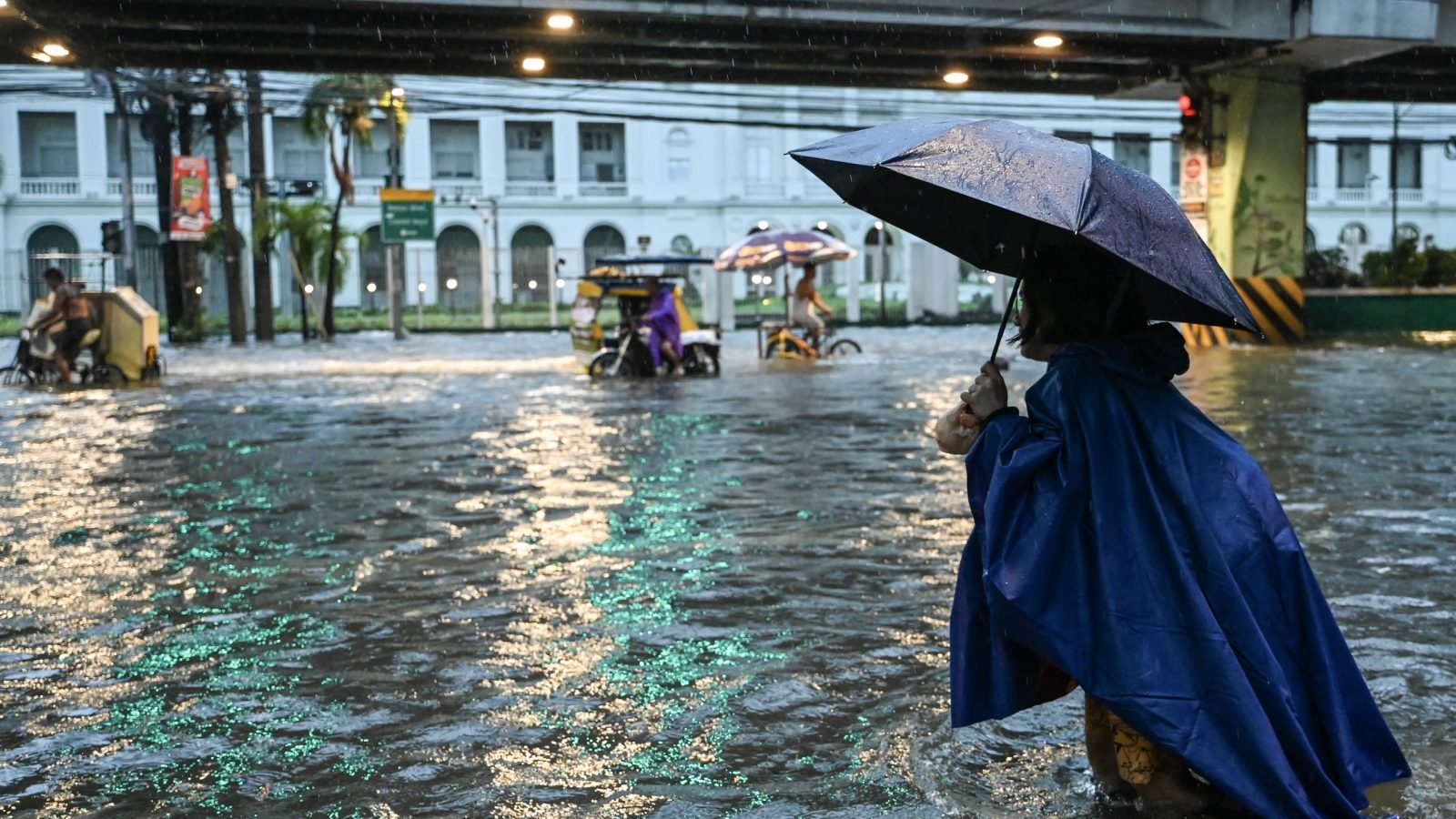
In the Philippines, there’s a long-running joke that BPO workers are “waterproof” — invincible in the face of cyclones. The humor masks the strict attendance policies that often leave workers choosing between safety and their jobs. About a month after the Cebu earthquake, Typhoon Kalmaegi, or Tino, hit the region, causing widespread outages, and killing nearly 100 people. Days later, Super Typhoon Fung-wong — known locally as Uwan — brought heavy rain and flooding to the Metro Manila area, where BPO offices are heavily concentrated. At least 33 people were killed.
There is no data on fatalities or injuries to BPO workers from these disasters. But resentment has long simmered over companies insisting work continues on-site during these events, including during the Covid-19 pandemic, when workers said they were forced to sleep on-site or in nearby hotels, and not allowed to go home. Those conditions prompted a formal complaint from a workers’ union. Similar complaints followed a volcanic eruption in 2020 and Typhoon Odette in 2021.
After Uwan, BIEN filed a formal complaint with the Department of Labor and Employment against 98 BPO sites, accusing them of violating the country’s safety and labor laws during the event. Workers were forced to report on-site despite “widespread flooding” and “high-risk” travel conditions, and those who failed to do so were issued a notice to explain their absence, the complaint said. Last November, the department opened an investigation.
In response, the IT and Business Process Association of the Philippines, an industry lobby group, said its member companies complied with the government directive that “work suspension would be left to the discretion of employers,” and continued to operate as needed.
While some of the companies named in the complaint provided shuttle services, free meals, or temporary lodgings, most had limited work-from-home options, Renso Bajala, BIEN’s national spokesperson, told Rest of World. Workers were simply told to plan ahead or arrive earlier for their shift, he said.
“What the workers demanded is suspension of work … or the ability to work from home,” so they could ensure their family’s safety, he said.
1.9 million The number of workers in the BPO industry in the Philippines.
The contracts between BPO firms and overseas clients often prioritize quantity over quality, making the physical presence of workers an essential metric, Bajala said. Most clients are based in the U.S. or Europe, with little knowledge of on-the-ground conditions in the Philippines during earthquakes and typhoons.
“They expect us to provide service every day, even if it is not safe,” Bajala said.
The anger at overseas clients dictating terms to underpaid workers in the Philippines is not new; there are several threads on forced attendance in extreme conditions on the Philippine BPO community on Reddit. One commenter said: “Always remember, your bosses aren’t in the Philippines. Rain, earthquake, volcano erupting … you still gotta go to work.”
The shift to AI-related work has further shrunk flexibility for workers. One Accenture employee, who works on AI systems for Meta, told Rest of World she is required to work on-site for her job, which involves reviewing disturbing content including violence and nudity.
“We’re told that it’s because we’re handling sensitive content,” the employee said, requesting anonymity because she is not allowed to speak to the media. During Uwan, employees in her office were not allowed to work from home, she said.
Philippines’ AI data training market is forecast to grow more than sevenfold by 2032. BPO workers are being trained for various AI-related jobs, which also requires being on-site. “You don’t miss training even during disasters,” the Accenture employee said.
Accenture did not respond to an inquiry from Rest of World.
Under the Philippine occupational safety and health law, workers may refuse work that poses imminent danger to life or health. The government’s labor advisory urges private-sector employers to “suspend work to ensure the safety and health of their employees during weather disturbances and similar occurrences.”
Enforcement is weak because the determination of “imminent danger” is largely left to employers, according to BIEN.
A spokesperson for U.S.-based Cognizant, which was named in the complaint, told Rest of World the Department of Labor and Employment inspected their site and deemed them compliant. French multinational company Teleperformance said it does not penalize staff for absence during verified emergencies. Foundever, a French customer service company, declined to comment on reports that its operations continued during Typhoon Uwan. Other major BPO firms including Concentrix, Infosys, and Alorica did not respond to queries from Rest of World.
The labor department’s investigation into BIEN’s complaint has been slow, said Bajala. The department did not respond to an inquiry from Rest of World. Labor Secretary Bienvenido Laguesma has said that compliance with occupational safety and health laws is a priority.
BIEN is now pushing for legislation that will make violations of occupational safety and health laws criminally liable, and mandate benefits such as hazard pay during disasters.
“We’re not just money-making machines, we are humans,” Bajala said. Global companies that benefit financially from outsourcing work to the Philippines should also be held accountable, he said. “They’re part of this system.”