More than 84 world leaders, 800 CEOs, and thousands others gathered amid the Alps this week to attend the World Economic Forum’s annual meeting in Davos, Switzerland.
Artificial intelligence — bubbles, jobs, robots, and surveillance — dominated tech-related panels and conversations at the summit. From Elon Musk’s vision for humanoid robots to Larry Fink’s bullish take on AI and Dario Amodei’s warnings, here’s what Davos revealed about the state of AI.
Is the AI bubble bursting?
Several moderators brought up the much-debated topic of the AI industry being in a bubble — a scenario where company valuations far exceed their current tangible value. Industry leaders approached the question from various angles but reached the same conclusion: All is well.
On the sidelines of the event, BlackRock CEO Larry Fink told Bloomberg TV he “sincerely believes” there is no bubble in the AI space.
What I see is this smooth exponential line.”
“I don’t think there’s any uncertainty about AI,” said Fink, also the co-chairperson of the WEF. “Hundreds of billions of dollars are needed to build this out. The capex is going to drive more global growth. … That being said, like in everything else in capitalism, there are going to be some big failures. … There are going to be some huge winners and some losers. But I believe the needed capital to build out AI is one of the great opportunities for the world to come.”
Anthropic CEO Dario Amodei said that while the public opinion on AI has “oscillated wildly” over the years, as an industry insider, he believes the technology has continued on the same trajectory.
“Every three to six months, we have this reversal of polarity where the media is incredibly excited about what the technology can do: It’s going to change everything. And then [after some time] it’s all a bubble. It’s all going to fall apart,” he said. “What I see is this smooth exponential line. … And that march has just been constant.”
What jobs is AI replacing?
Layoffs and the future of jobs amid AI advancement were among the most-discussed topics.
While several speakers appeared to be skirting the subject by emphasizing that bots and humans could co-work, Nvidia CEO Jensen Huang said AI was, in fact, creating high-paying “tradecraft” roles for plumbers, electricians, and steelworkers. Salaries for some of these workers in the U.S. have doubled, he said, reaching six figures in certain cases.
Jobs, jobs, jobs! It’s incredible.”
“Energy [sector] is creating jobs. Chips industry is creating jobs. The infrastructure layer is creating jobs. Jobs, jobs, jobs! It’s incredible,” Huang said. “This is the largest infrastructure buildout in human history. That’s going to create a lot of jobs. And it’s wonderful that the jobs are related to tradecraft. … Everybody should be able to make a great living. You don’t need to have a Ph.D. in computer science to do so, and I’m delighted to see that.”
Amodei said AI had the power to create a world where economies were growing fast, but that would not result in more jobs. He called it the “bad side of things,” and a “risk.”
“The signature of this technology is it’s going to take us to a world where we have very high GDP growth and potentially also very high unemployment and inequality. Now, that’s not a combination we’ve almost ever seen before,” Amodei said.
He gave the example of engineers at his company who use AI to write code, and then edit it themselves. But as AI advances, he said, they might not have any work left to do.
“There are still things for the software engineers to do. It’s like even if the software engineers are only doing 10% of it, they still have a job to do, or they can take a level up. But that’s not going to last forever,” he said.
Watch: Nvidia CEO Jensen Huang speaks at the WEF
Will Tesla’s Optimus robots replace humans?
The conversations around robots, robotics, and robotic agents at the Davos panels included their impact on humans, livelihood, and the environment.
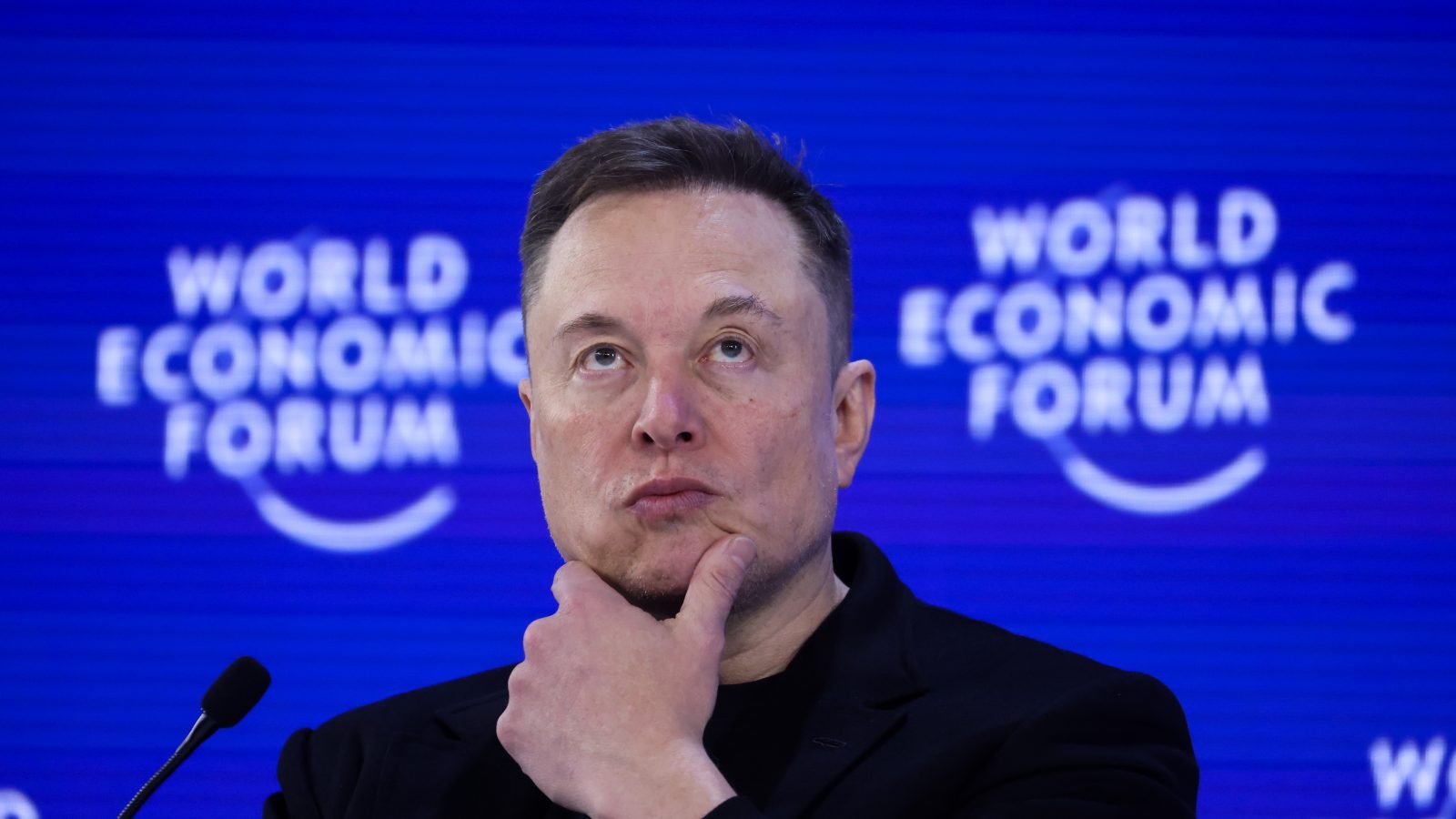
Musk surprised many when he said Tesla could start selling humanoid robots to the general public by the end of 2027. Tesla has been working on a general-purpose robot called Optimus for over five years. Musk has said the robot will eventually be able to handle everything from factory work to domestic chores.
There will be more robots than people.”
“My prediction is that there will be more robots than people [on Earth],” Musk said. “If you have billions of humanoid robots — and I think there will be — I think everyone on Earth is going to have one and is going to want one because you would want a robot to — assuming it’s very safe — to watch over your kids, take care of your pets. … There aren’t enough young people to take care of the old people. So, if you had a robot that could take care of and protect an elderly parent, that would be great. That would be an amazing thing to have. And I think we will have those things.”
In response to a follow-up question about human purpose in a scenario when there are more robots than humans, Musk quipped, “Nothing is perfect.”
“You can’t have work that has to be done and [an] amazing abundance for all,” he said.
Watch: Tesla CEO Elon Musk at the WEF
On AI in surveillance
Amodei said AI had become sophisticated enough to make individualized propaganda, break into any computer system in the world, surveil everyone in a population, and detect dissent and suppress it.
Calling this trend “really scary,” he said that more needs to be done to stop powerful AI surveillance technologies from being made available to autocratic governments.
“I am concerned that AI may be uniquely well-suited to autocracy and to deepening the repression that we see in autocracies,” Amodei said. He said governments need to put more focus on strategies, such as targeted policies of not selling chips to certain nations, to keep the threat of surveillance in check.
Watch: Anthropic CEO Dario Amodei at the WEF
AI in sustainable tech
The biggest limiting factor to the growth of AI is electrical power, Musk said. He spoke about the role solar energy could play in overcoming this challenge.
“We’re seeing the rate of AI chip production increase exponentially, but the rate of electricity being brought online is 4% a year max,” he said.
There’s so much room in space.”
He praised China for its growth in electricity production and said the country was able to achieve that because of its focus on solar.
“Solar is by far the biggest source of energy. Even on Earth, but certainly beyond Earth,” Musk said. “That’s why one of the things we’ll be doing with SpaceX within a few years is launching solar-powered AI satellites because the space is really the source of immense power, and then you don’t need to take up any room on Earth. There’s so much room in space, and you can scale to ultimately hundreds of terawatts a year.”
AI and geopolitics
When asked whether businesses and government were doing enough to prepare for the impact of AI, Amodei responded with an unequivocal “no.”
He said there was a need to closely observe how and where AI was being used, and until that is done, any policy is going to be blind and misinformed. “Many policies have gone wrong because they’re based on premises that are fundamentally incorrect,” Amodei said.