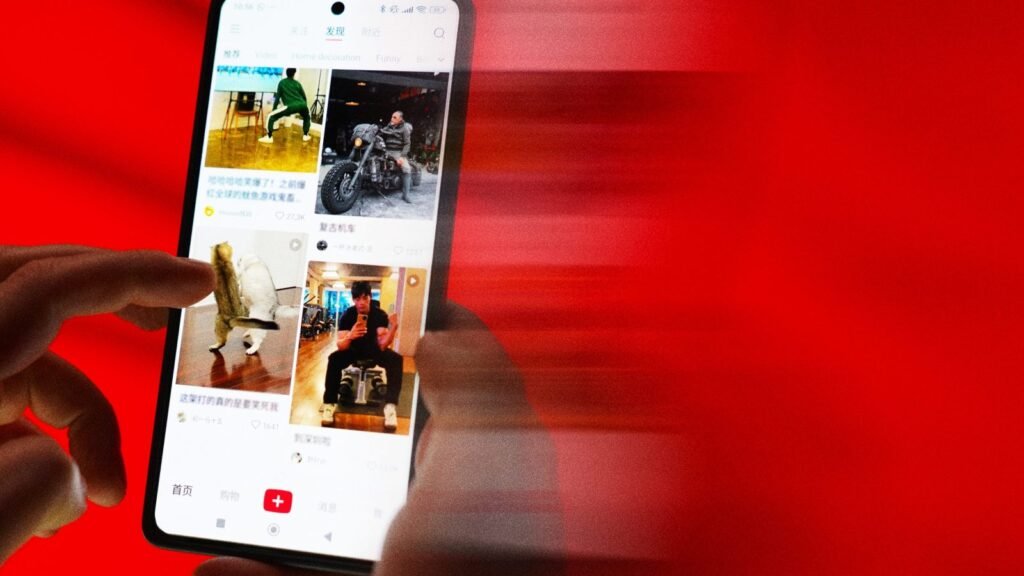
To understand China today and where it’ll go tomorrow, we must learn to read the Chinese internet: what goes viral and what disappears just as swiftly, how it shapes and is shaped by the outside world, and how it is controlled from the top down and mobilized from the bottom up. Social media feeds allow us to gauge public opinion when other forms of polling are inaccessible. Censorship directives often give us a better grasp of the Party’s fears and aspirations than any official communiqué. Viral memes reveal sharper diagnoses of popular sentiment than a think tank analysis. There are over twice as many Chinese web users as there are people in the United States; if Chinese netizens formed a sovereign country, it would be the world’s third largest. American “TikTok refugees” who migrated to XiaohongshuXiaohongshuXiaohongshu, which translates to “little red book” in Chinese, is a lifestyle e-commerce and social media platform.READ MORE were shocked by the dynamism they found on the other side of the Great Firewall. After all, few had ever set foot upon this online terrain; until then, they knew little about the texture of its landscape and the lives of its inhabitants.

As China’s influence expands beyond its borders, the boundaries of the Chinese internet have become increasingly blurred. Shenzhen-based Transsion serves as Africa’s largest mobile phone supplier, and Shein, now the biggest fashion retailer in the world, influences clothing trends in Los Angeles. Xiaohongshu, popular among the Chinese diaspora, shapes culinary tastes in Düsseldorf and tourism trends in Laos. Sichuanese vlogger Li Ziqi was lauded by The New York Times as the global web’s “Quarantine Queen”; the viral ethos of “lying flat” is now part of the lexicon of burned-out millennials the world over. Douban dissidents migrate to Reddit; Weibo lingo goes viral on Twitter; Douyin videos travel to TikTok. In 2023, I took on a role as the China editor at Rest of World, an international news publication covering technology outside the West. The reach of the Chinese web was so significant that we had to create a separate beat dubbed “China Outside China,” encouraging all correspondents to cover the story regardless of whether they were based in Lagos or Mexico City. From Foxconn workers in Chennai to TikTok livestreamers in Jakarta, many more people were learning to navigate the Chinese web, too.
Reading the Chinese internet requires rigor and nuance, empathy and skepticism. And now, more than ever, we need better readers. The number of foreign students studying in China has plummeted: In 2023, 700 Americans studied in Mainland China, down from 15,000 a decade earlier. Twitter commentary is a cesspool of pseudo analysts who have never set foot in the country, drowning out voices of true expertise and reason. Even the most reputable newspapers publish sweeping op-eds, a genre of twenty-first-century Orientalism, in an attempt to demystify a nation of one billion. One such article, published in February 2020, during the onset of the pandemic in The Wall Street Journal, titled “China Is the Real Sick Man of Asia,” sparked a vicious media conflict between the Chinese and U.S. governments that resulted in the expulsion of many foreign correspondents from China. For those who remain, it has become nearly impossible to get anyone to speak openly — not only for fear of government repercussion but also because of the very real likelihood that their words will be misconstrued by an ignorant readership.
The questions Chinese netizens have asked themselves for years are becoming questions many more of us must ask today.”
We misunderstand China to our own detriment. The questions Chinese netizens have asked themselves for years are becoming questions many more of us must ask today. Just as NBA players equivocate on whether to curb their online speech to reach a Chinese fan base, Hollywood studios debate whether to cut a scene in order to profit from a Chinese viewership. The TikTok ban is this debate writ large: In 2024, as the Biden administration moved to ban TikTok, the Biden campaign avidly used the Beijing-born platform to reach out to young voters. A platform once praised as a divinatory meme machine used by more than half the U.S. population is now also seen as a geopolitical Trojan horse, enabling the Chinese Communist Party to steal data and brainwash children. The irony of American TikTok refugees flooding Xiaohongshu in 2025 underscored a deeper reality: that the US internet had become much more like China’s, not the other way around. “In trying to ‘protect’ Americans from China, our gripped-by-moral-panic political class has made us just like China. The government has decided that the only way to combat China’s techno-authoritarian censorship model is to emulate it,” wrote the American blogger Mike Masnick. American alarm at Chinese influence has begun sounding like China’s own rhetoric: In August 2020, Secretary of State Mike Pompeo urged the United States and its allies to develop a “clean fortress” around its internet — in other words, to build a Great Firewall of its own.
The Chinese internet is shaped by forces not unique to China but present in autocracies and democracies alike: the amplification of illiberal voices, the contraction of the public sphere, the erosion of common sense. Today, both autocrats and oligarchic CEOs have taken over the once-open space of the web, monitoring our private lives, ensnaring us in an endless feed, and extracting our attention for influence and profit. As I write, Silicon Valley’s attention moguls work alongside the ascendant Trump administration, centralizing power in their hands beyond democratic oversight. We find ourselves fettered by the very technologies that once promised to liberate us; they shape our behavior in ways we ourselves cannot even see, dictating what we choose to click and consume, to pay attention to and ignore, to say and not to say. The imperative for us to “live within the truth” — authentically and with greater human agency in the face of manipulative systems — has become more urgent than ever before.
