With hotels full and flights sold out, Trinidad and Tobago Carnival returns at full volume this month, even as regional tensions hover over the Caribbean. Instead of shrinking the celebration, uncertainty is shaping it, right down to the costumes and themes.
Full Flights, Full Hotels, and a Savannah That Still Calls
By the time the big bands unveil their designs, the season is already moving faster than the island’s traffic can manage. Costumes are released a year in advance, so people can buy them, plan for them, and compete in the grand parade at Queen’s Park Savannah. That long runway matters now. With airfares up and economic uncertainty hanging around the region, a costume becomes both purchase and promise.
Yet the first obvious fact is simple: the carnival is still pulling people in. Hotels are full. Flights are sold out. In Port of Spain, the Savannah is preparing to take on what it always takes on, crowds and color and sound, and something more challenging to describe, the sense that the street is where Trinidad and Tobago tells the truth; it cannot fit into a press release.
Carnival, celebrated for more than two hundred years, will take place on February 16 and seventeen. So far, the expectation is that more than 30 bands, comprising more than 55,000 participants, will take the stage at Queen’s Park Savannah in Port of Spain. The trouble is, the moment you try to treat those numbers like the whole story, you miss what is actually happening. Carnival is not just a gathering. It is a national argument conducted in sequins, a relief valve that also remembers.
The regional backdrop has been tense. The crisis in neighboring Venezuela. The presence of U.S. warships in Caribbean waters. The airfares, the uncertainty, the feeling that geopolitics can drift close enough to touch daily life. Some in Trinidad and Tobago feared being pulled into tensions between the United States and Venezuela, especially after the country hosted U.S. military exercises and Prime Minister Kamla Persad-Bissessar traded threats with Nicolás Maduro. Then the most destabilizing detail arrived in the notes: Maduro was captured by the United States a month ago. It is the sort of event that can make any Caribbean nation recalibrate, quickly, because the region has long experience living near larger powers and their quarrels.
A festival celebrated for more than two hundred years, the carnival has shown resilience and adaptability, inspiring pride and hope despite regional tensions.
A Festival That Expands Beyond Port of Spain
The government’s message is that the machine is still running and the plan is still the plan. Minister of Culture and Community Development Michelle Benjamin said early indicators point to strong participation and called Carnival 2026 “bigger and better,” she told EFE.
As the carnival expands beyond Port of Spain, it fosters a sense of regional unity and shared identity, making the audience feel part of a larger Caribbean community.
What this does is shift the policy conversation away from a single stage and toward a wider map. If culture is spreading beyond Port of Spain, then the benefits and the pressures are spreading too. Carnival is not only a national symbol. It is an economic system. When flights are sold out and hotels are full, that money does not stay in one district. It moves, unevenly, into taxis and food stalls and costume workshops, into the ordinary infrastructure that supports the extraordinary two days.
Benjamin also said that despite regional uncertainty after Maduro’s capture, preparations remain on schedule and the government remains committed to supporting the carnival. That commitment is not just rhetorical. It sits in the background of every practical question: how to manage crowds, how to move people, how to keep an event this large functioning when the region feels politically volatile and economically strained.
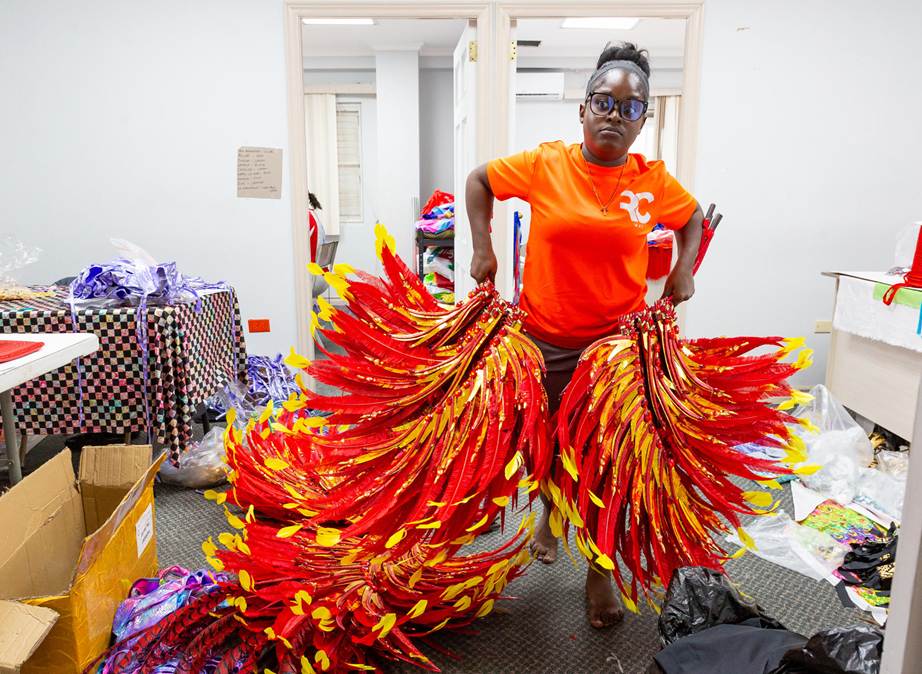
Costume work, meanwhile, keeps its own schedule. Sudesh Ramsaran, a costume decorator, said geopolitics has not dulled the enthusiasm of the most committed participants. “What happens at the regional level has not affected the unconditional Carnival lovers. This is their moment to celebrate, and they will make sacrifices to be part of it,” he told EFE.
That line holds a lot. Sacrifice can mean money. It can tell time. It can mean choosing a costume payment over something else, quietly, because belonging matters. In Trinidad and Tobago, carnival is where belonging gets worn.
Costumes of Uncertainty, Costumes of Hope
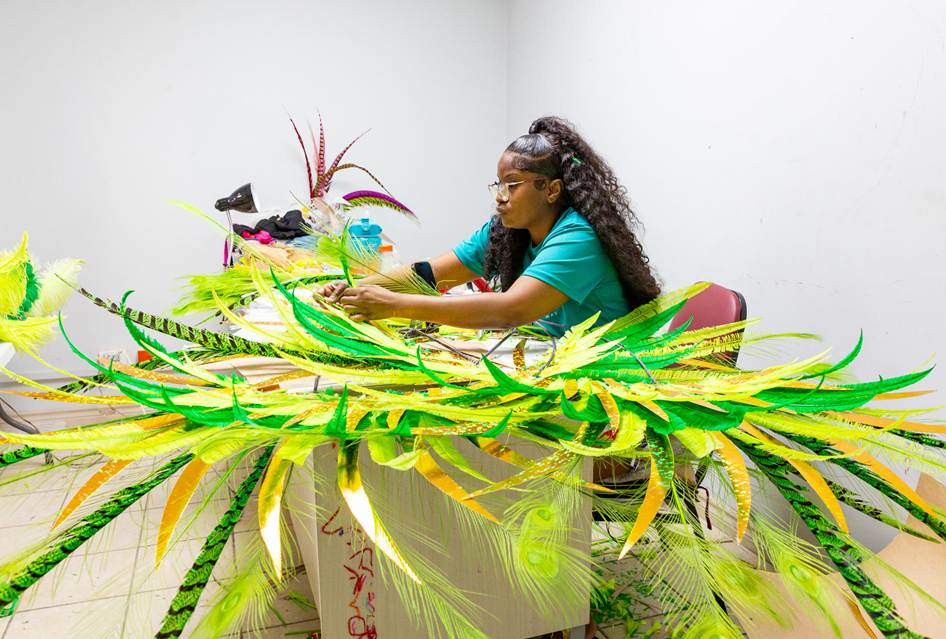
If the region’s headlines have been unsettling, the costumes have decided to stare straight at that unease and then transform it. Keston Benthum, a carnival designer and producer, said he named his King costume for 2026 “Father Time, on the wings of hope,” he told EFE. “It reflects uncertainty, but also hope: that the Caribbean will remain at peace and avoid conflict,” he said, describing the concept.
In the south of Trinidad, Lionel Jagessar Junior, leader of the band Jagessar Costumes, said he deliberately named his band “On the eve of battle” to reflect the current geopolitical climate. “From the outside, with military ships and rumors of conflict, it looks like something could happen. The theme reflects that uncertainty, but it also has a deeper meaning,” he told EFE.
The deeper meaning is not spelled out in the notes, but the direction is clear. Trinidad and Tobago is using carnival the way it has always used carnival, to metabolize the world outside and convert it into something the community can carry. It is satire without needing to shout. It is a commentary that can dance.
Historically, that is not an accident. Carnival emerged at the end of the eighteenth century and evolved as an expression of resistance and freedom among formerly enslaved Africans, fusing masquerade, music, and satire into a national tradition. That origin story still hums inside the modern spectacle, even when the costumes are new and the themes are updated for current anxieties.
For Trinidadian historian Jerome Teelucksingh, the festival, with its competitions and varied cultural programming, has become over time “an economic engine and a symbol of identity in Trinidad and the Caribbean,” he told EFE.
The wager here is that the same thing that makes carnival powerful also makes it necessary. In a region where tension can arrive by ship, by tariff, by rumor, Trinidad and Tobago still answers with the street. Not because it is escapism. Because it is governance of the spirit, practiced in public, and stubbornly alive.
Also Read:
Uruguay’s Secular Image Softens as Iemanjá Fills Montevideo’s Shore