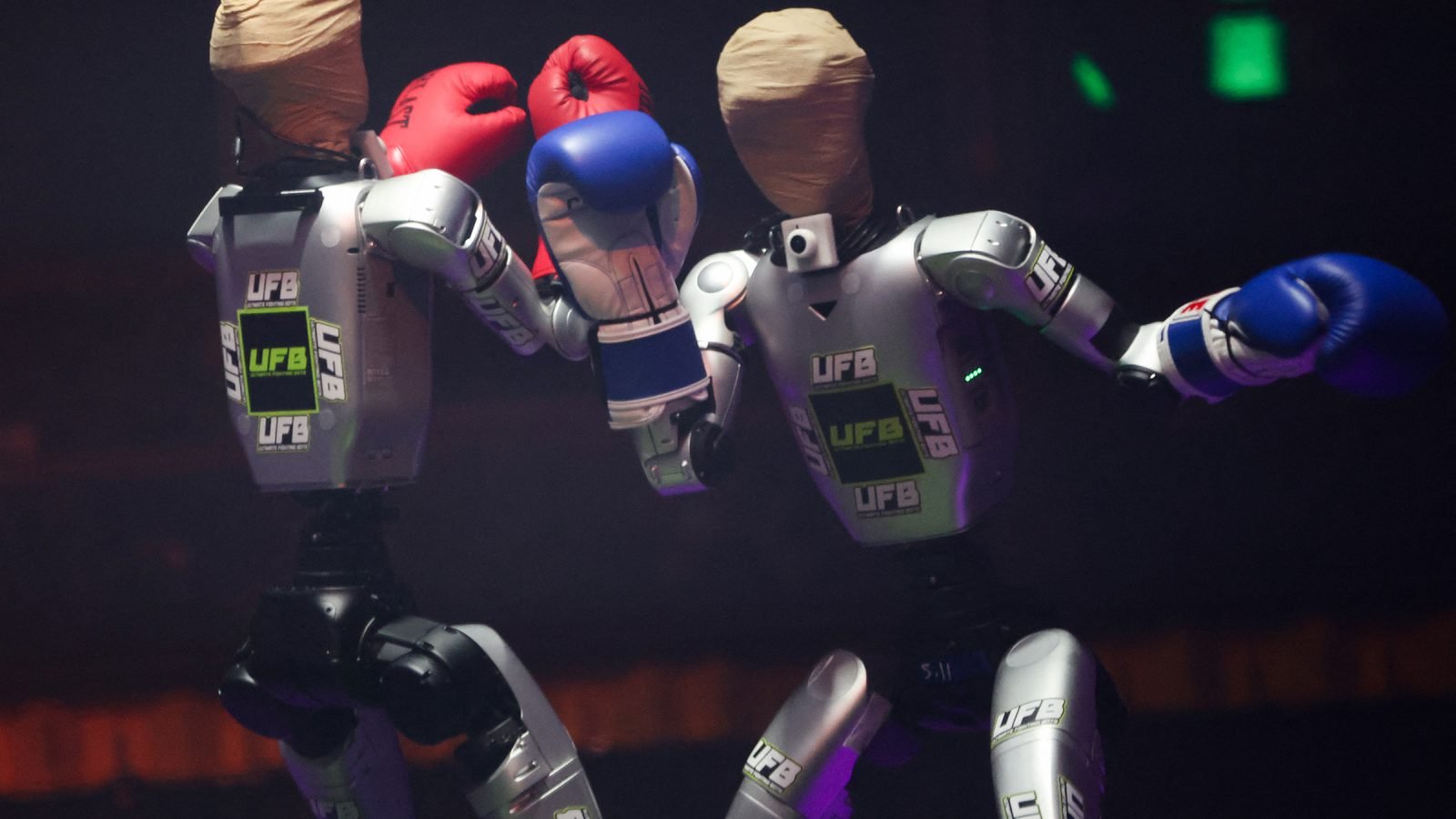
The Super Bowl wasn’t the only sporting event that drew excited fans to the Bay Area last weekend. An event at a much smaller venue in San Francisco was hailed as the future of combat sports: virtual reality-controlled humanoid robots boxing in a cage.
The match was organized by Rek, a San Francisco-based company, and drew hundreds of spectators who had paid about $60–$80 for a ticket to watch modified G1 robots go at each other. Made by Unitree, the dominant Chinese robot maker, they weighed in at around 80 pounds and stood 4.5 feet tall, with human-like hands and dozens of joint motors for flexibility.
The match had all the bells and whistles of a regular boxing bout: pulsing music, cameras capturing all the angles, hyped-up introductions, a human referee, and even two commentators. The evening featured two bouts made up of five rounds, each lasting 60 seconds.
The robots pranced around the cage, throwing jabs and punches, drawing ohs and ahs from the crowd. They fell sometimes, and needed human intervention to get them back on their feet. Rek plans to put on more matches, and develop a league of robot boxers, including full-height robots that weigh about 200 pounds and are nearly 6 feet tall, founder Cix Liv told Rest of World.
“Right now we are mainly focused on the U.S. But we will consider international matches after our next big event in a few months,” he said, without giving details.
The Rek match — the second in San Francisco — came just days before the world’s first humanoid robot “combat league” launched in China. Called the “ultimate robot knock-out legend,” the competition combines “competitive spectacle with technological challenges,” according to a statement from Engine AI, a robot maker in Shenzhen. The champion team stands to win a prize worth about $1.4 million. Pictures from the launch showed Engine AI’s full-height T800 robots that can kick, jump, and punch.
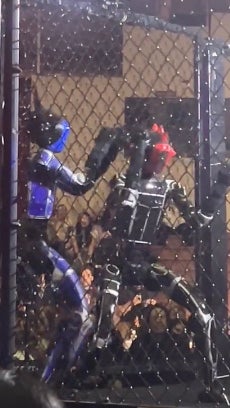
In China, humanoid boxing matches, races, and football games have become common in recent years, with robot makers showcasing the skills of their latest products at the annual spring gala to hundreds of millions of television viewers. In San Francisco, Rek isn’t the only company capitalizing on the artificial intelligence boom and eager techies with cash to burn. Ultimate Fighting Bots — claiming to be the world’s first robot combat league with human pilots — also hosts game nights with Chinese robots.
David Hatch, a San Francisco resident who works in tech design and is a science-fiction and design nerd, told Rest of World he enjoyed the Rek match. “I do see more people really getting into seeing robots fight — you can see how the crowd here got excited, and there were some rousing moments,” he said. “You can do a lot of things with robots — there can be a lot of customization, it can be a lot more participatory with VR glasses.”
While the Rek match and the URKL showcase robots far more advanced than those in BattleBots, the 1990s American television show that featured fighting robots with weapons, much of it still remains “robot theater,” said Ken Goldberg, a professor of engineering and robotics researcher at the University of California, Berkeley.
“We are in the middle of the humanoid craze today; they look human-like and do some things, but they’re not very sophisticated,” he said at a recent briefing in San Francisco. “Many of them have humans controlling them. Which is why I always tell people who are impressed with robot videos: Beware of what you see in the videos, it isn’t quite real.”
China dominates the humanoid robot industry, with nearly 90% of those sold last year made by Chinese companies including Unitree, AgiBot, and Engine AI. The firms use hundreds of workers to generate the training data needed for the robots. A basic G1 is priced upward of $13,000, while a T800 costs more than $40,000. Most are used in research, retail, and for industrial purposes. A small number will end up in boxing cages in San Francisco.
At the Rek match, the crowd cheered as a 13-year-old VR pilot named Dash beat his older competitor. Hatch stood and clapped: “That was awesome!”
Hatch was also pleased that no one got hurt. “You can repair the damage more easily with robots,” he said.