Bogotá, Colombia – On January 30, the acting president of Venezuela, Delcy Rodríguez, announced an amnesty proposal to release hundreds of political prisoners in the country.
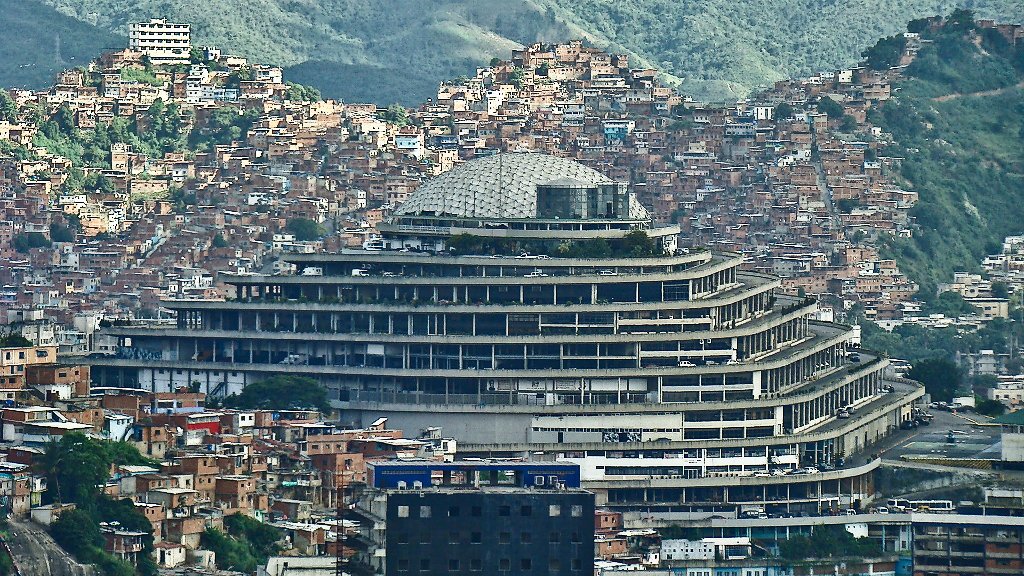
During her speech, she also stated there are plans to close the infamous prison known as El Helicoide in Caracas.
“We have decided that the installations of El Helicoide, which today are used as a detention center, are going to be transformed into a sports, social, cultural, and commercial center for police families and neighboring communities,” confirmed Rodríguez during her speech.
Over the last few years, this giant building in Caracas has been implemented as the headquarters of the Bolivarian National Intelligence Service (SEBIN) and the Bolivarian National Police (PNB).
Following the recent announcement regarding the “rebranding” of the country’s most feared prison, a deeper debate has emerged: can a place related to systemic torture be redefined?
An open wound
Prisons, pain, and a tireless struggle for justice have marked Andreina Baduel’s life. In 2021, her father, the General and ex-minister of Defense, Raúl Isaías Baduel, passed away inside the cold walls of El Helicoide.
“He died under state custody at that place due to a lack of medical attention that was denounced and simply ignored,” she told Latin America Reports.
General Baduel became the first Hugo Chávez ally to rebel against his policies. After being considered a hero and serving as Minister of Defense, he spent years being hunted and targeted as an enemy, spending his final days without any chance to recover his freedom.
“The most painful part is that he died in the arms of my brother, Josnars, who was also detained and remains in custody (he was transferred from El Helicoide to El Rodeo l in 2024). It’s an open wound… My brother has spent over four years in arbitrary detention, and he has been a victim of physical and psychological torture,” said Andreina Baduel.
Andreina is one of the leaders of the Committee for the Liberation of Political Prisoners (Clippve), and her story is not the only one related to this prison; dozens of families are suffering as they walk the same as hers.
A 2022 Human Rights Watch report detailed how prisoners in El Helicoide were subjected to torture, including electric shocks and waterboarding. Further findings from Venezuelan NGO Justicia, Encuentro y Perdón (JEP) highlighted that in April 2025, dozens of detainees with serious health conditions were still being denied adequate medical attention.
During the past years some survivors of the giant prison shared grim stories of their experiences.
“It makes you want to die; it makes you want to cease to exist, because you are nothing,” Víctor Navarro, a Venezuelan activist detained in 2018 and later released, told CNN. “You’re there, and you know that… you’d prefer to be dead than still there.“
“A direct mockery”
Delcy Rodríguez’s proposal to transform the prison into a mall, a sports stadium or a cultural center is also being rejected by activists and students across the country.
“El Helicoide will pass into history as the most terrifying torture center in the country’s history; that place represents terror, fear, evil, and death. And we will always remember it as a place that should have never existed,” said Octavio González, one of the leaders from the Student Movement at the Central University of Venezuela (UCV).
Instead of a commercial hub, Gonzalez is advocating for a complete transformation of the site: “I believe that the building must be destroyed and replaced with some kind of tribute to those who perished there… A memorial, something that represents the dignity of the people who were detained or died behind the bars of that place.”
Gonzalez’s call for a memorial aligns with Andreina Baduel’s perspective; she also argues that “El Helicoide can only take on a new meaning if it truly becomes a site of historical memory – a place where what happened is acknowledged and due to that, precisely, never happens again.”
The latest decisions announced by Delcy Rodríguez could be considered an important step in the Venezuelan healing process, in a country where many claim that repression often overrides the common good.
However, this particular building remains the living image of a pain that is still present and will remain for decades to come.
“When we hear these proposals about turning it into a mall or a cultural center, we see it as a direct mockery of the victims. You can’t just put a colorful facade over walls that still hold the screams of those who were tortured”, concluded Baduel, “For us, that building isn’t about architecture; it’s the place where they took a loved one away from us.”
Featured image description: Helicoide prison.
Featured image credit: Damián D. Fossi Salas via Flickr