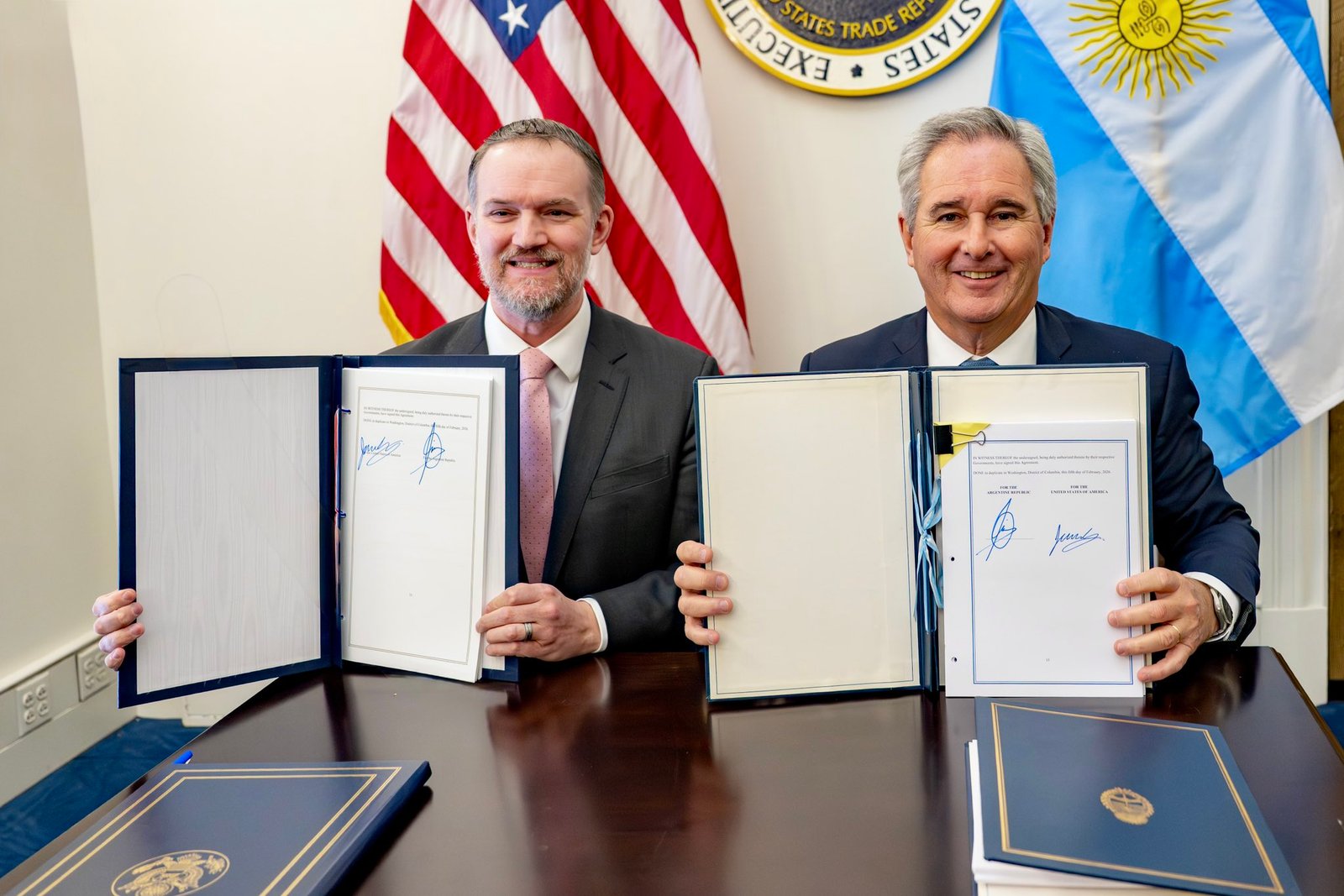
London, England – On February 4, Argentina and the United States signed a critical minerals agreement, announced by Pablo Quirno, Argentina’s Minister of Foreign Affairs, on X.
The Framework Instrument for Securing Supply in the Mining and Processing of Critical Minerals is reportedly worth USD$130 billion and represents one of the most significant bilateral economic deals between the two nations.
Through the deal, the U.S. secured priority access to critical Argentinian minerals and broadened its supply chains for lithium and other strategic resources. For its part, Argentina strengthened its alliance with the U.S. and gained better access to its markets, hoping to increase exports and economic growth.
“Today, Argentina sent a clear signal to the world: we are a reliable partner, open to trade, and committed to clear rules, predictability, and strategic cooperation,” said Quirno during his announcement.
While the agreement primarily aims to secure U.S. independence from the Chinese monopoly on minerals important to defense systems, for Argentina it could prove a catalyst for economic transformation and growth. The U.S. also issued Argentina a USD$20 billion credit line to make it a stable partner.
Crucial strategic directions of the agreement
Beyond the core strategic objective of strengthening U.S. mineral independence and advancing Argentina’s mining and industrial development, the agreement also underscores a deeper alignment of mutual economic and strategic interests.
While at first glance U.S. mineral independence appears to be the central focus, some observers highlight a parallel desire to reduce Argentina’s reliance on the Chinese market.
“The government wants to send strong signals of distancing itself from China while at the same time showing strategic alignment with Trump,” Diana Tussie, director of the International Relations area at the Latin American Faculty of Social Sciences, told Argentina Reports.
She described the deal as a concession to the United States rather than a negotiated agreement, noting that there was no consultation with the companies involved in Argentina’s mining sector.
But the deal may hold promise for the country’s mining industry. As part of the broader agreement, the U.S. guaranteed to buy lithium at a minimum price, regardless of global market changes. With Argentine miners receiving a higher “floor” price for the mineral, the industry is protected from potential Chinese market manipulations.
Géraldine Smeets, Vice Chair of EuroCámaras Argentina and board member of the European Business Organisation Worldwide Network (EBOWWN), described the agreement as a step towards strengthening Argentina’s mining investment climate.
“Committing to fast-tracking eligible projects under RIGI – the Large Investment Incentive Regime, a government program that offers incentives to major projects in mining, energy, and technology – and signalling more predictable regulatory practices is a work in favor of Argentina’s mining sector development,” Smeets told Argentina Reports.
However, despite the positive outlook of the deal for miners, some experts caution about its long-term implications.
“While the interests are convergent, whether the alliance is lasting or not will depend on the duration of both governments, not on their intentions,” said Andrés Malamud, a political scientist specializing in Latin American politics and international relations at the Institute of Social Sciences at the University of Lisbon.
Long-term risks to Argentina’s economy
Despite the Argentine government’s enthusiasm over the deal, some experts question its implications for Argentina’s industrial independence and economic self-determination. While reducing reliance on China and attracting international capital, the mineral framework also introduces new regulations and restrictions.
But according to Smeets, positioning Argentina as a key strategic partner for the United States in critical minerals creates significant opportunities.
“On the opportunity side, closer integration with the U.S.-led supply chains can reinforce Argentina’s role as a reliable supplier of critical minerals amid global diversification, attract investment, improve project bankability, and support infrastructure development,” said the business leader.
She added that the key for Argentina is in the implementation: ensuring that the partnership raises overall standards and improves the operating environment for all investors, rather than narrowing engagement to a single partner.
More than a mining agreement, the framework signals a geopolitical realignment whose economic benefits for Argentina will depend on whether it translates into sustainable development rather than deeper resource dependence.
Its long-term success will ultimately be measured not by pledged investment figures, but by whether the partnership strengthens domestic industry, regulatory stability, and Argentina’s position within diversified global supply chains.
Featured image description: U.S. Trade Representative Jamieson Greer and Argentine Foreign Minister Pablo Quirno present the signed minerals agreement.
Featured image credit: @pabloquirno via X.