A downpour in Old San Juan did not stop a centennial tribute to Catalino Tite Curet Alonso. At his grave, bomba drums and dancing carried his lyrics back into public space, reopening questions about cultural policy, preservation, and Puerto Rico’s voice abroad.
A Cemetery Bomba Under a Hard, Clean Rain
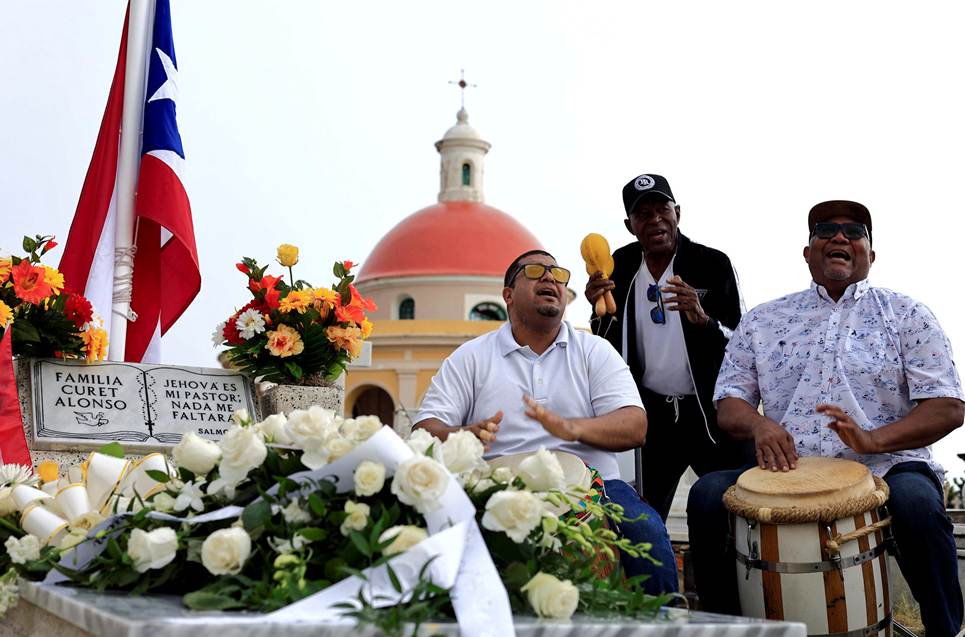
The micro scene is wet and simple. In the cemetery of Old San Juan, where Catalino Tite Curet Alonso is buried, people gather under copious rain. Family members stand close. The group Plenibom plays bomba, an Afro-Puerto Rican rhythm that hits the body before it reaches the intellect. A couple dances in front of the others while the music cuts through the weather.
They play Sorongo. They play Las caras lindas. They play Se escapó un león. In that moment, the tribute is not abstract. It is not a plaque. It is not an anniversary post. It is music in the open air, in a place where people do not usually dance.
Tite Curet is remembered on his centennial as a master of songs that evoke pride and admiration. His ability to craft melodies for legendary salseros like Ismael Rivera, Héctor Lavoe, Cheo Feliciano, Rubén Blades, and La Lupe made his work feel inevitable, creating a deep sense of cultural pride among Puerto Ricans.
Hilda Curet, one of his daughters, watched the homage and felt a profound sense of gratitude and a gentle ache. ‘I feel very honored and happy,’ she told EFE, sharing how he wrote at least 1,400 songs, including works for Menudo, Nelson Ned, Tony Croatto, and orchestras of Roberto Roena and Tommy Olivencia, which highlights her pride and emotional connection.
“I would have liked my dad to be alive so he could see all the celebration and what the Committee has done to spread the legacy of his music across Puerto Rico and internationally,” she told EFE.
That line lands because it is both personal and political. A family wanting a father to witness his flowers is a human truth. But it is also a statement about recognition delayed, about how often the island’s cultural architects become fully visible only when they are gone.

A Writer Who Never Drove, Always Listened
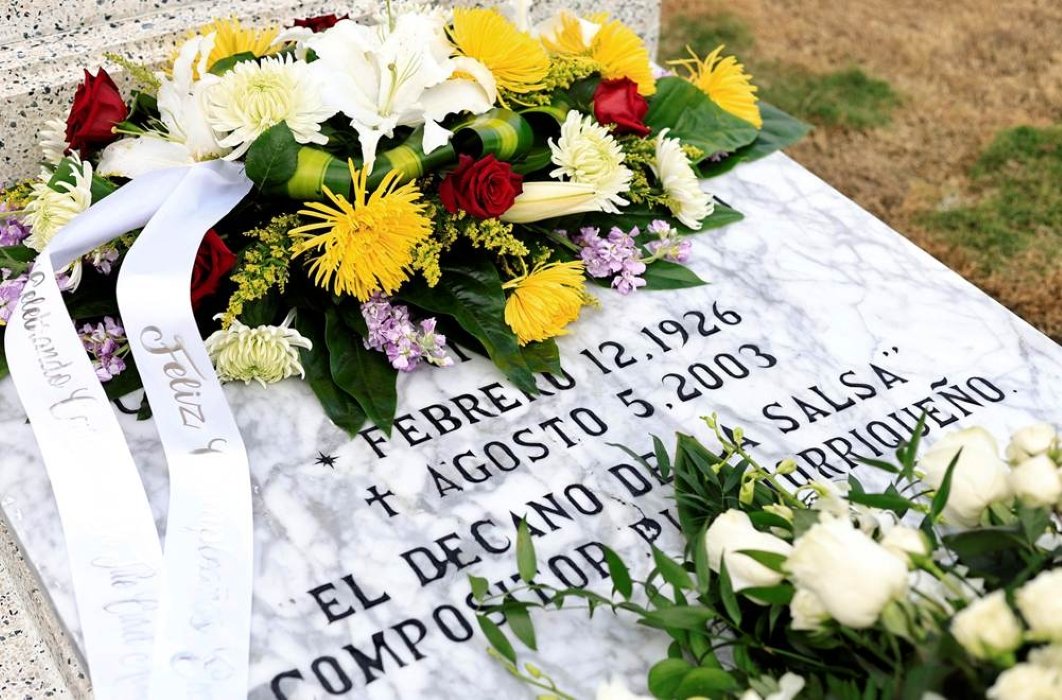
Curet was born on February twelve, 1926, in Guayama, in southern Puerto Rico. His daughter said he was crossing borders from a young age and may not have known the reach of his music, including the fact that one of his songs ended up in film soundtracks such as The Godfather II.
From Guayama, he moved to Barrio Obrero in San Juan, a neighborhood known for musical fervor in salsa, bomba, and plena. This is where the method becomes part of the legend. He observed. He analyzed. He took the lived experiences and anecdotes of people around him and turned them into songs.
The everyday observation implied by the notes is the way public life becomes material when a writer is paying attention. A conversation at a corner. A complaint was heard on a bus. A story repeated in a doorway. For Curet, the city was not the background. It was the source.
He used public transportation or walked because he did not drive. He collected experiences and wrote them down in a notebook, recorded them on tape with his voice, or typed them on a typewriter, then delivered them to singers.
This is where the tailoring metaphor becomes concrete. A composer without a car, moving through the city at street speed, gathering language in fragments, then shaping it into something that could hold a stadium. The trouble is that modern cultural policy often measures value through scale and export. Big venues. Big streaming numbers. Big international deals. Curet’s practice suggests another measure, the slow accumulation of listening that produces songs sturdy enough to travel.
His catalog includes La Perla and Las caras lindas for Rivera, Periódico de ayer and Barrunto for Lavoe, Anacaona and Mi triste problema for Feliciano, Plantación adentro for Blades, La cura for Frankie Ruiz, and Marejada feliz for Roena and his orchestra.
Hilda Curet remembers the daily discipline behind all that output. “I always saw him writing. He never got tired of writing. It was a gift, because he did it well, and something in the family, because he came from a family of writers,” she told EFE. She noted that he worked for the United States Postal Service while also writing music columns for magazines.
It is a life that makes the romantic image of the composer look more like labor. Two jobs. A notebook. A typewriter. A mind that keeps turning.
A Legacy That Demands Institutional Care
José Rodríguez, president of the Committee Camino al Centenario Catalino Tite Curet Alonso, frames the centennial as an obligation to public memory. He said the author’s life must be celebrated and remembered as one of the greatest composers the country has given to popular music.
Rodríguez insists on the nickname that best explains the craft. “Tite is and will be the tailor of composition, because what he created for artists was a custom suit, a number made to measure. He created it directly for that singer’s personality, and it was a success,” he told EFE.
He also argues that Curet’s work traveled the world because it carried social denunciation, including racial realities, along with other textures of daily life. “It is an icon of popular music and salsa. In every country where Tite’s music has been heard, there should be space to reflect on his career and legacy,” he told EFE.
That is the policy question behind the rain-soaked tribute. Reflection depends on institutions that value popular music as heritage, inspiring hope and collective responsibility. Archives, education, and public funding are essential to treat songs as vital historical documents, not just entertainment.
The centennial is being marked with art exhibitions and conferences in Peru, Panama, and New York, as well as in other parts of Puerto Rico, including Ponce, which has dedicated its famous carnival to him.
The wager here is whether Puerto Rico can hold this kind of legacy in public view beyond anniversaries. A cemetery gathering under heavy rain is moving, but it is also fragile. It depends on volunteers, committees, families, and memory. Curet wrote at street level, for the people who rode buses and walked. Keeping his work alive requires the same street-level commitment, plus the institutional will to treat popular music as part of the island’s cultural infrastructure.
In Old San Juan, the drums kept going anyway. Rain or no rain. That is the point. The songs were built to endure. Now the question is whether the systems around them will do the same.
Also Read:
Guatemalan Arjona Turns Madison Square Garden Into a Borderless Cabaret