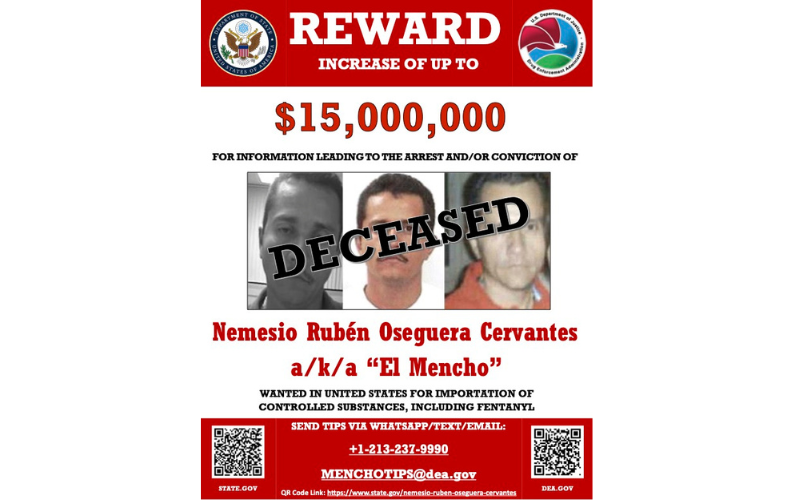
What does El Mencho’s death mean for Colombia?


Bogotá, Colombia – Last Sunday, Mexican authorities killed the leader of the Jalisco New Generation Cartel (CJNG), Nemesio Oseguera Cervantes, alias ‘El Mencho’, unleashing a wave of violence in the country.

The CJNG is one of the world’s most sophisticated criminal organizations, its influence stretching into countries like Colombia, where it sources cocaine to traffic to the United States.

But how significant is the cartel’s presence in Colombia and what impact will El Mencho’s killing have in the South American country?

Who are the Jalisco New Generation Cartel?

The CJNG was born out of a split in the Milenio cartel around 2011 and has become one of the world’s largest illicit manufacturers of synthetic drugs like fentanyl and methamphetamine, according to the United States Drug Enforcement Agency (DEA). 

It has a presence in all 50 U.S. states and 40 countries worldwide, making billions of dollars in profit every year from drug trafficking. 

The CJNG has earned a reputation for its particularly brutal tactics, according to InSight Crime, an organized crime think tank; since the cartel took control in Jalisco, reports of homicides, forced disappearances and mass graves have increased.

As well as manufacturing and selling synthetic narcotics, the CJNG is also one of the primary importers of cocaine to the United States.

How active is the cartel in Colombia?

Colombia is the world’s primary producer of cocaine and is a key source of the drug for Mexican cartels like the CJNG. 

In recent years, drug supply chains have become increasingly fragmented, with each stage of production and export controlled by different actors. Accordingly, the CJNG’s activity in Colombia is complicated.

“The short answer is that the CJNG, or any other Mexican criminal group, does not maintain a permanent presence in Colombia,” said Henry Shuldiner, an investigator at InSight Crime.

He explained that the prevalence of other armed groups in Colombia – namely, the National Liberation Army (ELN), Gaitanist Army of Colombia (EGC), and dissidents of the now-demobilized Revolutionary Armed Forces of Colombia (FARC) guerrillas – makes it hard for Mexican cartels to establish themselves in the country. 

“Rather than deploying armed members to guard cocaine labs or directly participate in shipping cocaine to Mexico, its presence is better understood through the role of ‘emissaries’,” continued Shuldiner.

The CJNG sends these business envoys to Colombia to purchase cocaine, which is then transported north to Mexico and the United States.

The cartel has alliances with specific Colombian armed groups from which it buys the drug, according to analysts.

“Those alliances are pretty shifting,” said Elizabeth Dickinson, deputy director for Latin America at the International Crisis Group. But she added that the CJNG has been known to deal with the Central General Staff (EMC), a FARC dissident group with a strong presence in Colombia’s Amazonian and Pacific regions.

How might El Mecho’s fall be felt in Colombia?

While analysts say El Mencho’s death could have knock-on effects down the supply chain in places like Colombia, they play down the extent of these risks. 

“I think this is going to be a risk that governments in the Andean region particularly will be watching for if there is a reconfiguration of the market in any way,” said Dickinson, noting the possibility for violence if the CJNG’s role as a cocaine buyer were to shift. 

“Having said that, I also think we don’t want to sort of overblow the risks,” she added, saying that the sophisticated nature of the cocaine market means that even if the CJNG stops buying cocaine due to a split or leadership struggle, business will continue as usual.

Shuldiner also noted that a succession contest in the Jalisco cartel does not necessarily mean that the criminal group will stop buying cocaine: “While there might be a struggle to figure leadership in Mexico, business is still going to continue.

As the future of the CJNG remains unclear, it appears that for now, Colombia has bigger problems at home: as elections rapidly approach, authorities are more concerned by threats posed by domestic criminal organizations than those thousands of miles away.

Featured image description: El Mencho deceased poster

Featured image credit: U.S. State Department


Source link

Leave a Reply

Translate »
Share via
Copy link