France to boost nuclear arsenal and extend “advanced deterrence” to European partners
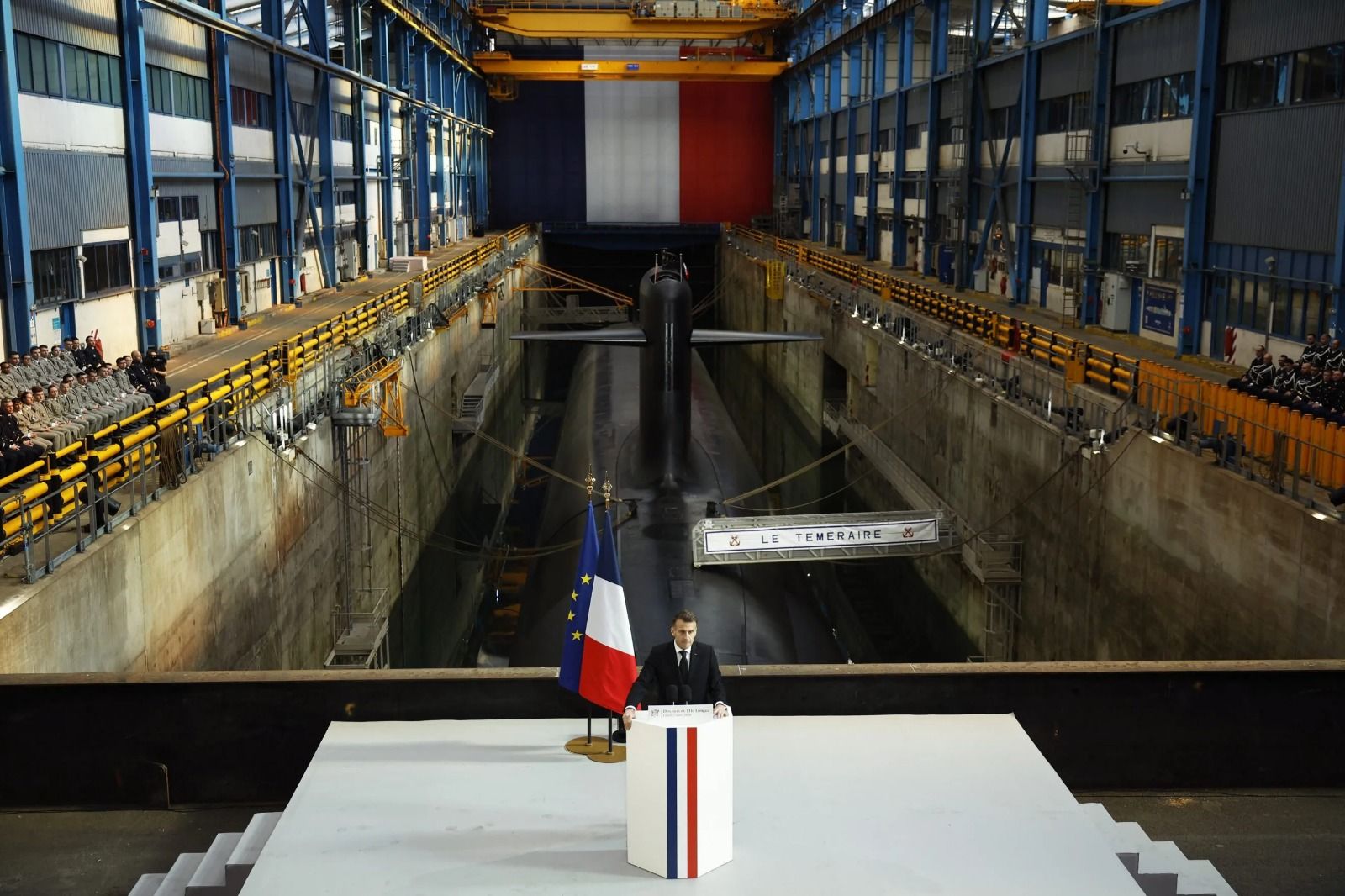
Macron spoke at the Île Longue naval base near Brest, addressing naval officers with a nuclear submarine in the background
President Emmanuel Macron said France will increase the size of its nuclear arsenal and roll out a new “advanced deterrence” doctrine that would involve a group of European partners more directly in exercises, deployments and supporting capabilities—moves Paris framed as a response to a more unstable strategic environment.
Macron spoke at the Île Longue naval base near Brest, addressing naval officers with a nuclear submarine in the background. He said “the next 50 years will be an era of nuclear weapons” and announced his decision to raise the number of warheads—currently assessed at under 300 in publicly available figures—while declining to provide a new total.
He also unveiled plans for a new nuclear-armed submarine, “The Invincible,” scheduled to enter service in 2036, as part of France’s broader deterrent modernization.
At the centre of the doctrine, Macron said eight European countries—the United Kingdom, Germany, Poland, the Netherlands, Belgium, Greece, Sweden and Denmark—had agreed to take part in an “advanced deterrence” strategy. Options described include participation in exercises linked to France’s air-launched nuclear forces and the prospect of partners hosting bases or infrastructure from which French nuclear bombers could be stationed under unspecified circumstances.
Macron argued this would allow strategic assets to “spread out” across Europe and “complicate the calculations” of potential adversaries. At the same time, he stressed that the decision to use nuclear weapons would remain solely with the French president and that no explicit “guarantees” would be extended to partners—maintaining the deliberate ambiguity typical of nuclear deterrence.
Following the speech, Poland confirmed talks with France and close allies on the programme. Prime Minister Donald Tusk wrote: “We are arming up together with our friends so that our enemies will never dare to attack us.”
Paris and Berlin also issued a joint declaration to take concrete steps this year, including German conventional participation in French nuclear exercises, joint visits to strategic sites and cooperation on areas such as early warning, air defence and deep precision strike. The two governments said the initiative would “complement, not replace” NATO’s nuclear deterrence.