Billions of dollars in U.S. technology infrastructure, and trillions more in planned investment, now depend on fiber-optic cables running through war zones.
Amazon, Microsoft, and Google spent years building data centers across the Gulf, betting the region would become the world’s next great hub for artificial intelligence. The undersea cables connecting those facilities to Africa, South Asia, and Southeast Asia pass through two narrow passages: the Red Sea and the Strait of Hormuz. Both are now effectively closed to commercial traffic.
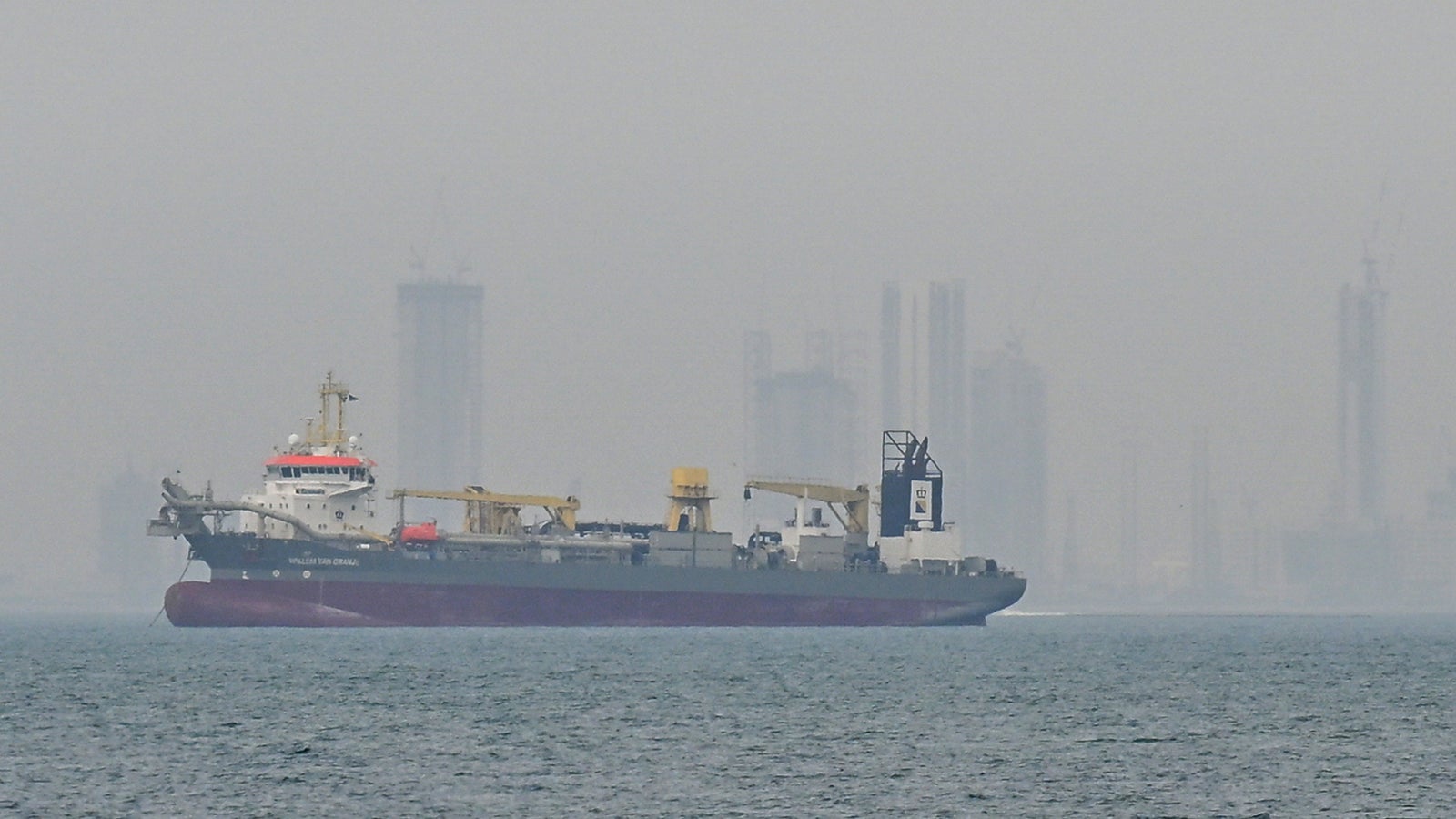
Iran’s Islamic Revolutionary Guard Corps declared Hormuz shut on March 3, threatening to “set ablaze” any vessel attempting passage. At least five tankers have been damaged and roughly 150 ships are stranded around the strait. In the Red Sea, Houthi militants announced they would resume attacks on shipping in solidarity with Iran, ending a ceasefire that had held since late 2025. The war that began on February 28 has turned both choke points into active conflict zones simultaneously, something that has never happened before.
About 17 submarine cables pass through the Red Sea, carrying the vast majority of data traffic between Europe, Asia, and Africa. Additional cables run through the Strait of Hormuz, serving Iran, Iraq, Kuwait, Bahrain, and Qatar. If any are severed, the specialized repair ships can’t safely reach either passage.
“Closing both choke points simultaneously would be a globally disruptive event,” Doug Madory, director of internet analysis at the network intelligence firm Kentik, told Rest of World. “I’m not aware of that ever happening.”
Sam Zabin, a fellow at the Center for Strategic and International Studies, noted that the Gulf data infrastructure has never been tested this way. Oil has had decades of conflict exposure and is heavily integrated into military planning. Data centers, until recently, were treated as commercial assets rather than national security concerns.
“A theoretical scenario has become a concrete precedent,” Kristian Alexander, a senior fellow at the Rabdan Security and Defence Institute in Abu Dhabi, told Rest of World. “This does not necessarily introduce a new risk so much as it validates what was already in every serious threat model.”
That validation came fast. Drones struck three AWS data centers over the weekend, two in the UAE and one in Bahrain. AWS told customers to consider migrating workloads out of the Middle East entirely, warning that the regional operating environment “remains unpredictable.”
The cables themselves are not the immediate target. A deliberate strike would require a ship dragging an anchor across the seafloor or a direct attack on a landing station. Iran would risk severing its own connectivity in the process, Madory said.
The real danger is accidental damage or collateral strikes. In February 2024, three Red Sea cables were cut by the dragging anchor of a cargo ship struck by a Houthi missile, disrupting 25% of traffic between Asia, Europe, and the Middle East. One cable took five months to repair because vessels could not safely access the area. If multiple major cables were severed now, with repair crews locked out of both choke points, disruption could last far longer.
The crisis exposes a fundamental gap in how Washington approached its Gulf technology expansion. Security frameworks were designed to prevent advanced chips from reaching China rather than to protect the physical infrastructure from missiles.
“U.S. government and industry leaders have prioritized expansion over kinetic risk mitigation, reflecting how AI development is outpacing national security doctrine,” Zabin told Rest of World. “Undersea cable routes are geographically constrained with fewer options for physical bypasses.”
Undersea cable routes are geographically constrained.”
The timing could not be worse. U.S. President Donald Trump’s tour of the region last May produced $2.2 trillion in investment pledges built on the Gulf’s perceived strengths: political alignment with Washington, abundant sovereign capital, and world-class infrastructure. OpenAI, G42, Oracle, Nvidia, and SoftBank announced Stargate UAE, a planned 5-gigawatt AI campus in Abu Dhabi that would be the largest outside the U.S. Amazon committed $5 billion to an AI hub in Riyadh with Saudi Arabia’s Humain.
The Gulf states held up their end. It was Washington’s decision to strike Iran that put those investments in the line of fire. When Iran’s attacks began, the UAE intercepted 165 ballistic missiles, two cruise missiles, and 541 drones over a single weekend. Saudi Arabia and Qatar mounted similarly robust defenses.
The U.S. security architecture surrounding those investments had focused on a different threat entirely. The January 2026 Pax Silica initiative brought the UAE and Qatar into a U.S.-led effort to keep advanced semiconductors away from China. Abu Dhabi’s G42 cut ties with Huawei, and Humain aligned with U.S. chip suppliers.
“The security frameworks underpinning the U.S.-UAE AI partnership appear to have focused on supply chain control and geopolitical alignment, not on physical defense during high-intensity conflict,” Ali Bakir, an assistant professor of international affairs at Qatar University, told Rest of World.
Inside Iran, the regime has imposed its own digital blackout. Kentik data shared with Rest of World shows internet traffic into the country collapsed on February 28 and has remained near-zero ever since. The three largest Iranian networks, MCCI, MTN Irancell, and TIC, all dropped to negligible levels, suggesting a deliberate government shutdown rather than infrastructure damage.
Anadolu via Getty Images
The Gulf’s structural advantages remain firm. The region retains its capital, its energy resources, and its strategic location. The UAE and Saudi Arabia have pipelines that can bypass Hormuz for oil exports, and both governments have proven capable of defending their territory.
“The structural advantages have not yet changed, although the story is still being written,” Ryan Bohl, senior analyst for the Middle East and North Africa at RANE Network, told Rest of World. “If this conflict continues, there will increasingly be a greater likelihood that major impacts will alter the perception of safety and value for the long term.”
Few had believed the U.S. would strike Iran and trigger retaliation against the region, said Abishur Prakash, a geopolitical futurist and founder of The Geopolitical Business advisory firm. Strategic planning revolved almost entirely around energy and financial flows, leaving technology infrastructure vulnerable.
“This is all inverted now, exposing the entire technology landscape and ambitions of the region,” Prakash told Rest of World. The U.S. needs to treat Gulf data infrastructure the way it treats oil, integrating it into contingency planning and regional security coordination, Zabin said. That framework took decades to build for energy.
For AI, it doesn’t exist yet. The cables do.