Brazil, Epstein, and the Modelling Trap That Looked Like Escape


A BBC News Brasil investigation reveals how glamour, visas, and a mother’s doubts came together in Brazil, uncovering a modelling path that seemed like a way out but instead brought young women close to Jeffrey Epstein and Jean-Luc Brunel.

When Glamour Knocks at the Door

What makes this story so disturbing is how normal it starts. A man shows up at a family home in the Brazilian countryside. He’s charming and talks about opportunities. He offers a way out. For a teenager just starting in modelling, and a family asked to trust an unknown world, this visit can feel like fate knocking gently.

Interviews and documents from BBC News Brasil show that this is how Jean-Luc Brunel came into Gláucia Fekete’s life in 2004. He convinced her mother to let Gláucia travel to a modelling contest in Ecuador. On the surface, everything seemed legitimate. The Guayaquil competition was reported locally as an event for 15- to 19-year-olds. It looked organized and real. That’s what makes this story so credible.

In Latin America, the modelling world has long fed on a difficult mixture of aspiration and imbalance. The promise is mobility. The reality, too often, is dependence. Young women from the countryside or provincial cities are told that beauty can be a passport, that discipline and luck can lead to class ascent, that a contest or a casting can pull them into another life. What the BBC reporting lays bare is how easily that dream could be folded into something much darker when the adults controlling access also controlled documents, travel, money, and silence.

Gláucia says nothing major happened during the trip, but one thing stuck with her: she wasn’t allowed to contact her family. That kind of restriction changes everything. A real competition doesn’t require isolation. A good opportunity doesn’t start by cutting a teenager off from home.

Another former contestant, identified by the BBC as Laura, remembered Brunel as a strange presence around very young Brazilian girls. Her recollection is striking not because it is dramatic, but because it is observational. She says he seemed to know which girls were vulnerable. That is the real architecture here. Not glamour by itself, but glamour fused with selection.

Later, when Brunel offered to fly Gláucia to New York at all expenses, her mother said no. The refusal sounds firm in the report: “No. Not a chance.” Looking back, that decision may have changed everything. In Gláucia’s words, it was a close call.

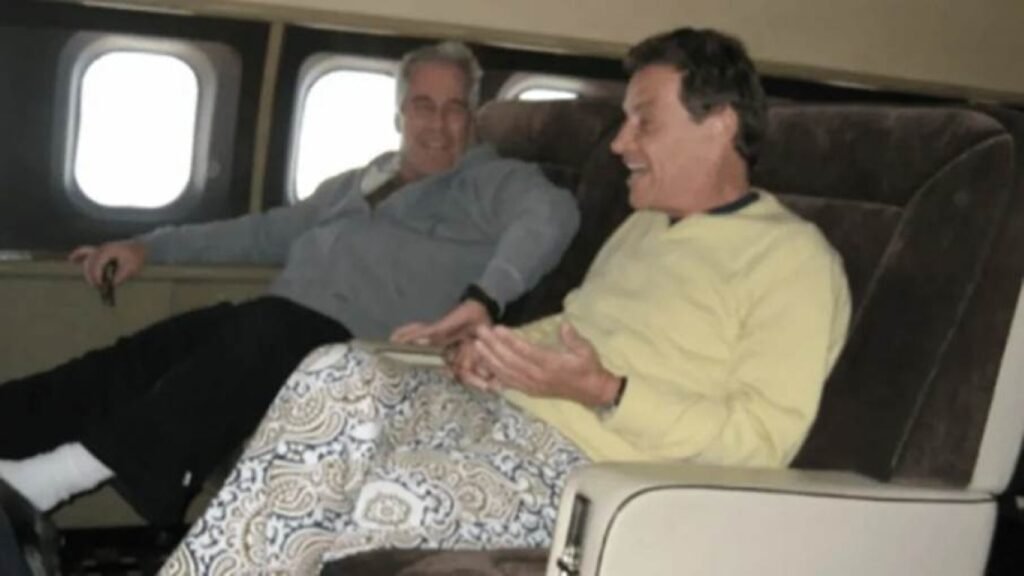
Jean-Luc Brunel (right) with Jeffrey Epstein (left). US Department of Justice

The Visa Route Behind the Fantasy

If Gláucia’s story shows how danger can hide behind prestige, Ana’s account, supported by BBC News Brasil and US Department of Justice records, reveals the system from the inside. Her story isn’t about a door closing in time. It’s about a system that kept opening.

Ana says she left her hometown in southern Brazil after being promised modelling jobs in São Paulo. Instead, her documents were taken, she was put in debt, and the promise of work turned into sexual exploitation. This sequence is important. In Brazil and across Latin America, exploitation often doesn’t start with chains or force. It starts with obligation, taking papers, and turning hope into debt. A girl thinks she’s going to work, but work becomes an excuse for control.

Ana says Jeffrey Epstein picked her up at a luxury hotel in São Paulo. Later, she showed the BBC a US business visa listing Karin Models of America, an agency Brunel set up in the US, as her sponsor. She says she never worked for that agency and that the visa’s real purpose was to help her travel to Epstein. The neatness of this setup is what makes it chilling. On paper, it looks like a business. In reality, the visa is a passage for power to move a young woman across borders for hidden reasons.

This goes beyond the crime itself. In Latin America, documents are crucial because many lives depend on them. Papers mean survival. They give permission. They decide if someone can work, move, stay, leave, or dream. The BBC report suggests Brunel’s agencies didn’t just find faces. They provided official cover. They made exploitation easy to move around.

Court records and files cited by the BBC show that Brunel used US agencies to bring in girls from several countries, including minors, and Epstein helped fund this setup. This isn’t a story of isolated abuse but a recruitment chain dressed up in respectability. Agencies, visas, contests, flights, apartments, English lessons, parties. Step by step, the trap looked like a career.

Jean-Luc Brunel. US Department of Justice

Brazil’s Uneasy Reckoning

This report hits hard in Brazil for another reason. It challenges the common view that glamour industries are separate from the country’s harsher social layers. They are not separate. They often come from the same inequalities. A teenager from the countryside and a young woman from southern Brazil moving to São Paulo don’t have the same protection. Their vulnerability is not by chance. It’s social.

That is why the language used by Gláucia’s mother cuts so deeply when she says they were “only looking for children, minors”. It is a mother’s conclusion, but it is also a political one. She is describing a market logic in which youth itself becomes the commodity and innocence becomes the asset most easily converted into control.

The investigation by Brazil’s Federal Public Prosecutor’s Office, reported by the BBC, shows the country is trying to determine whether there was a recruitment network in Brazil linked to Epstein. This matters not just for justice but for the story itself. For years, stories like this were told as foreign scandals with Brazilian women on the sidelines. The BBC report challenges that. Brazil wasn’t just a backdrop. It was part of the route.

Still, the heart of the article isn’t the predator’s power. It’s the women who survived being close to it. Gláucia looks back and sees a storm she didn’t understand at the time. Ana looks back and compares her luck to others’. Neither reaction is simple. Both feel real.

That might be the toughest truth here. Not every rescue seems heroic at first. Sometimes it looks like doubt. Sometimes it sounds like a mother saying no. And sometimes, in a region where so many promises come wrapped in dreams of success, that refusal is the only thing standing between a future and a network designed to destroy it.

Also Read:
Caribbean Islands Reveal Deep Secrets as Protection Plans Catch Up


Source link

Leave a Reply

Translate »
Share via
Copy link