As Venezuela moves closer to approving a mining law that would open up rare earths and other minerals to foreign investment, the country’s rich deposits could be placed at the center of a struggle for profit between the U.S., China and Colombian, Venezuelan and Brazilian armed groups operating in the country.
Since taking office last year, Donald Trump’s administration has blown up dozens of alleged drug boats in the Pacific and Caribbean, launched military operations inside Ecuador against drug traffickers, provided intelligence to Mexico’s military to take out the leader of the Jalisco New Generation Cartel, and captured President Nicolás Maduro, accusing him of heading the Cartel de los Soles.
Analysts say that Venezuela’s mining outposts — many of which are controlled by armed groups including Colombia’s National Liberation Army (ELN), dissidents of the now-demobilized Revolutionary Armed Forces of Colombia (FARC), Brazil’s Comando Vermelho (CV) and Primeiro Comando da Capital (PCC), as well as Venezuelan criminal groups — could be the next area in Latin America where Trump sets his sights.
Bram Ebus, a consultant for the International Crisis Group and the co-founder of Amazon Underworld, told Latin America Reports that “a scenario is emerging in which further military action, whether by the Colombian army with U.S. military support or through direct special forces involvement, could target armed groups like the National Liberation Army (ELN) under a counternarcotics narrative, while pursuing the parallel objective of securing influence over resource-rich areas”.
For over a decade, groups like the ELN have been expanding their presence in Venezuela’s Amazon rainforest region and exhorting local miners who are exploiting everything from gold, cassiterite (tin), wolframite (tungsten), and coltan (niobium and tantalum) ores and more.
Amid the growing demand for critical minerals in our current geopolitical landscape, Ebus pointed out that the U.S. could be gunning for Venezuela’s critical mineral resources.
Last week, U.S. Secretary of the Interior Doug Burgum met with interim-President Delcy Rodriguez in Caracas to discuss rare earth minerals, bringing with him “over two dozen American companies with us today, some of the biggest, strongest, best mining and minerals companies in the world”.
The proposed mining law would give the U.S. greater access to critical minerals.
Ebus said that “one possibility is that U.S. corporations get involved in mining, but since Washington wants to secure access to the supply chain, it is also possible that U.S. refiners get privileged access to minerals sourced by public companies.”
Chinese presence in the region: Not on Trump’s watch?
As soon as Secretary Burgum landed back in the U.S., the administration authorized transactions with Venezuelan state-owned gold mining company Minerven, El Pais reported. The license also restricted access for companies doing business with U.S. rivals Iran, Russia and China.
Though it’s difficult to assess the full Chinese buyer presence in the region, Ebus said that “we know that Chinese citizens have been entering Venezuela via Puerto Carreño, on the Colombian side of the border, and that mines report Chinese buyers on-site”.
He also noted that “taking into account historical China-Venezuela migration patterns, we consider some may hold Venezuelan citizenship. Shipping data also shows direct shipments from both Colombia and Venezuela to Chinese companies.”
As Trump moves to edge out China from the Western Hemisphere via his “Donroe Doctrine”, Ebus said it’s likely the U.S. will “directly clash with the interest of China” and that, in the Amazon region, “there is a concrete risk of direct or indirect U.S. military involvement, or sanctions, to secure access to rare earths”.
Unmapped resources in a lawless region signals competition and violence
What’s more, Ebus explained, this competition for rare earths could spill over outside of Venezuela to neighboring countries with deposits.
“This is a dynamic that extends beyond Venezuela to, for example, include Ecuador and Brazil”, where uncharted deposits of critical and transition minerals are located at the tri-border.
He suggested that U.S. activity will face challenges given the level of authority the criminal groups have in the Amazon.
Historically, the ELN has used Venezuela as a safe haven from Colombia’s army, and as Maduro’s government faced economic pressures, their illicit mining activity was “tacitly approved by Caracas”, said Ebus.
This form of “criminal governance” has allowed the group to maintain its presence.
“Critical mineral mines now fall under its control [the ELN], with operations run under extreme violence, including summary executions and strict social control over local populations”, Ebus added.
Venezuelan military forces, other Colombian armed groups including FARC dissidents, and Brazil organized crime groups Comando Vermelho (CV) and Primeiro Comando da Capital (PCC) are also present, meaning “increased competition over mineral-rich territories is a distinct and growing prospect”.
This will further complicate matters for the U.S.
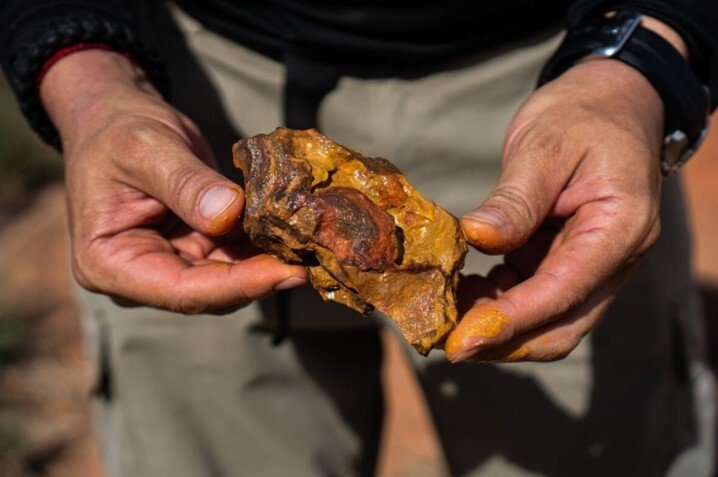
Featured image: A fragment of mine soil rich in critical minerals.
Image credit: Bram Ebus, co-director, Amazon Underworld