Kast launches border barriers in northern Chile and hardens migration agenda
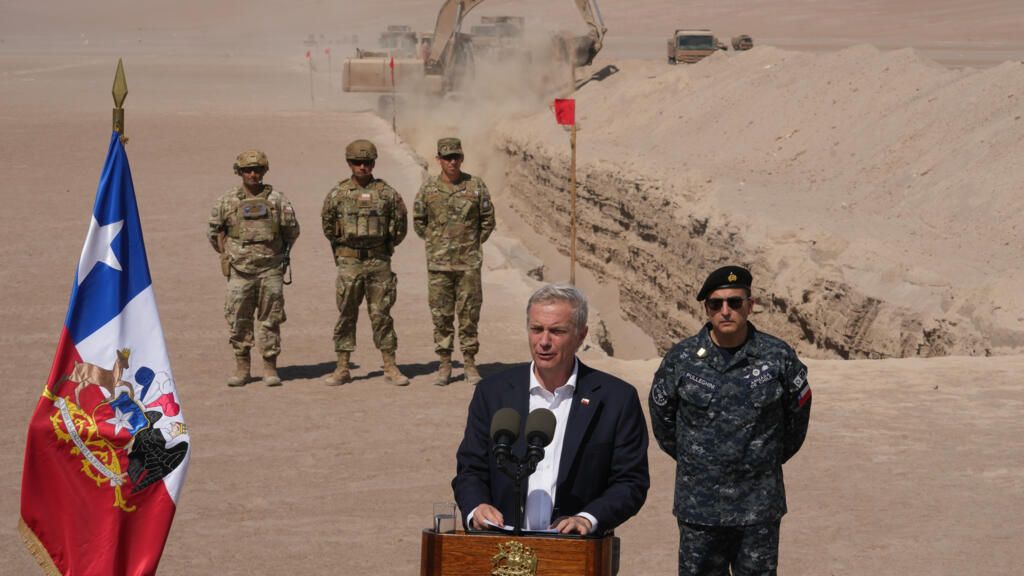
Photo: AP/Esteban Felix
Chilean President José Antonio Kast on Monday launched the border control works he had promised during the campaign, starting in Chacalluta in the Arica and Parinacota region, in an early sign that migration and security will be among the defining priorities of his administration. According to Chile’s presidency, Kast inspected the works at the frontier and highlighted the Army’s deployment to secure the area.
During the visit, Kast said the country was beginning to “stop irregular migration,” echoing the message that helped carry him to office after a campaign focused on border enforcement, organized crime and drug trafficking. Reports published on March 16 and 17 said the intervention began near the Chacalluta crossing on the Peruvian border and is part of a broader plan that also covers the regions of Tarapacá and Antofagasta, including the Colchane area on the border with Bolivia.
The plan includes physical barriers in the north, a stronger military presence and expanded technological surveillance through drones, cameras, sensors and other monitoring equipment. According to statements attributed to Interior Minister Claudio Alvarado, the infrastructure would extend for roughly 500 kilometers and be built within 90 days, although the government had not yet fully detailed the final design of the works.
Kast’s move comes even as irregular entries had already been falling before he took office. Chile’s National Migration Service, SERMIG, said on March 9 when presenting its fifth statistical report that 26,275 complaints of unauthorized border entry were recorded in 2025, down from 29,269 in 2024, confirming a downward trend from the peak reached in 2021. The agency said the decline reflected the combined effect of tighter border controls, interagency coordination and regulatory adjustments introduced since 2022.
At the same time, the latest official estimate of the foreign resident population, published by SERMIG, Chile’s national statistics institute and other state bodies, put the number of people in irregular migratory status at 337,000 within a total foreign resident population of about 1.9 million at the end of 2023. That estimate was built using administrative records, police reports, school enrollment data, biometric registration and records linked to expired tourist stay extensions.
The new government is seeking to turn that environment into a visible show of control at the frontier. Kast said Chile had been “breached” in recent years by illegal migration, drug trafficking and organized crime, while his administration also announced bills to punish those who help migrants enter irregularly and to make illegal entry itself a criminal offense.
While tougher border measures respond to a demand present in part of Chilean public opinion, the official data show that pressure at unauthorized crossings was already easing before the change in government. That leaves an open debate not only about territorial control, but also about the proportionality and effectiveness of a strategy built around physical infrastructure, military deployment and stronger criminal penalties for irregular entry.