Cubans Transform Scrap Ingenuity into A Cautionary Example For Latin America


A charcoal-powered car in rural Cuba may appear as a local curiosity; however, Reuters reporting reveals a deeper reality: when fuel blockades intensify, Latin America’s crisis economies persist. They improvise, demonstrating both the region’s resilience and the harshness of contemporary scarcity.

The Vehicle That Illustrates a Continent’s Challenges

In Aguacate, a town of 5,000 located approximately 70 kilometers east of Havana, a mechanic with an eighth-grade education constructed a device that initially appears as a folk oddity but, upon closer examination, serves as a political statement.

Juan Carlos Pino’s 1980 Polish-built Fiat Polski now operates on charcoal. The fuel tank, a distinctive 60-liter container soldered to the rear, attracts attention as the vehicle moves along potholed streets where passersby stop for photographs and inquire whether similar modifications can be made. Reuters quotes Pino stating, “In a crisis like this, it’s the best option we have. We need mobility, we need to be able to plant crops.”

This statement elucidates not only a single invention but also reflects a broader regional condition.

For decades, Latin America has experienced the politics of scarcity, arising from sanctions, debt, deteriorated infrastructure, or elite neglect, often in combination. Cuba’s recent fuel crisis, exacerbated after Washington ceased oil shipments in January, exemplifies a severe manifestation of a common Latin American reality: when official systems fail, ordinary citizens must assume roles as mechanics, logisticians, and survival strategists.

Reuters characterizes Pino’s town as formerly energized by a sugar refinery that has since closed, now encircled by cow pastures and stone quarries, where workers commute with long-handled saws. This depiction is significant as it situates the invention within a landscape shaped by the aftermath of industrial decline. The innovation does not emerge from abundance, venture capital, or state planning; rather, it arises from the remnants of unfulfilled promises.

This circumstance resonates beyond Cuba. Throughout Latin America, this pattern is well known: state withdrawal, disappearance of imports, fuel shortages, contraction of the formal economy, followed by an improvised survival economy constructed from scrap metal, collective memory, and whatever materials can be repurposed into functioning mechanisms.

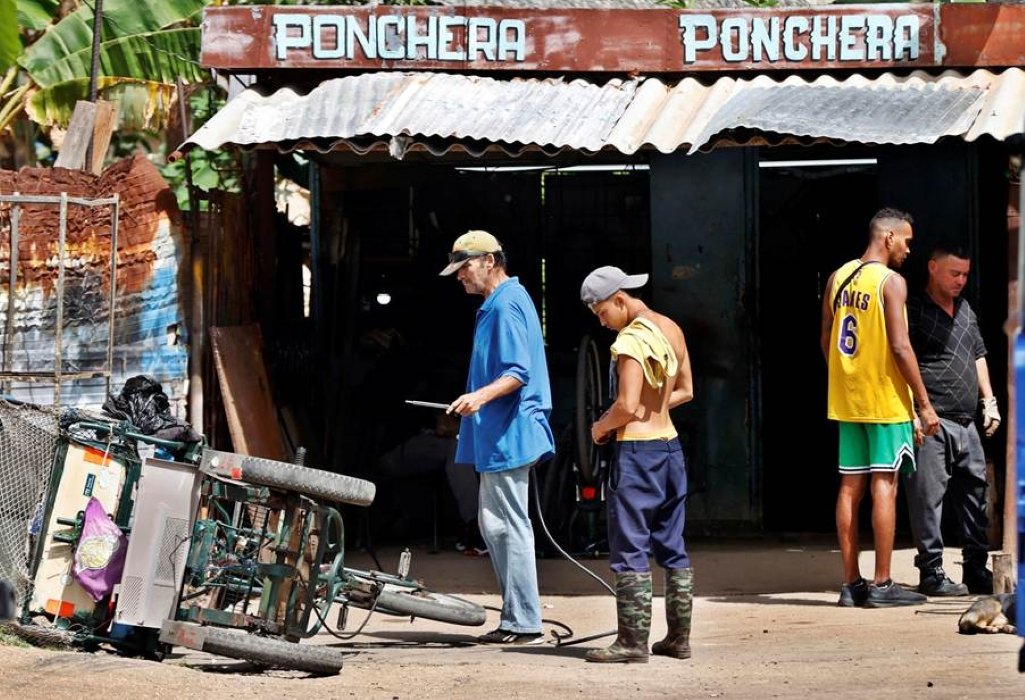
People travel in electric vehicles in Havana, Cuba, amid a severe crisis that has disrupted transport, healthcare, and daily life. EFE/Ernesto Mastrascusa

Scarcity as a Mechanism of Governance

Pino constructed his device entirely from repurposed materials. According to Reuters, the charcoal combusts within a converted propane tank sealed with a transformer lid. A stainless steel milk jug filled with old clothes functions as a filter. Although this appears almost miraculous, the necessity driving its creation is far from romantic.

Scarcity has long been a constant in Cuba’s Soviet style command economy. Now it has intensified after the United States deposed Nicolás Maduro, cutting off Venezuelan oil and threatening tariffs on any other countries that supply Cuba with fuel. The consequences are immediate and humiliating. Power blackouts are now normal. Gasoline is strictly rationed. On the black market, Reuters reports, gasoline sells for $8 per liter, or US$30 per gallon, six times the official price.

At this juncture, the political implications expand. Scarcity in Cuba transcends an economic condition and is evolving into a form of governance imposed from multiple sources. The Cuban state, despite its rigidity and chronic inefficiencies, continues to regulate daily life through command and shortage. However, U.S. pressure intensifies external constraints, transforming fuel into a weapon and mobility into a privilege.

Latin America must promptly acknowledge the associated risks. When access to transportation, food, healthcare, and agricultural labor depends on a country’s ability to circumvent sanctions or improvise replacement systems from scrap materials, the region moves beyond abstract ideological debates to confront the extent to which geopolitical pressures can disrupt civilian life.

Reuters cites Argentine innovator Edmundo Ramos, whose open-source technology inspired Pino, reporting that other Cubans have also contacted him: an ice maker, an ice cream vendor, a shop owner, and another individual powering a neighborhood with a 50-kilowatt generator. This sequence of communications reveals a society reorganizing itself not through policy relief but via emergency adaptation.

This represents a critical lesson for the region. In Latin America, crises seldom remain isolated within a single sector. A fuel shortage cascades into challenges across agriculture, transportation, food security, healthcare, and politics. The economy does not fracture into discrete categories but unravels across daily life.

Therefore, Reuters documents not only Cuban ingenuity in Aguacate but also the dynamics that emerge when a country is compelled to survive through decentralized improvisation. While the outcome may appear heroic externally, it frequently entails exhaustion internally.

La Habana (Cuba) EFE/ Ernesto Mastrascusa

Distinguishing Resilience from Justice in Latin America

There is a tendency, particularly outside the region, to view stories such as Pino’s as celebrations of Latin American inventiveness. Narvis Cruz, who drives a 1953 Pontiac assembled from a Perkins engine, a Mercedes transmission, a Czech steering system, and an East German differential, provided Reuters with a fitting characterization of this phenomenon: “That’s Cuba. A salad made of everything.”

This phrase is both insightful and, in its own way, tragic.

Resilience in Latin America is frequently admired by those who do not experience it firsthand. The capacity to persist under adverse conditions is genuine, as are the creativity and persistent intelligence that sanctions, austerity, and state failure have not extinguished. However, conflating resilience with a solution is problematic.

According to Reuters, Pino’s charcoal-powered car completed an 85-kilometer journey and reached a top speed of 70 kilometers per hour. Fellow Cubans described it as “the invention of the year” and expressed astonishment. While these reactions are sincere, they also highlight the magnitude of the surrounding void. A society should not be compelled to convert a two-cylinder Polski into a charcoal-powered vehicle merely to maintain the basic dignity of mobility and agricultural activity.

This situation exemplifies a broader phenomenon in Latin America. Cuba demonstrates, on a small scale, the consequences of formal systems being constrained to the point where survival becomes artisanal. The region has previously witnessed similar instances, including homemade electrical repairs, informal transport networks, and kitchens and clinics sustained by barter and personal favors. The lesson is not that Latin Americans are infinitely adaptable but that powerful states and failing institutions have come to depend on this adaptability.

Reuters presents the image of Pino driving slowly through Aguacate, with people gathering in amazement. This striking, almost cinematic scene carries a harsher political significance. When governments and empires render normal life impossible, the burden falls once more on ordinary citizens to construct workarounds from discarded materials and residual hope.

While this may attest to Cuban ingenuity, it also serves as a warning to the rest of Latin America about how readily resilience can be used to justify enduring crisis.

Also Read:
Cuba Confronts a Low-Cost Drug Epidemic and Its Social Consequences


Source link

Leave a Reply

Translate »
Share via
Copy link