Argentina marches on 50th anniversary of coup that led to the Falklands War and the regime’s fall — MercoPress


Argentina marches on 50th anniversary of coup that led to the Falklands War and the regime’s fall

Tuesday, March 24th 2026 – 10:14 UTC


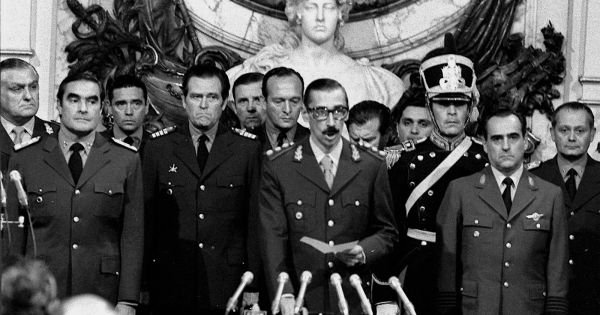
Jorge Rafael Videla being sworn in as president on March 29, 1976, five days after the coup.

Thousands of people are expected to gather this Tuesday in Plaza de Mayo and in Argentina’s major cities to mark the 50th anniversary of the March 24, 1976, military coup that installed a dictatorship responsible for thousands of forced disappearances and which, in its final stage, launched the Falklands War in a desperate bid to cling to power.

The military regime led by General Jorge Rafael Videla, who spearheaded the coup and headed the first junta, overthrew the government of María Estela Martínez de Perón and ruled Argentina for seven years. Videla was sentenced to life in prison in 1985 for crimes against humanity, pardoned in 1990 by President Carlos Menem and retried and imprisoned again in 2010 after the pardons were annulled. He died in prison in 2013. Under his command and that of the juntas that followed, the regime carried out a systematic plan of forced disappearances, torture, theft of babies and operated more than 340 clandestine detention centres, according to the National Commission on the Disappearance of Persons (CONADEP). The annual march under the banner “Never Again” took on special significance this year as the coup reached its half-century mark.

By 1982, the dictatorship — then led by Leopoldo Galtieri — faced mounting popular discontent and a deep economic crisis. On April 2 of that year, the regime launched Operation Rosario to reclaim the Falkland Islands, held by the United Kingdom since 1833. The move sought to generate a wave of nationalist fervour to relegitimise the military government. The war lasted 74 days and ended with Argentina’s surrender on June 14, claiming the lives of 649 Argentine soldiers, 255 British servicemen and three islanders. The military defeat hastened the regime’s collapse and paved the way for the return of democracy with the election of Raúl Alfonsín in October 1983.

Description of the image

Memorial Day 2024, in Buenos Aires. EFE/Juan Ignacio Roncoroni

Tuesday’s mobilisation, led by human rights organisations, included slogans drawing parallels between the dictatorship’s economic programme and that of President Javier Milei’s current government: “The same plan, the same fight. They are 30,000. Say where they are.” Historic figures including Estela de Carlotto, president of the Grandmothers of Plaza de Mayo, and Nobel Peace Prize laureate Adolfo Pérez Esquivel attended the central rally.

A study by the University of Buenos Aires Public Opinion Observatory found that 71% of Argentines rate the dictatorship’s performance as bad or very bad, and 70% support the continued prosecution of those responsible. However, 32% interpret the period as “a fight against terrorism in which there may have been excesses.” Among those aged 16 to 30, an Amnesty International survey found 56% fear the dictatorship’s crimes could be repeated, and 75% reject a potential pardon for convicted military officers.

Milei’s government, which since taking office has downplayed state terrorism crimes and defunded memory policies, did not participate in official commemorations. From the opposition, presidential candidate Iván Cepeda, who leads polls ahead of the May 31 first round, expressed condolences to “the entire Nation.”CompartirContenido del proyectoMercoPressCreado por tiAgrega PDF, documentos u otro texto para consultar en este proyecto.


Source link

Leave a Reply

Translate »
Share via
Copy link