A week to forget for Milei: Adorni scandal, skeptical markets, cultural battle collapse

Public opinion indicators deepened the administration’s concerns. A Universidad de San Andrés poll recorded just 33% satisfaction with the government, a seven-point drop since November 2025
Argentine President Javier Milei’s administration closed one of its worst weeks in office, cornered by an expanding judicial front against Cabinet Chief Manuel Adorni, adverse market signals, and the collapse of its discursive offensive on historical memory.
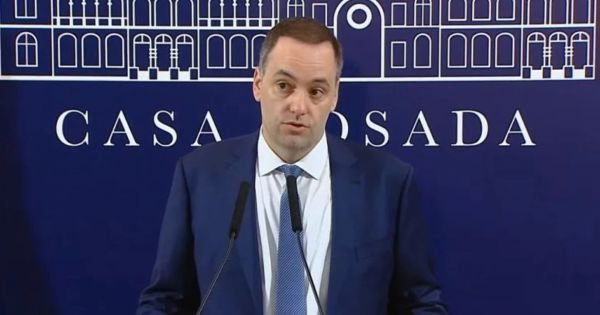
Adorni, formally charged in a federal investigation into alleged illicit enrichment now consolidated under Judge Ariel Lijo, attempted on Wednesday to dispel doubts at a press conference that achieved the opposite: he appeared irritable, avoided direct answers, and left more questions than clarity. The official has invoked his right to patrimonial privacy and is banking on his sworn asset declaration, due May 30, to settle the matter. His circle has previewed a mortgage as the explanation for the acquisitions under scrutiny.
Presidential General Secretary Karina Milei, the president’s sister and central figure in the administration’s internal power structure, skipped the press conference but later posted a show of support on social media. Her strategy this week focused on securing key congressional positions: she promoted lawmaker Lilia Lemoine to chair the impeachment committee and placed Sebastián Pareja, her political operative in Buenos Aires province, at the head of the bicameral intelligence oversight body — a seat that Mauricio Macri’s Pro party had sought to retain.
The Adorni affair paralyzed the legislative agenda. Lower House Speaker Martín Menem postponed debate on the glacier protection law and has confined himself to organizing committees. Adorni’s mandatory report to Congress was set for April 29, with Milei himself announced to attend in an unprecedented move whose feasibility some legislators doubt, given the pace of the judicial proceedings.
The administration’s sole reprieve came Friday, when a U.S. court overturned Argentina’s conviction in the 2012 partial expropriation of oil company YPF. Milei marked the ruling with a national broadcast that closed with an uncharacteristic Long live the Fatherland, but the celebration exposed a difficult contradiction for a libertarian government: cheering the successful outcome of state intervention against the private sector. The legal victory was internally capitalized by the team linked to presidential adviser Santiago Caputo, who regained ground against the Karina Milei faction after months of palace defeats.
Public opinion indicators deepened the administration’s concerns. A Universidad de San Andrés poll recorded just 33% satisfaction with the government, a seven-point drop since November 2025, with presidential approval at 39%. Consultancy 1816 flagged what it called economic K risk: unemployment rose in 2025 for the first time this century alongside GDP growth, the registered private real wage for January 2026 was the lowest in 18 months, and household loan delinquency quadrupled in just over a year.
Markets reflected their own reservations. At this week’s bond auction, securities maturing during the current term priced at a 5.02% rate, while those maturing under a potential new government reached 8.5% — a spread analysts read as a signal that Milei’s reelection is far from a foregone conclusion.
The administration’s strategy of pushing a complete memory narrative during the 50th anniversary of the 1976 military coup crashed against a massive popular mobilization in Plaza de Mayo, possibly the largest in recent years. Social media mentions associated with the concept fell 69% compared to 2025, according to consultancy Ad Hoc. Milei himself barely reposted a single official video among more than a thousand social media interactions that week.
With the economy as citizens’ top concern, no consolidated political rival in sight, and expectations of economic improvement in decline, the government faces a crisis with no clear exit on the horizon.