On March 27, El Salvador’s legislative assembly approved legislation allowing those under the age of 18 to serve life sentences for murder, rape and terrorism.
The move came just weeks after the Nayib Bukele regime amended the constitution to permit life sentences for adults, part of its hallmark iron fist approach to crime.
The extension of penalties marks a significant escalation in the severity of the country’s punitive policy, raising a number of ethical and legal concerns, according to rights groups.
The reform to the Juvenile Criminal Law provides for “the inapplicability of the special juvenile procedure” which formerly saw children and adolescent held in separate, secure centres designed to provide a more nurturing environment for younger inmates.
With the support of the Salvadoran Institute for the Comprehensive Development of Children and Adolescents, child-friendly court-procedures and age-appropriate prisons which prioritized education, vocational training, psychological support and social reintegration were once foregrounded.
But under the reformed law children and adolescents could now be condemned to a lifetime in prison.
Rights groups warn that the reform risks disproportionately targeting children and adolescents from lower socio-economic backgrounds, many of whom are already vulnerable to coercion and exploitation by organised crime.
The United Nations Children Fund (UNICEF) and the Committee on the Rights of the Child (CRC) said in a joint statement that the reforms “constitute a contradiction of the standards enshrined in the Convention on the Rights of the Child.” These standards say that children in conflict with the law must be treated in a manner that “prioritizes their rehabilitation and reintegration, and that deprivation of liberty be used only as a measure of last resort and for the shortest, appropriate time.”
Since being elected as president in 2019, Bukele has been a divisive figure in El Salvador. In a bid to tackle gang violence, he introduced a state of emergency in March 2022, granting authorities broad-based authority to arrest and detain individuals suspected of gang affiliation without warrants.
The state of emergency, intended to last no longer than 30 days, has been extended more than 20 times as Bukele continues his crusade against criminal networks, groups, individuals and affiliates.
As of March 2026, approximately 91,500 people have been arrested under the state of emergency, according to official government figures.
While the policy has been credited with reducing homicide rates and improving public safety, its implementation has been deeply controversial. Reports suggest that many individuals, and even young people and adolescents, have been detained based on tenuous evidence, including their socio-economic status.
This raises the alarming possibility that minors could face life imprisonment not on the basis of proven criminal activity, but on suspicion alone.
However, Bukele seems an unstoppable force, frequently polling above other Latin American leaders in popularity during his term.
Minors face arrests under repeated states of emergency
The precedents set by President Bukele’s mano duro policy are particularly concerning with the new reformed juvenile penal code on the horizon.
Salvadoran security forces have already detained more than 3,300 children, many of whom had no apparent connection to gangs’ criminal activities, according to this Human Rights Watch report.
The risk of condemning a young person to a lifetime in prison based on flawed evidence or coerced confessions is a significant concern for NGOs and analysts.
“The legislative changes place children under the authority of El Salvador’s adult prison administration, which has been responsible for torture and other grave abuses,” noted Juanita Goebertus, Americas director at Human Rights Watch.
While the reform promises to hold “periodic reviews” for life sentences, it still raises questions about the availability of the alternative of rehabilitation programs within the prison system.
Previous amendments to the Criminal Code which determine that criminal courts will have “exclusive jurisdiction” to hear proceedings “against adults and minors” involved in crimes punishable by life sentences equally raises concern about the adequacy of legal representation for minors.
If the repercussions of the “Bukele Method” continue to be enacted so stringently, young people will likely continue to face undue arrest.
Minors transferred to adult prisons
Equally concerning are the precedents set by the “Bukele Method”, demonstrating a tendency that juvenile offenders may be absorbed into an already overburdened prison system.
UNICEF and CRC have similarly argued that “detention is not only harmful to children, but also highly costly and ineffective in preventing crime”.
Juanita Goebertus explained that there is a risk of children experiencing mistreatment in adult prison systems and that “transferring children into detention facilities designed and operated for adults, even if they are placed in nominally separate areas, is a massive regression for children’s rights in El Salvador.”
Evidence demonstrates that young children and adolescents imprisoned for “collaborating” with organised crime groups or low-level crimes are more likely to reoffend or become more closely affiliated with criminal groups during their time in prison.
While many Salvadorans credit Bukele’s hardline policies with delivering safer streets and a dramatic reduction in violence, international bodies such as UNICEF caution that security gains may prove fragile unless “the specialized nature of the juvenile justice system” and the rights of all children are fully upheld.
Failing to invest in rehabilitation, education and social reintegration risks entrenching the very cycles of crime these policies seek to eliminate. Prioritizing punitive measures over children’s rights may ultimately undermine both long-term public safety and the wellbeing of future generations.
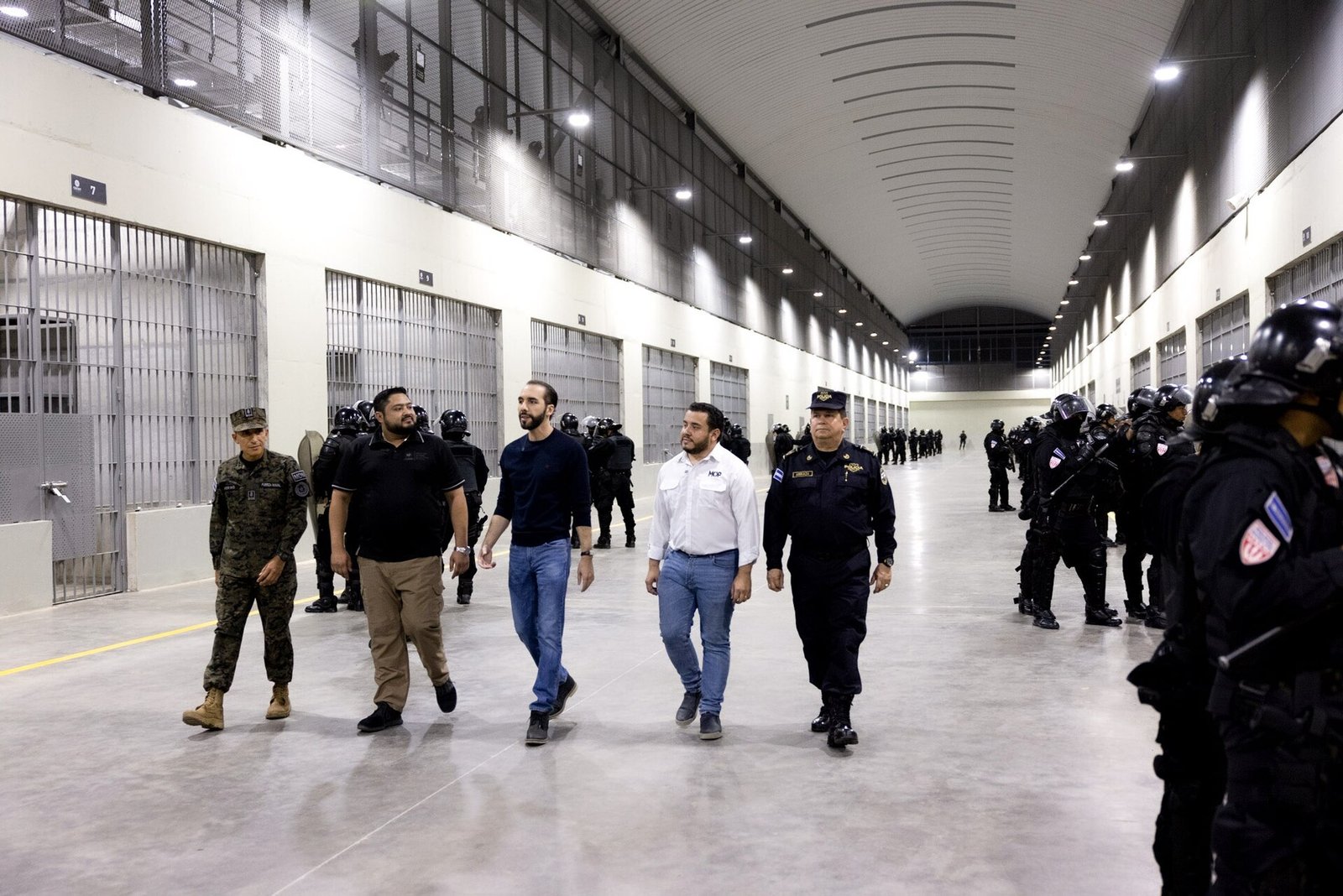
Featured image description: (From left to right) Minister of Defense René Merino Monroy, General Director of Penal Centers Osiris Luna Meza, President Nayib Bukele, Minister of Public Works Romeo Herrera, and Director of the National Civil Police Mauricio Arriaza Chicas touring the Terrorism Confinement Center (CECOT) in January 2023.
Featured image credit: President’s Office of El Salvador.