In a world where AI development is dominated by a few global powers, sovereign AI, that is, artificial intelligence developed and owned by a country, is a necessity for self-reliance. For India, with its linguistic and economic diversity, building home-grown AI solutions is of critical strategic importance.
AI4Bharat, an initiative launched at IIT Madras in 2020, exemplifies this approach. It focuses on AI tools tailored for Indian languages and real-world constraints. Unlike Silicon Valley’s compute-heavy models, AI4Bharat builds lightweight systems that run on low-end smartphones and low bandwidth networks, enabling access across the digital divide.
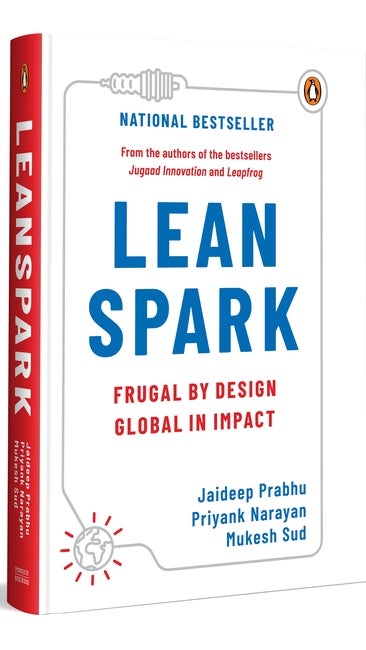
This is LeanSpark in action: solving large-scale problems under constraints of cost, bandwidth and infrastructure.
India is a mosaic of over 1,600 dialects and 22 official languages. In such a multilingual society, the global models of AI built for English simply don’t work. This is why sovereign AI, developed in India, is not a luxury but a necessity. It ensures that technology speaks the language of all people and not just the language of the rich.
“When ChatGPT came out in November 2023,” Vivek Raghavan says, “it simply blew my mind. Here was a truly deflationary technology in every sense of the term. Immediately, I could see a way for India to achieve huge breakthroughs in health and education. Here was an opportunity to put a personal tutor in the pocket of every Indian child, and a personal physician in the hands of every Indian adult. An AI tutor, for instance, would cost far less than today’s schools and provide much more personalized instruction.”
Generative AI, Vivek realized, could change lives in ways he hadn’t imagined before or even thought possible. But it was crucial to build something that was suited to the Indian context: something that was highly affordable, scaled, based on voice and in Indian languages.
That was when Sarvam AI took shape. The company’s mission would be to create scalable, cost-effective AI models that addressed the unique needs of Indian society. The startup would develop full-stack AI solutions tailored to India’s diverse linguistic and cultural landscape.
Krutrim and Sarvam AI represent a growing trend in the Indian tech ecosystem, where home-grown startups are leveraging AI to address the country’s specific needs and challenges.
The vision for the company was deeply influenced by Vivek’s belief in “sovereign AI” models that respect data privacy and cultural nuances. The company would build on the frugal design principles that had influenced Aadhaar and the Unified Payments Interface. The approach would involve open-sourcing AI models and collaborating with Indian enterprises to build domain-specific solutions. This strategy would not only foster innovation but also empower local researchers and developers to push the boundaries of AI technology.
Pratyush Kumar co-founded Sarvam AI with Vivek, after the two had worked together on AI4Bharat at IIT Madras. With a PhD from ETH Zurich and degrees from IIT Bombay, Pratyush brought deep expertise in AI and systems engineering to the partnership.
When Pratyush and Vivek started Sarvam AI, they chose a for-profit model for the startup, believing that to truly scale AI’s impact across India, especially in areas like healthcare and education, significant investment and market competition were needed. Sarvam AI’s goal is to bring generative AI to 800 million Indians with smartphones, helping them use AI tools to improve their lives in meaningful ways.
In healthcare, Sarvam AI is deploying voice-enabled, multilingual conversational agents that allow rural patients to access medical advice, schedule appointments and consult doctors through WhatsApp and low-bandwidth interfaces. Their models, such as Sarvam 2B and Sarvam-M, are fine-tuned for medical reasoning and symptom triage in local languages, without the need for high-end devices or constant internet. These systems can summarize patient notes, offer diagnostic guidance and even prioritize cases, functioning as low-cost, frugal AI assistants for overstretched healthcare workers.
In the education sector, Sarvam AI is building sovereign, frugal solutions that cater to India’s vast linguistic diversity. With its flagship model SarvamM, a 24-billion parameter large language model (LLM) trained across 10 Indian languages, Sarvam enables vernacular learning assistants capable of understanding codemixed queries and delivering personalized instruction in students’ mother tongues. These lightweight, optimized models empower AI tutors to adapt lessons in mathematics and programming to regional educational contexts, far beyond what English-centric platforms do.
These startups reflect the growing power of India’s AI ecosystem—solving local challenges with global relevance.
OpenHathi, developed by Sarvam AI, is a frugal and open-source project designed to teach Indian language skills to existing LLMs. Instead of building a model from scratch—an expensive and resource-heavy process—Sarvam adapted pre-trained models like Meta’s LlaMA (short for Large Language Model Meta AI) and France’s Mistral to understand Indian languages, starting with Hindi.
As Vivek puts it, “The idea is to bolt Indian language skills onto existing models. Once that’s done, we can create smaller, domain-specific models in fields like finance or medicine that are much cheaper and more efficient to use.” By building on open-source platforms and releasing models on Hugging Face, OpenHathi empowers developers to create local AI solutions in Indian languages—bringing sovereign AI closer to the people, one language at a time.
As Sarvam AI built its Indian language models, it ran into an unexpected challenge: Language costs money. Not because of translation fees or licensing, but because of how AI breaks language down into tokens. A simple sentence in Hindi, for instance, required three to four times more tokens than the same sentence in English. That meant every AI interaction in an Indian language was significantly more expensive.
As Vivek puts it, “The same question, when asked in English, costs one-fifth of what it costs in an Indian language.”
Their success will depend on building AI that is not just cutting-edge, but also affordable, inclusive and context-aware.
To address this, the Sarvam team created better tokens for Indian languages and performance without blowing up costs, focused on building high-quality datasets to improve models. By tackling this problem at its root, Sarvam AI made it cheaper and more efficient to run AI models in Indian languages, a critical step towards making AI accessible for healthcare workers, students and everyday users across India.
Sarvam AI has Indian partners and competitors. In April 2023, Bhavish Aggarwal, the co-founder of Ola Cabs, launched Krutrim, an AI start-up focused on developing LLMs tailored for the Indian market. Together, Krutrim and Sarvam AI represent a growing trend in the Indian tech ecosystem, where home-grown startups are leveraging AI to address the country’s specific needs and challenges.
Trained on over 2 trillion tokens, Krutrim can understand and generate text in 22 Indian languages, making it one of the most inclusive models designed for India’s diverse population. But Krutrim’s real power lies in its frugal DNA. Built with India’s infrastructure in mind, it is optimized to run efficiently without the need for supercomputers. This makes it ideal for schools, startups and government services that want powerful AI at low cost.
Together, Krutrim, Sarvam and a rising wave of Indian AI startups are rewriting the global AI playbook with solutions that are not only smart, but also scalable, affordable and multilingual. And they are not alone. India’s burgeoning AI startup ecosystem is home to several innovative ventures that are making significant strides in the field of generative AI.
These startups reflect the growing power of India’s AI ecosystem—solving local challenges with global relevance. Their success will depend on building AI that is not just cutting-edge, but also affordable, inclusive and context-aware.
Vivek believes India has a unique opportunity to shape the future of AI, not by chasing massive, expensive models like those in Silicon Valley, but by focusing on frugal, purpose-driven AI that solves real problems. This India-first approach to AI—frugal, inclusive and multilingual—offers a blueprint for the Global South.