
By NAN Business Editor
News Americas, NEW YORK, NY, Fri, April 24, 2026: Caribbean economies are set to follow sharply different growth paths in 2026 and 2027, with oil-producing nations surging ahead while tourism-dependent economies face slower expansion, according to new data from the World Bank. The latest Latin America and Caribbean Economic Update shows that while the Caribbean economic growth overall continues to struggle with slow growth, the Caribbean is increasingly split between high-growth and moderate-growth economies.
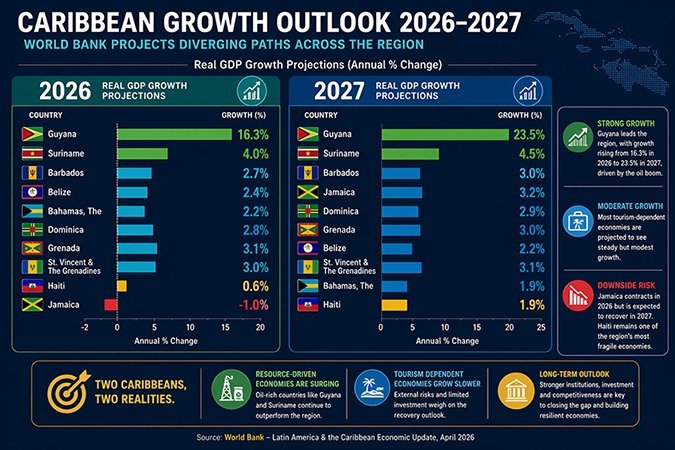
At the center of this divergence is Guyana, which remains the region’s fastest-growing economy, driven by its oil boom. Growth is projected at 16.3% in 2026, rising further to 23.5% in 2027, far outpacing every other Caribbean nation.
Suriname is also emerging as a strong performer, with growth expected to reach 4.0% in 2026 and 4.5% in 2027, supported by energy-related investments and future oil production expectations.
By contrast, many tourism-dependent economies are seeing more modest expansion. The Bahamas is projected to grow at 2.2% in 2026 and 1.9% in 2027, while Barbados is expected to post 2.7% growth in 2026 and 3.0% in 2027.
Jamaica, however, stands out on the downside, with the economy expected to contract by -1.0% in 2026 before recovering to 3.2% in 2027, reflecting ongoing economic pressures and recovery challenges.
Smaller economies like Grenada, Dominica and St. Vincent and the Grenadines are expected to maintain steady but moderate growth in the 2.8%–3.1% range over the next two years.
Haiti remains one of the region’s most fragile economies, with growth projected at just 0.6% in 2026, rising to 1.9% in 2027, underscoring continued structural challenges.
Overall, the World Bank warns that despite pockets of strong performance, the Caribbean’s outlook reflects a broader pattern across Latin America and the Caribbean, where growth remains constrained by limited investment, global uncertainty, and structural weaknesses.
“Stagnation in economic growth and persistent difficulties in creating high-quality jobs have moved industrial policy back to the radar of the policy debate,” the Bank noted.
As global conditions remain uncertain, the report emphasizes that long-term growth across the Caribbean will depend on stronger institutions, improved investment climates, and the ability to attract capital into productive sectors.
Invest Caribbean CEO, Felicia J. Persaud, noted that “for investors, the takeaway is clear: growth is not uniform – and capital must be deployed strategically.”
Understanding where growth is accelerating – and where it is constrained – will be critical for deploying capital effectively across the Caribbean in 2026 and beyond.
Assess your project’s funding readiness now.
RELATED: U.S., China Tensions Rise Over Bahamas Hospital Project