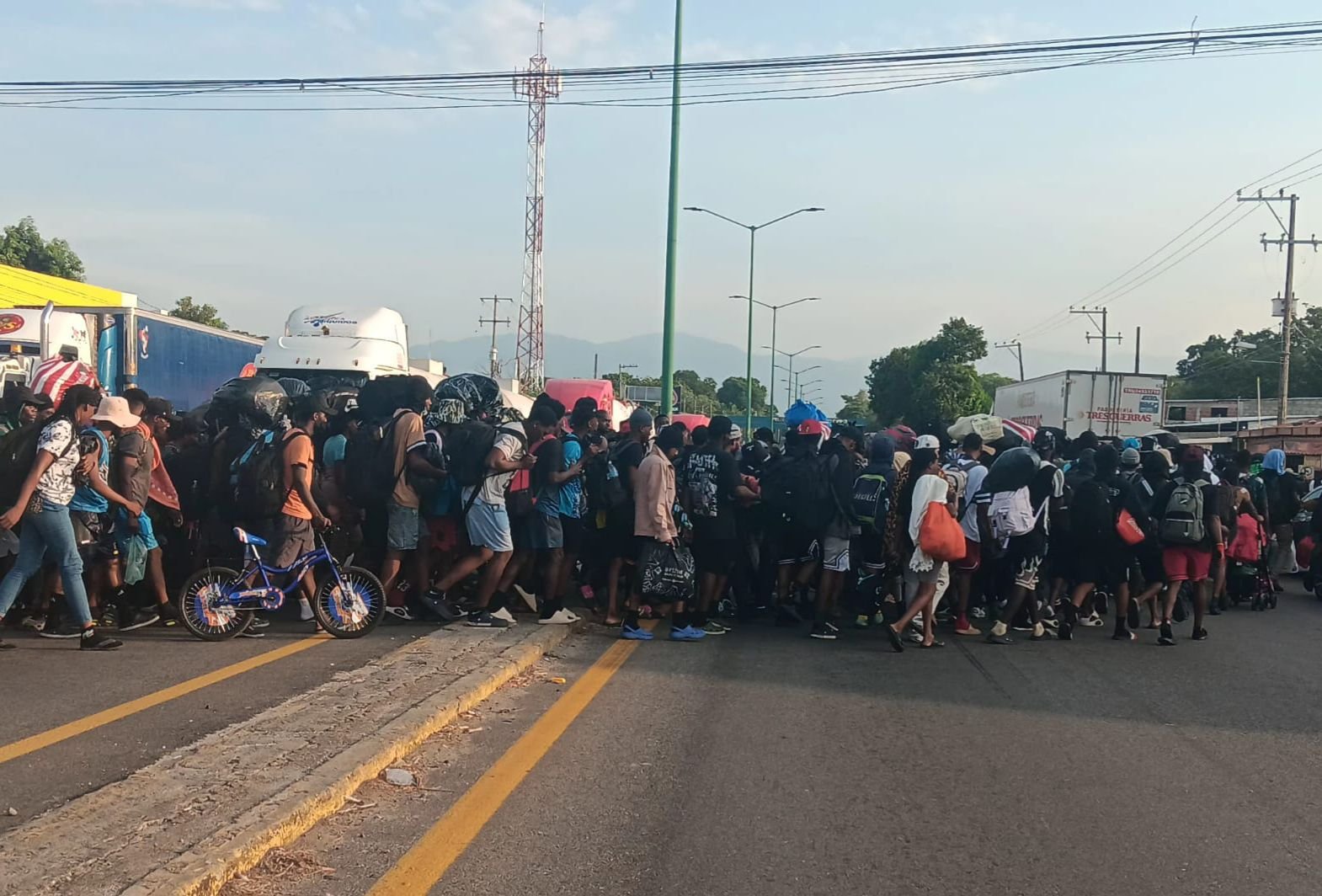
Medellin, Colombia — On Tuesday, a group of more than two thousand migrants, mainly of Haitian origin, reportedly left the southeastern city of Tapachula in Chiapas, on their way to cities in central and northern Mexico.
In years past, migrant caravans traversing Mexico were usually destined for the United States. But following the second Trump administration’s tightening of asylum policy, this goal has become more unrealistic, and Mexico has increasingly become a destination country for migrants, according to the International Organization for Migration (IOM).
Some of the people who make up the “David” caravan have spent weeks or more in southern Mexico, waiting to normalize their migration status to be able to move more freely in Mexico, according to migrant news website Conexión Migrante. The process can be slow as Mexico fields more asylum requests.
According to the UNHCR, between 2020 and 2024, there were almost 500,000 asylum requests in Mexico, a number that has resulted in long delays from the Mexican Commission for Refugee Assistance (COMAR) and the National Institute of Migration (INM).
As of September 2025, there were more than 58,800 new asylum claims, and COMAR had increased its processing capacity fivefold since 2018.
Between October 1 2024 and June 30 2025, there were 142,145 requests for humanitarian visas in Mexico, but only 5,191 were granted, according to the INM Strategic Plan.
The bureaucratic problems pre-date Trump’s immigration crackdown in his second term.
In 2020, the COVID-19 pandemic forced COMAR to suspend activity, accumulating a backlog of asylum petitions. Exacerbating the issue was Trump’s January 2025 suspension of the CBP One digital asylum-seeking app in the U.S., followed by budget cuts to COMAR from the Mexican government as well as the UN Refugee Agency (UNHCR).
Via a Whatsapp group organized for the caravan, many members cited extreme delays for processing asylum applications as a motive for heading north from Mexico’s southern border. Lack of employment and cost of living were also cited, according to Conexión Migrante.
Without documentation, many foreign migrants are stuck in a legal limbo, where they run the risk of being stopped by authorities, deported or sent back to the southern border with Guatemala.
Migrants have also been targeted by criminal groups for kidnapping and extortion, with ProPublica reporting that this problem has entered a new phase in terms of scale and character. Migrants’ undefined legal status also often forces them to work long hours with lower pay, according to the International Rescue Committee.
Since Claudia Sheinbaum took office in October 2024, there have been 18 migrant caravans leaving from Tapachula, though none of them have made it further than Oaxaca, the state neighbouring Chiapas.
At the end of March, the ‘Genesis’ migrant caravan set off from Tapachula, but it was intercepted after 12 days and dissolved by the INM.
According to local news outlet Diario del Sur, on Thursday, the David caravan arrived in Escuintla, Chiapas after three days of walking, where members will rest before continuing the journey.
Many migrants were demonstrating signs of extreme physical exhaustion, and approximately thirty who fell behind the main group have been sent back to Tapachula, where they remain under the custody of the authorities, according to Reporteros del Sur.
Featured image description: David migrant caravan in Mexico
Featured image credits: @reporterosdlsur via X