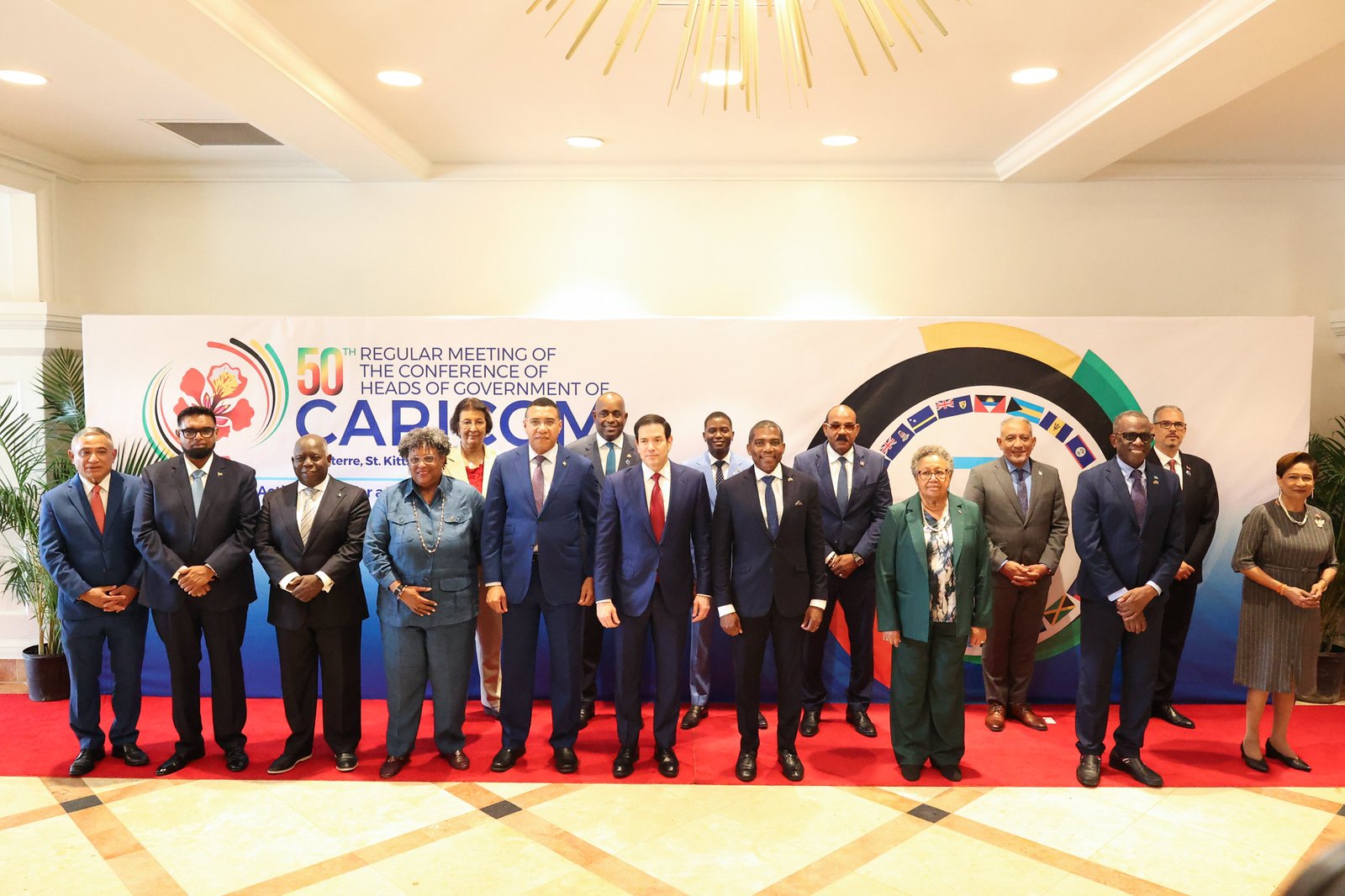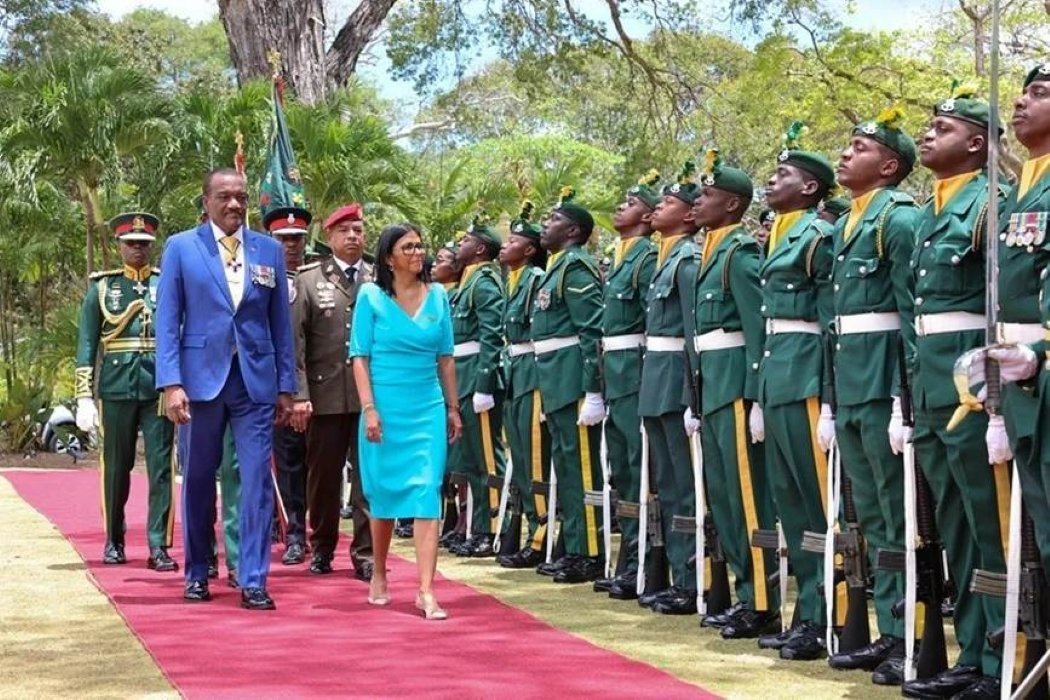
Venezuela and Barbados are selling cooperation as a Caribbean future built on energy, food, and tourism. Still, the deeper story is regional survival, political legitimacy, and a small-island economy looking toward a troubled mainland neighbor.
A Handshake With Regional Echoes
The new cooperation announced by Venezuela and Barbados sounds, at first, like the kind of diplomatic language that often gets lost in protocol. Energy. Food production. Tourism. More flights. Maritime links. Cultural exchange. Spanish classes. It is easy to read it as another Caribbean communiqué, polite and warm, wrapped in phrases about friendship and opportunity.
But this one carries more weight than its soft tone suggests.
According to a report by EFE, Venezuela’s acting president, Delcy Rodríguez, concluded an official visit to Barbados by announcing that both governments had agreed to work together on energy, food production, and tourism, alongside Barbadian Prime Minister Mia Mottley. The declaration, transmitted by Venezuela’s state channel, presented the visit as a moment of “deep happiness” and as the beginning of what Rodríguez called an economic and commercial union between Barbados and Venezuela.
That phrase matters because it reaches beyond two governments. It speaks to a Caribbean basin where geography has always been more honest than ideology. Venezuela is not some distant South American abstraction for the islands. It is near. Its oil, ports, farms, workers, crises, and political storms have always found a way across the water. Barbados, for its part, is not merely a vacation postcard in this equation. It is a small island state trying to think like a regional strategist in a world where food, fuel, and tourism cannot be treated as separate questions.
The announcement comes with an obvious Venezuelan objective. Rodríguez invited Barbados to invest in Venezuelan oil and gas fields, tying the proposal to the country’s effort to increase hydrocarbon production after approving a reform meant to open the sector to foreign and private investment. That is not just economics. It is a search for oxygen. Venezuela seeks capital, partners, and proof that it remains a useful regional hub despite years of political isolation, institutional conflict, and economic fracture.
Barbados, meanwhile, appears to be reading the moment through a pragmatic island lens. Mottley welcomed the energy cooperation opportunities and recalled Venezuelan support for Caribbean islands since 1999 through affordable energy. That memory is not minor. In the Caribbean, energy is not only a commodity. It is the price of electricity, shipping, refrigeration, hotels, food imports, and household survival. A cheaper barrel or a steadier energy relationship can become the difference between growth and suffocation.

Food Security Meets Political Need
The food proposal may be the most revealing part of the agreement. Rodríguez said Barbados could produce food on Venezuelan lands, both to supply its own country and to help turn the island into a hub for exporting food to the Caribbean and Africa. The idea is ambitious, perhaps even grandiose, but it also reflects a blunt regional truth: the Caribbean cannot live on beaches alone.
Small island economies have long lived with a cruel vulnerability. Tourism brings dollars, but it does not guarantee food security. Imports fill shelves, but they leave countries exposed to shipping shocks, fuel prices, and foreign supply chains. A storm, a war, a price spike, or a pandemic can make the supermarket feel like a border post. In that context, Venezuelan land becomes more than land. It becomes an answer, or at least the image of an answer.
For Venezuela, the offer also has symbolic force. A country associated internationally with scarcity and migration is presenting itself as a platform for food production and regional supply. That is a political message as much as an agricultural one. It says Venezuela is not only a problem to be managed, but a territory to be used, cultivated, and reconnected.
Still, the risks are plain. Cooperation built on Venezuelan land, Venezuelan energy, and Venezuelan state promises will depend on trust, rules, and execution. Caribbean governments know the value of solidarity, but they also know the cost of fragile institutions. If these agreements remain vague, they will become another layer of speeches over the old Caribbean wound: brilliant ideas without enough machinery underneath them.
The report says both sides will review production and export matrices to achieve trade complementarity. That word, complementarity, sounds technical, but it is doing heavy political work. It tries to avoid the language of dependency. It suggests that Barbados and Venezuela are not donor and client, not giant and island, not ideological patron and grateful neighbor, but partners matching needs and capacities.
That is the right language. Whether it becomes the right reality is another matter.

Tourism Is Also Geopolitics
The tourism section may look lighter, but it is not. Rodríguez spoke of increasing flights, integrating nearby destinations, and offering tourism packages from both countries. She also emphasized the need to restore maritime connections for cargo and passengers, and raised the possibility of training Venezuelan tourism operators in Barbados.
This is where the agreement becomes most Caribbean in spirit. The region has always been shaped by movement: ships, labor, music, languages, exile, commerce, rumors, families split by water but not by memory. More flights and maritime links are not just conveniences. They can rebuild habits of connection that politics and crisis have weakened.
The Spanish-language proposal also carries cultural meaning. Rodríguez said she would give special attention to supporting Spanish instruction in Barbados through the Venezuelan Institute of Cultural Cooperation, responding to Mottley’s desire to make Spanish the island’s second official language in an English-speaking country. That is not a decorative detail. It points to a future in which the Caribbean sees Latin America not as a neighbor across a linguistic wall, but as part of its own strategic neighborhood.
For the region, the Venezuela-Barbados announcement is a reminder that Caribbean geopolitics rarely arrives with drums. Sometimes it arrives as a tourism package, a solar panel factory, a food export plan, a Spanish classroom, a cargo route restored after too much neglect.
The danger is that political theater can outrun institutional reality. The promise is that necessity can force imagination. Barbados needs resilience. Venezuela needs reinsertion. The Caribbean needs bridges that are not built only for crisis.
If this agreement becomes real, it could mark a small but meaningful shift toward a more practical regionalism, one less obsessed with summits and more focused on ships, food, fuel, language, and movement. If it fails, it will join the long archive of Latin American and Caribbean declarations that sounded historic at the microphone and vanished before touching the dock.
For now, Venezuela and Barbados are offering the region a familiar gamble: trust the handshake, but watch the cargo.
Also Read:
Bolivia’s Gold Fever Meets Cacao Fields That Refuse to Yield