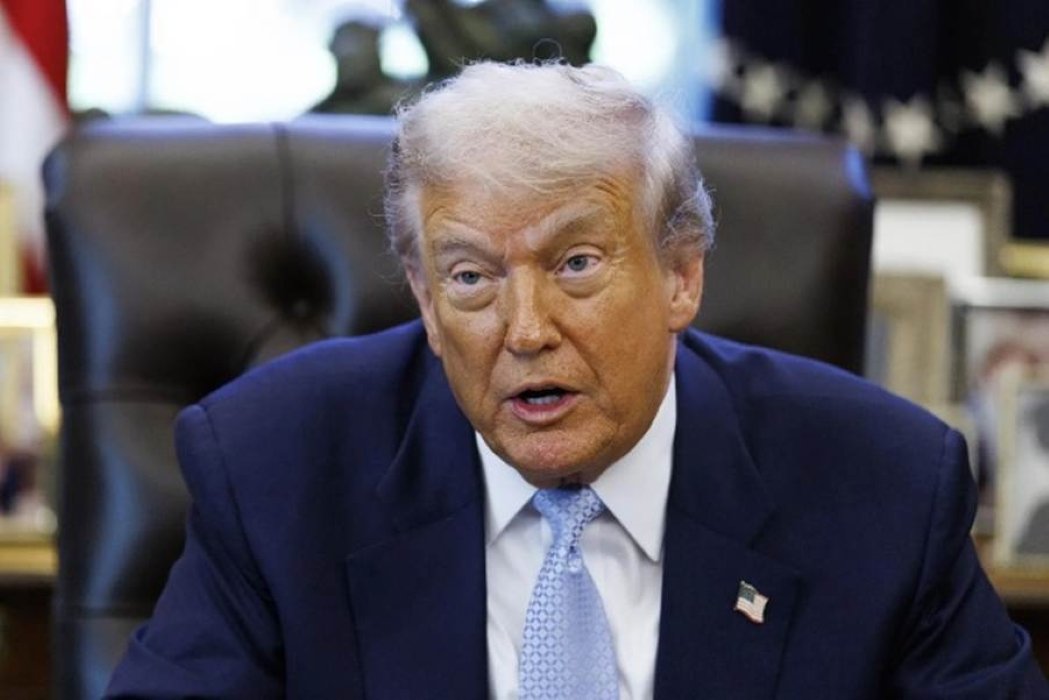
Trump’s talk of making Venezuela the fifty-first state is not harmless provocation. It is imperial language dressed as spectacle, exposing how crisis, oil, sanctions, and political exhaustion can turn sovereignty into a bargaining chip.
A Flag Over Someone Else’s Country
A map can look silly until history begins to speak through it. When U.S. President Donald Trump posted an image on Truth Social showing Venezuela filled with the U.S. flag, after twice expressing interest in making the South American nation his country’s fifty-first state, the gesture landed with the ugly familiarity of an old empire. It was crude, performative, almost cartoonish. But in Latin America, cartoons of power are rarely innocent.
This is a region that has seen jokes become doctrines, doctrines become interventions, interventions become occupations, and occupations become family memory. To treat Venezuela as a possible extension of the United States is not clever negotiating. It is a direct insult to the idea that Latin American sovereignty exists beyond Washington’s convenience.
The disturbing part is not only Trump’s imperial fantasy. It is the muted response from Caracas. For more than two decades, any U.S. statement questioning Venezuelan sovereignty would have been met with thunder from senior officials, street demonstrations, state television denunciations, and the familiar chant of “Gringo go home.” As recently as January 3, after then-President Nicolás Maduro was captured by the U.S., the ruling party organized demonstrations in Caracas with exactly that anti-U.S. fury.
This time, the government mostly stayed quiet. Acting President Delcy Rodríguez told reporters Monday that Venezuela had no plans to become a U.S. state. Still, her language was controlled, reserved, almost careful. That restraint says more about Venezuela’s current weakness than a thousand fiery speeches ever could. Rodríguez is walking a narrow ledge between a broken country, a hostile patron, a changed Chavismo, and a population too exhausted for slogans that do not restore salaries, food, electricity, or normal life.
The Trump administration’s phased plan to stabilize Venezuela after the January military attack in Caracas has forced the ruling movement to swallow much of the anti-U.S. sentiment that once defined its mythology. That does not make Trump’s behavior less dangerous. It makes it more dangerous. Empire loves nothing more than a wounded country that cannot afford to shout back.

Chavismo’s Silence Has a Price
The Trump administration stunned Venezuelans by choosing to work with Rodríguez rather than the country’s political opposition after Maduro’s ouster. Since then, Rodríguez has led cooperation with Washington’s phased plan, pitching Venezuela to international investors, opening the energy sector to private capital, accepting international arbitration, and replacing senior officials, including Maduro’s loyal defense minister and attorney general.
Trump has praised her work. His administration has lifted economic sanctions against her personally and eased sanctions against Venezuela, although some remain. Washington now recognizes her as the sole head of state. For a country that spent years denouncing U.S. imperialism as the center of its political faith, the reversal is severe. The old language of resistance has been replaced by the new grammar of managed recovery.
There is an obvious reason for that shift. Venezuela is devastated. Its institutions were hollowed by authoritarianism, corruption, economic collapse, political repression, international isolation, and the long decay of oil-state dependency. Maduro’s government claimed victory in the 2018 election, a contest widely considered fraudulent after opposition parties and candidates were barred from participating. The U.S. stopped recognizing him as legitimate in 2019. Now Maduro and his wife, Cilia Flores, are in a Brooklyn detention center facing drug trafficking charges, to which both have pleaded not guilty.
None of this should be romanticized. Chavismo’s authoritarian record is real. Its damage to Venezuela is real. Its propaganda often hid hunger behind flags and decay behind revolutionary language. But a country’s internal catastrophe does not give a foreign power the right to mock its sovereignty, redraw its map, or treat its oil-rich territory as an annex.
That is the moral trap Latin America must refuse. Opposing Trump’s imperial stance does not require defending Maduro. Rejecting annexation fantasies does not mean endorsing Chavista repression. A nation can deserve democracy, accountability, investment, and reconstruction without being treated as a prize.
In Caracas, some residents reportedly viewed the government’s response as submission to Trump, even as they acknowledged Rodríguez cannot unleash Chavismo’s old anti-U.S. propaganda under current conditions. That ambivalence is the human center of the crisis. Many Venezuelans know the old regime failed them. Many also know that foreign control, however polished, carries its own dangers. They are trapped between a failed revolutionary promise and a northern power that still speaks as if Latin America were a negotiable backyard.

Latin America Knows This Script
Trump’s comments must be read beyond Venezuela. He has made similar remarks about Canada, but the symbolism changes when the target is a crisis-wrecked Latin American oil state with a long history of U.S. pressure. Power does not fall evenly. A reckless comment from Washington lands differently in Caracas than it does in Ottawa because Latin America carries the archive of intervention in its bones.
The region knows how imperial logic works. First comes the claim of disorder. Then the promise of rescue. Then the condition: open the markets, align the politics, accept the terms, soften the language, forget the insult. It is never called domination at first. It is called stabilization, modernization, investment, partnership, security, or recovery. The names change. The hierarchy remains.
Venezuela’s oil makes the fantasy even more obscene. The country is not being imagined as a fifty-first state because Washington suddenly discovered affection for Venezuelan families, music, baseball, food, or democratic dignity. It is being eyed through the old geopolitical lens of energy, strategic access, and influence. The map with the U.S. flag is not merely symbolic aggression. It is the unconscious speaking out loud.
That is why Rodríguez’s diplomatic restraint, while perhaps tactically understandable, cannot be allowed to normalize the insult. Venezuelan sovereignty cannot depend on whether Washington approves of the current management team. Latin American sovereignty cannot become a reward granted to governments that cooperate and withdrawn from governments that resist. If that becomes the rule, then every country in crisis becomes vulnerable to being reimagined by a stronger power.
The presence of colectivos, armed groups that remain among the government’s strongest supporters, adds another layer of danger. Local leader Jorge Navas called Trump’s remarks “irresponsible acts of provocation” while praising Rodríguez’s diplomatic response. Even a broken political system understands that provocation can awaken forces no one fully controls. Imperial language not only offends governments. It can inflame streets, factions, memories, and armed loyalties.
Venezuela needs a future beyond Maduro’s ruin and beyond Trump’s fantasies. It needs institutions that answer to Venezuelans, not to foreign managers. It needs investment that does not arrive as submission. It needs justice that is not selective. It needs diplomacy that does not confuse cooperation with humiliation.
Above all, it needs the world to remember a simple principle: a nation wounded by its own rulers is still a nation. Its flag is not empty space. Its people are not a market test. Its territory is not a joke map for a president’s social media feed.
Trump may call it provocation. Latin America should call it by its older name. Empire.
Also Read:
El Salvador Rewrites Its Rules as Bukele Locks in Power