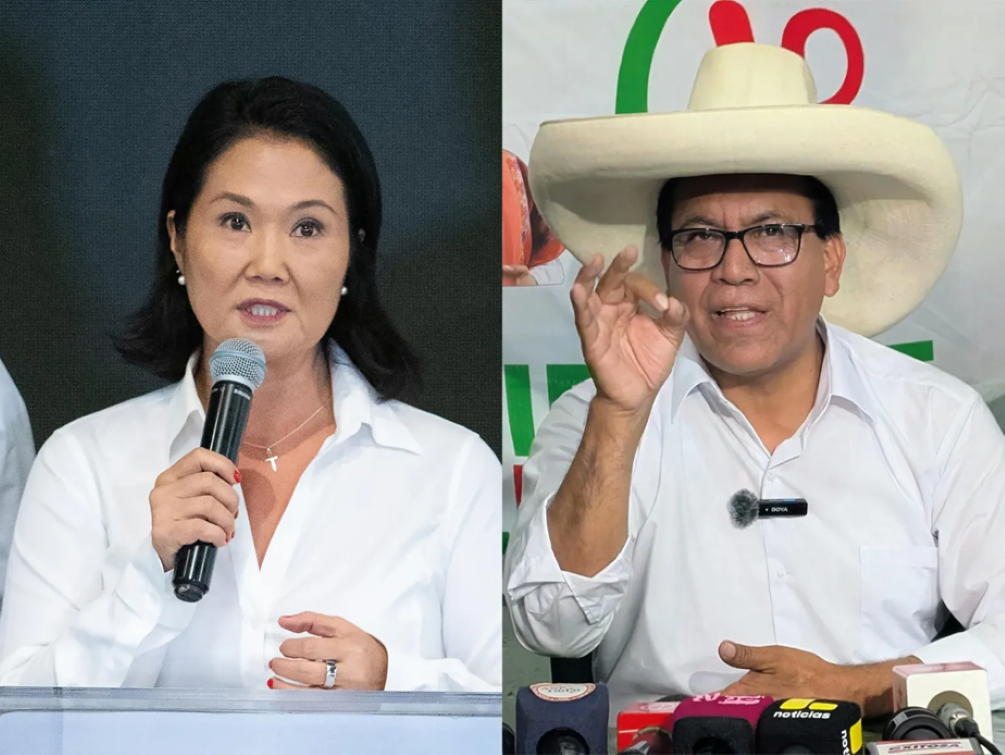
Peru’s June runoff between Keiko Fujimori and Roberto Sánchez exposes a fractured democracy in which blank votes beat every candidate, fraud claims test institutions, and a weary nation must choose again after cycling through eight presidents in one decade.
A Runoff Nobody Fully Owns
Peru has chosen its finalists, but not with the confidence of a country convinced by its options. The National Jury of Elections officially confirmed Sunday that right-wing candidate Keiko Fujimori and left-wing contender Roberto Sánchez will compete in the June 7 presidential runoff, closing the long certification of the April general election and opening another chapter in Peru’s exhausting political drama.
The ceremony, presided over by JNE president Roberto Burneo, gave institutional form to a result the country had waited thirty-three days to see fully settled. The National Office of Electoral Processes had completed the 100 percent vote count on Friday, after weeks of contested ballots, public hearings, and accusations. Fujimori finished first with 17.19 percent, nearly 2.9 million votes. Sánchez came second with 12.03 percent, or 2.01 million votes, barely ahead of far-right candidate Rafael López Aliaga, who took 11.91 percent and 1.99 million votes.
That margin tells the first truth of the election: Peru did not rally. It scattered.
With thirty-five presidential candidates on the ballot, the largest election in the country’s history became a portrait of public distrust. The most revealing number was not Fujimori’s first-place finish or Sánchez’s narrow survival. It was 16.84 percent of ballots cast blank or null, totaling 3.41 million votes. In raw terms, rejection outperformed every individual candidate.
That is not a technical detail. It is a national mood.
The blank and null vote has become Peru’s silent protest, a way for citizens to mark attendance without granting faith. It says the republic still votes, but the political class has not earned the room. It says democracy is alive as a procedure, but wounded as a promise.

The Old Ghosts Return
The runoff is expected to revive the polarization of 2021, when Pedro Castillo defeated Keiko Fujimori and the country entered another spiral of confrontation, investigations, institutional breakdown, and distrust. Fujimori, the daughter and political heir of former president Alberto Fujimori, is seeking the presidency again after losing the previous three elections. Her name carries order and trauma at once, depending on who is speaking and what they survived.
For some Peruvians, Fujimorismo evokes the defeat of insurgency, economic stabilization, and a hard state that many now remember through the lens of rising crime. For others, it means authoritarianism, human rights abuses, corruption, and the shadow of a government that showed how easily an emergency can become a method of rule. Keiko Fujimori’s candidacy, therefore, does not begin from zero. It begins inside a family name that still divides the country like an old scar.
Sánchez arrives from the opposite pole, running as an ally of imprisoned former president Pedro Castillo, the rural teacher whose 2021 victory was read by many as a rebellion of the neglected interior against Lima’s political and economic establishment. Castillo’s presidency later collapsed into crisis, but the social anger that lifted him has not disappeared. It has moved, adapted, and searched for another vehicle.
That is the deeper Peruvian fracture. This election is not simply right against left. It is Lima against the periphery, anti-crime fear against anti-elite resentment, market continuity against demands for redistribution, and institutional fatigue against the temptation to burn everything down. Peru’s politics are often described as unstable, but instability is not the cause. It is the symptom of a country whose economic growth has never built a trusted state.
The data from this vote shows how thin the mandates are. Fujimori’s 17.19 percent and Sánchez’s 12.03 percent together represent less than one-third of the valid political enthusiasm in a first round in which the largest bloc was not a movement but fragmentation. Whoever wins on June 7 will govern a country where most voters did not initially choose them.
That matters in a system already battered by a decade of upheaval and eight presidents. Peru has become a regional case study of how democratic procedures can persist even as legitimacy drains away. Elections are held. Authorities proclaim results. Parties compete. Yet presidents fall, Congress obstructs, protests erupt, and citizens learn to expect another crisis before the last one has fully cooled.

Latin America Watches Lima Again
The geopolitics of Peru’s runoff reach beyond its borders because Peru is not a marginal state in Latin America. It is a mining power, a Pacific economy, a country tied to China, the United States, regional trade, Andean politics, migration routes, and the future of resource governance. Its instability travels through copper, investment, food prices, diplomacy, and the ideological balance of South America.
A Fujimori-Sánchez runoff will be watched by investors, neighboring governments, social movements, mining communities, and foreign capitals because Peru sits at the crossroads of two regional anxieties. One is the fear of disorder, crime, and institutional weakness. The other is the fear that economic models built around extraction have benefited elites while leaving rural and Indigenous regions feeling disposable.
Mining is central to that tension. Peru’s mineral wealth gives it geopolitical weight, especially in a world hungry for copper and critical resources needed for energy transitions. But extraction without legitimacy produces resistance. Communities that see pollution, inequality, and little state presence will not be persuaded by macroeconomic charts forever. In that sense, Peru’s electoral crisis is also a resource politics crisis. Who benefits from the ground beneath the Andes remains one of the country’s oldest unanswered questions.
The delays in the first-round count also matter. More than 5,000 contested ballots were reviewed by sixty special electoral juries, and more than 60,000 disputed voting records were examined. López Aliaga alleged fraud and demanded a new election and audit. However, he did not present conclusive evidence, and his challenge failed. The JNE has argued that the certification timeline was consistent with past elections, noting proclamations on May 13 in May 10, 2011 in 2016, and May 18 in 2021.
That institutional defense is important. In Latin America, where distrust is easily weaponized, electoral authorities must do more than count. They must survive suspicion. Peru’s system took longer than citizens wanted, but speed is not the only measure of credibility. In close elections, the ritual of review can be democracy’s last fragile wall against accusation becoming fact by repetition.
Still, the wall is fragile. The runoff will decide who governs from 2026 to 2031. Still, it will also test whether Peru can produce more than another temporary presidency. The country does not only need a winner. It needs a government capable of building enough trust to last.
Peruvians have already sent their warning through the numbers. The candidates advanced. The public withheld affection. On June 7, the ballot will force a choice. The harder question is whether the next president can convince a tired country that choosing still means something.
Also Read:
El Salvador Rewrites Its Rules as Bukele Locks in Power