Venezuela’s promised 300 prison releases have not quieted families demanding freedom for every political detainee, as deaths in custody, torture allegations, U.S. pressure, and post-Maduro transition politics turn jail gates into the country’s most revealing national democratic test right now.
Freedom Measured in Incomplete Numbers
In Venezuela, a prison gate opening does not always sound like justice. Sometimes it sounds like arithmetic. Three hundred promised releases. More than 8,000 people are reportedly benefiting from an amnesty law, most of them already on parole. The government counted more than 800 releases in January. About 25 political prisoners verified as released by Foro Penal by Wednesday morning. Eight more were reported by the Committee for the Freedom of Political Prisoners from the National Bolivarian Police headquarters in La Yaguara, Caracas.
Numbers move. Families wait.
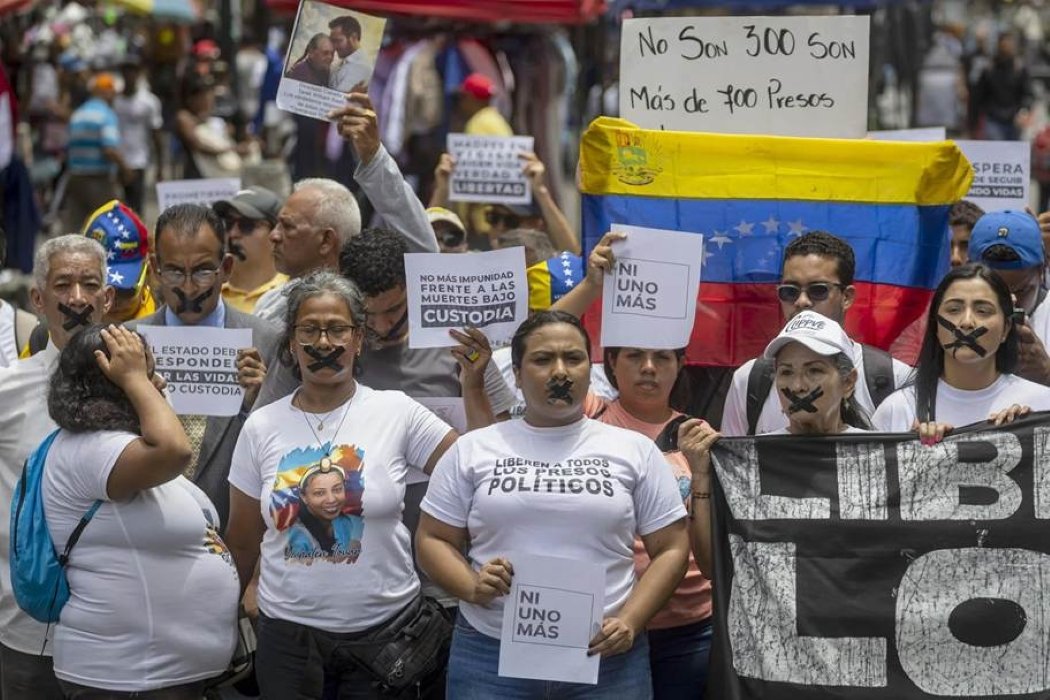
The interim government led by Delcy Rodríguez promised this week to grant 300 prison releases, presenting the move as another sign of Venezuela’s “new political moment” after the U.S. capture of former president Nicolás Maduro. But on Wednesday, relatives of political prisoners and human rights defenders answered with a silent march to the Ministry of Penitentiary Service. Their message was not gratitude. It was an insistence.
“It must be everyone,” protesters shouted at the end of the demonstration, according to interviews and reporting credited to EFE. “Delcy, it’s not 300; the order is that it must be for everyone.”
That sentence contains the fault line of Venezuela’s transition. Partial freedom can save real lives. No one should minimize the meaning of a person leaving prison, hearing a family voice without guards nearby, or sleeping under a familiar roof. But partial freedom can also become a political instrument. It can divide families into the relieved and the still desperate. It can turn rights into favors. It can allow a government to sell mercy while avoiding accountability for why so many people were detained in the first place.
Jorge Rodríguez, president of Parliament, announced Tuesday that 300 people would be released this week as part of a new round of measures. He said the releases would proceed alongside those granted through the February amnesty law, which authorities say has benefited more than 8,000 people. He also noted that the latest round began Monday with the release of a 16-year-old adolescent and Merys Torres de Sequea, 71, mother of Captain Antonio Sequea, sentenced to 24 years for involvement in the failed maritime attack against Maduro’s government in May 2020.
Those details matter because they reveal both the breadth and the ambiguity of the process. Venezuela is not only releasing famous opposition figures. It is touching old files, military cases, minors, elderly relatives, people on parole, and detainees whose names are known only to families and lawyers. The country is not cleaning one wound. It is opening an archive.

The Dead Still Walk in the March
The march to the penitentiary ministry was silent at first, but in Venezuela, silence has never meant emptiness. Many participants covered their mouths with black tape and carried posters with photographs and names of political prisoners. In the center of the protest, they held a cardboard coffin bearing the names of detainees who died under state custody.
The immediate reason was the case of Víctor Hugo Quero Navas, whose death in state custody was reported by the government on May 7 after his mother, Carmen Teresa Navas, had spent 16 months denouncing his disappearance. She died Sunday. Her story gives the crisis its cruelest shape: a mother searched, waited, spoke, and died almost at the same time the state finally acknowledged what had happened to her son.
Because of Quero’s case, relatives called the protest. When they reached the ministry, their chants sharpened: “not one more death,” “close the torture centers,” and “indolent minister, urgent removal.”
“We are denouncing what continues to happen in Venezuela,” Andreína Baduel, a member of CLIPP, told EFE. She said that with Quero, 27 political prisoners have died under state custody since 2014. She warned that none have received true justice.
That figure should stop the country in its tracks. Twenty-seven deaths in custody are not only a human rights statistic. They are an indictment of the state’s power over bodies it has already disarmed. A prison death is never just a prison matter when the detainee is political. It asks whether the state used confinement to punish, break, silence, hide, or dispose of a person.
Aurora Silva, wife of recently released opposition figure Freddy Superlano, told EFE that the objective must be freedom for all, so that detainees leave “those unjust prisons.” Her words point to the moral problem behind the release announcements. The gate opening today cannot erase the cell from yesterday. The prisoner who comes out carries proof of a system that still holds others inside.

Transition Cannot Be a Transaction.
The geopolitical stakes are larger than the prison system. The releases come one week after U.S. President Donald Trump said his government would ensure the release of all Venezuelans imprisoned for political reasons. In post-Maduro Venezuela, shaped by Washington pressure, sanctions relief, diplomatic bargaining, and Delcy Rodríguez’s attempt to stabilize power, political prisoners have become both human beings and a form of negotiating currency.
That is dangerous.
If releases are driven primarily by U.S. pressure, they may save lives while weakening Venezuela’s own democratic legitimacy. If they are driven by government calculation, they may become a spectacle of controlled generosity. If they occur without truth, investigation, reparations, and institutional reform, they risk becoming a revolving door in which the state retains the power to imprison again when politics change.
Latin America knows this pattern. Transitions often begin with gestures: amnesties, releases, renamed ministries, new alliances, softer language. But a true democratic transition requires dismantling the machinery that enabled arbitrary detention. It requires judges who are not obedient, prosecutors who are not weapons, police intelligence structures that do not disappear people, prisons that are not punishment laboratories, and archives that can be opened without fear.
For Venezuela, the issue is also regional. The country’s prison crisis is tied to migration, sanctions diplomacy, energy negotiations, democratic credibility, and the balance of power between Caracas and Washington. A Venezuela that wants investment, recognition, and reintegration into Latin American diplomacy cannot continue treating political freedom as a staged concession. It must prove that rights no longer depend on political timing.
The families outside the ministry understand this better than many diplomats. They are not asking for a public relations reset. They are asking for names, bodies, release orders, medical care, accountability, and an end to the system that made them stand in the street with cardboard coffins.
Three hundred releases may matter. Twenty-five verified releases may matter. Eight names from La Yaguara may matter. But the slogan remains the measure of truth: it must be for everyone.
Until then, every open gate in Venezuela will still cast the shadow of the cells behind it.
Also Read:
Peru Mothers Seek Sons Lost to Russia’s War Machine Abroad