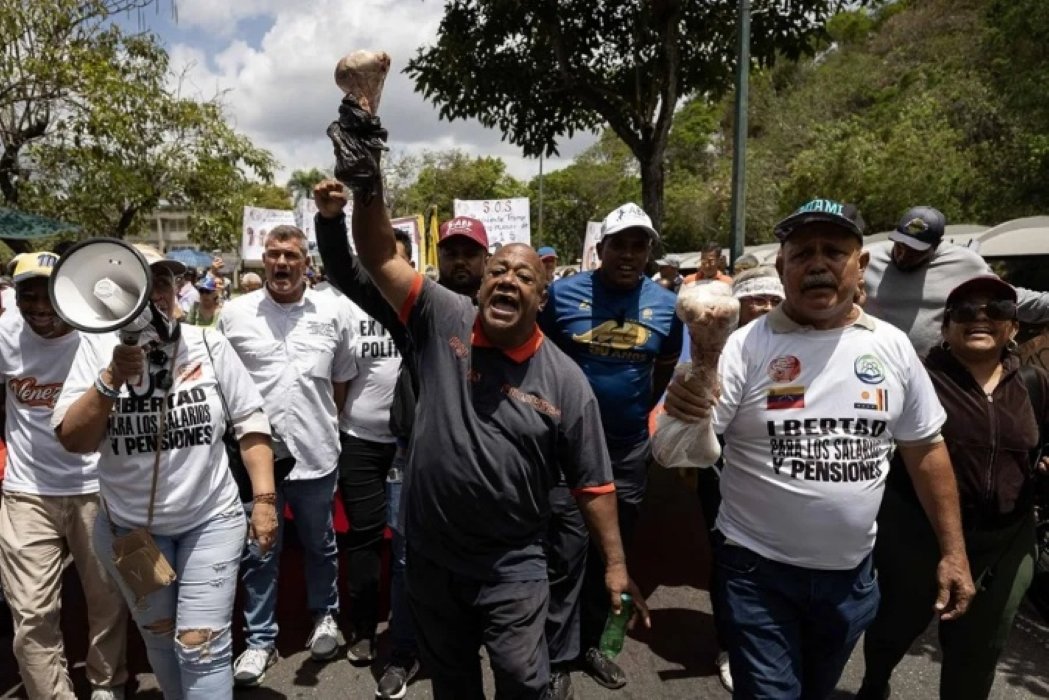
Five months after Maduro’s capture, Venezuelan unions are calling for national protests to demand free elections, the release of political prisoners, water, electricity, and wages, exposing how Delcy Rodríguez’s interim government is buying time while economic normalization advances faster than democracy.
The Street Sets a Deadline
In Venezuela, the calendar has become a battlefield. Not only the street, not only the prison, not only the voting booth that still has no date. The calendar itself. Days are counted like evidence. Ninety days. A possible ninety-day extension. Five months since the U.S. military attack that captured Nicolás Maduro. Thirty days left, union leaders say, before the interim mandate should end.
Representatives of several Venezuelan unions called Thursday for a national protest on June 3, the date marking five months since Maduro’s capture, to demand free elections in a country where transition has become a word used by everyone and defined by almost no one. José Patines, secretary general of the Foreign Ministry union, said after a workers’ assembly at the Central University of Venezuela that demonstrators would take to the streets for free elections, the release of all political prisoners, water, electricity, and basic survival.
The list matters because it refuses to separate democracy from daily life. In Venezuela, the demand for elections is not an abstract institutional slogan. It sits beside blackouts, empty taps, wages replaced by bonuses, and families waiting outside prisons. The ballot is tied to the bulb, the faucet, the salary, the cell door.
Patines also called for a cacerolazo at 8 P.M. local time, a popular protest in which people bang pots and pans. The message, he said, would be directed at interim President Delcy Rodríguez and Parliament President Jorge Rodríguez: “We don’t want you anymore.” He added that from June 3, they would have 30 days before the interim period expires on July 3.
According to Article 234 of Venezuela’s Constitution, temporary or absolute absences of the president are covered by the executive vice president for up to 90 days, extendable by Parliament for the same period. After Maduro’s capture in January, Delcy Rodríguez, then vice president, was sworn in as interim president by order of the Supreme Court. But by the end of the first three months, NGOs, jurists, and opposition parties began questioning the legal basis for her continued mandate and, above all, the absence of an electoral calendar.
That is the core of the crisis. Venezuela is being asked to trust a transition with no visible destination.

Normalization Without the Vote
The government’s defense has been consistent: recovery first, elections later. On March 2, Jorge Rodríguez said it was not urgent to set an election date, though he insisted elections would take place. At the time, he said the priority was the country’s economic recovery.
That phrase has become the ruling coalition’s shield. Venezuela is exhausted enough that recovery sounds persuasive. After years of collapse, sanctions, migration, shortages, institutional decay, repression, and oil-sector ruin, the promise of economic stabilization can quiet many questions. A working electrical grid, a functioning salary, investment, fuel, and food can feel more immediate than electoral theory.
But this is where the danger lies. Four months after January 3, Venezuela does not appear to be moving through a democratic transition so much as through economic normalization without binding political conditions. The sequence is too coherent to ignore: a new agreement with Chevron in the Orinoco Belt, U.S. sanctions openings through OFAC General Licenses 56 and 57, international investor outreach, institutional appointments loyal to Rodríguez, the unilateral termination of the Amnesty Law, and the continued detention of hundreds of political prisoners.
This looks less like improvisation than sequencing. Rodríguez appears to understand the oldest rule of controlled transitions: consolidate first, promise later.
The appointments of Larry Devoe as attorney general and Eglée González Lobato as ombudsman, both aligned with the ruling coalition in different ways, are especially significant. These offices form part of what Venezuela calls Citizen Power, the branch responsible for oversight, prosecution, and the protection of rights. In any real transition, such institutions would shape accountability, investigations, asset recovery, and the legal fate of outgoing power structures. If they are captured before elections are called, they can help protect the system even if a vote eventually happens.
The end of the Amnesty Law shows the same logic. Rodríguez declared it finished on April 23, even though the law reportedly contained no expiration clause. The government had already used it to produce 8,616 releases, but Foro Penal says only 186 were true political prisoners. Ending it now preserves leverage over those still detained, including the 473 political prisoners cited in the broader debate. It also signals that repression remains selective, institutional, and available.
This is why the union chants of “We are not afraid” carry such weight. Some of the demonstrators are former political prisoners. They know the state not as a theory, but as a cell.

Latin America Should Watch the Simulation
For Latin America, Venezuela’s stalled electoral timeline is not only a national issue. It is a regional warning about how authoritarian systems adapt under pressure. The old model relied on direct repression, revolutionary theater, and anti-U.S. language. The new model is more subtle. It may accept investors, negotiate with Washington, release some prisoners, speak of a transition, and still fail to create the conditions that make an election genuinely competitive.
That is the risk of a simulated transition.
The United States has its own contradictions. The appointment of John Barrett as chargé d’affaires in Caracas, replacing Laura Dogu, came with a promise to continue implementing the Trump administration’s three-phase plan: stabilization, recovery, and transition. The problem is that the third phase remains undefined. U.S. Energy Secretary Chris Wright has suggested elections would occur during the Trump administration, meaning any time before January 2029, and that organizing them could require nine to ten months once a coordinated effort begins. That could push a vote into mid-2027 or later.
Time, in politics, is not neutral. Time favors whoever controls institutions, money, courts, media access, security forces, and the calendar. Every week that economic normalization moves forward without public electoral benchmarks, Rodríguez’s position strengthens and outside leverage weakens. By the time foreign governments demand conditions, they may have already spent the tools that could have forced them to comply.
The opposition still has international support. María Corina Machado’s European meetings and Washington’s reception of Dinorah Figuera, head of the 2015 National Assembly, show that anti-government forces remain visible abroad. But visibility is not power unless it changes incentives. Diplomatic language about a “peaceful democratic transition” or a “stable, orderly and consolidated transition” means little without measurable requirements: independent electoral authorities, a fixed election date, full release of political prisoners, and restored political rights.
Venezuela’s crisis also tests the region’s memory. Latin America has seen transitions that were real, negotiated, and staged to preserve the old order under softer names. It has seen military regimes retreat into amnesty. It has seen ruling parties redesign institutions before leaving office. It has seen elections used not to transfer power, but to maintain continuity.
The June 3 protest call is therefore more than a labor action. It is a demand to stop the clock from being manipulated. The unions say a country cannot recover economically while its citizens wait indefinitely for the right to choose. They are saying water and electricity matter, but so does the vote. They are saying salaries matter, but so does freedom from political imprisonment.
If Venezuela’s transition becomes only a market opening, Latin America will inherit a dangerous precedent: economic normalization without democracy, investment without accountability, and stability built on postponed citizenship. The cacerolazo planned for June 3 may sound like metal-on-metal. But politically, it is something sharper: a country trying to remind its rulers that the calendar belongs to the people, too.
Also Read:
Venezuela Prison Releases Expose Freedom’s Price After Maduro’s Sudden Fall