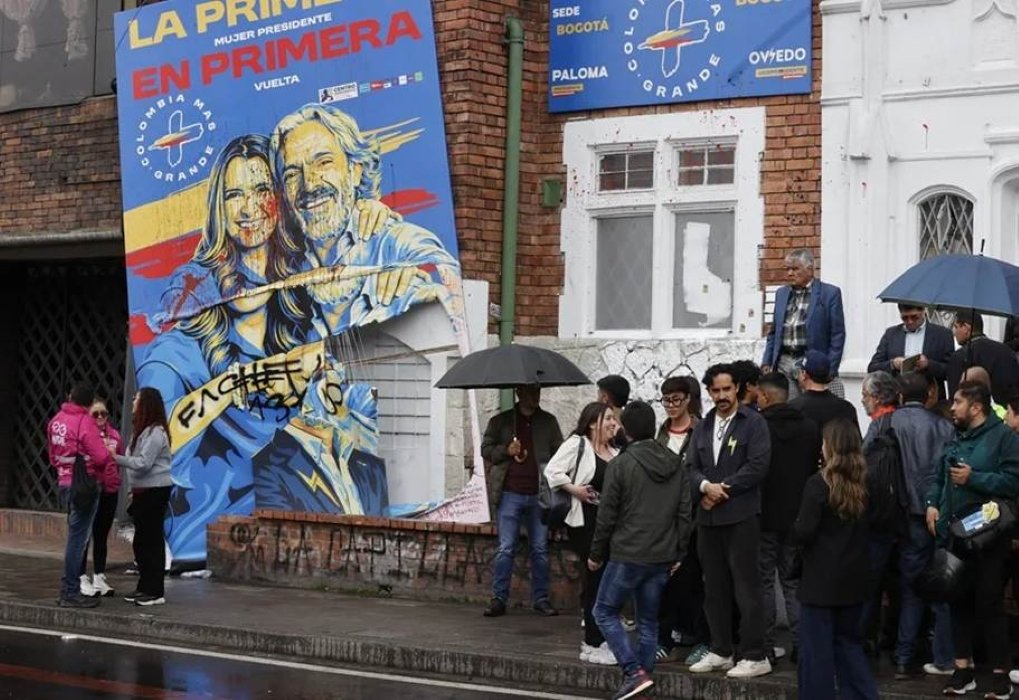
Vandalism at Paloma Valencia’s Bogotá campaign headquarters exposes a tense Colombian election where security fears, right-wing fragmentation, AI politics, Petro’s constitutional ambitions, and the memory of Miguel Uribe’s assassination converge before voters choose on May 31 under heavy national pressure.
A Campaign Office Becomes a Warning
The broken glass in Chapinero was not only broken glass. In the final stretch of Colombia’s presidential campaign, the vandalized headquarters of Paloma Valencia, the right-wing Centro Democrático candidate, became a small but revealing theater of the country’s deeper anxiety: politics is no longer merely polarized. It is becoming physically exposed.
Valencia’s campaign office in Bogotá was attacked on Thursday by a group of hooded young people protesting along one of the capital’s main avenues. The headquarters was left with graffiti, shattered windows, paint thrown from the street, and torn campaign material. Some of the masked protesters pulled down a campaign poster after crossing out the face of Juan Daniel Oviedo, Valencia’s vice-presidential running mate, according to campaign accounts included in the reporting.
Bogotá Government Secretary Gustavo Quintero condemned the episode on X, saying an isolated group had used violence unjustifiably and even attacked city dialogue and coexistence teams working on the ground. Valencia’s campaign called the attack unacceptable, saying the assailants entered the site to graffiti the installations, steal elements from the facade, and endanger people inside the office. The campaign also linked the incident to vandalism two days earlier near the residence of former President Álvaro Uribe in Rionegro, near Medellín, and asked authorities to investigate, identify those responsible, and guarantee security for all political actors before the May thirty-first election.
That demand is not routine. Colombia has learned, again and again, that political violence rarely begins with the most dramatic act. It begins with permission. A poster was ripped down. A face crossed out. A campaign office marked as enemy territory. A rumor of a threat. A bodyguard added. A candidate changing a route. A rally is becoming a risk calculation.
The country enters this election carrying the memory of Senator Miguel Uribe Turbay, a Centro Democrático presidential hopeful, who was shot at a campaign event in Bogotá’s Modelia neighborhood on June 7 last year. He died two months later. Valencia has invoked his case directly, saying she is not asking for pity but promising to lead a security agenda so Colombia can live without fear.

The Right Fights Itself While Cepeda Leads
The attack on Valencia’s headquarters landed inside a race already strained by a strange imbalance. Iván Cepeda, the left-wing senator running with the Pacto Histórico coalition of President Gustavo Petro, leads major polls. But the conservative vote is divided between Valencia and ultraright candidate Abelardo de la Espriella, the controversial lawyer known as “the Tiger.” Valencia sits around third in voting intention, behind Cepeda and De la Espriella.
That split may decide the election more than any single campaign speech. The first round is unlikely to be won outright because candidates need more than 50 percent to avoid a June twenty-first runoff, and Cepeda remains below that threshold in several polls. The race, then, is partly a contest to determine which opponent the left will face in round two: Valencia, the uribista heir with institutional experience and lower rejection, or De la Espriella, the outsider-styled hardliner whose aggressive security message may excite the right but frighten the center.
The tension between them has become increasingly public. De la Espriella accused Valencia of avoiding an open debate and dismissed her campaign as “little games,” presenting himself as someone outside the political establishment. Valencia, however, carries both the strength and burden of Centro Democrático, founded by Álvaro Uribe, the central conservative figure of modern Colombian politics and Cepeda’s historical adversary.
That is why the vandalism cannot be read as an attack on a single office. It becomes symbolic fuel for the right’s larger argument that opposition forces lack guarantees in Colombia. It also allows Valencia to reinforce her campaign’s core message: security, order, and resistance to intimidation. Yet the same incident may deepen the emotional spiral that makes sober debate harder.
Valencia has already alleged that a FARC dissident front planned to assassinate her, saying she was told a narcoterrorist group had put a price on her head. She claimed the alleged plot involved the FARC’s Front Forty-Two and a figure known as Buchetula, with a payment of 2 billion pesos, about 560,000 dollars. President Gustavo Petro rejected that version, saying intelligence indicated the supposed attack was not real but rather a dispute between criminals. Defense Minister Pedro Sánchez Suárez also said intelligence work ruled out a threat against Valencia tied to the FARC structure or the individual mentioned, while insisting security protection for candidates remained active.
In a healthy democracy, such claims would be processed through institutions trusted by all sides. Colombia no longer has that luxury. Every denial can be read as a form of minimization. Every warning can be read as campaign theater. Every security briefing becomes political material.

A Ballot Under Regional Pressure
For Latin America, Colombia’s election matters because it sits at the intersection of nearly every regional fracture: crime, coca production, armed dissidents, democratic fatigue, social spending, security populism, constitutional reform, and the future of the left after Petro. If Colombia tilts too far into fear, it could join the wider Latin American swing toward hardline security politics. If it dismisses fear too easily, it risks appearing indifferent to citizens living under extortion, attacks, and armed control.
Cepeda’s advantage depends partly on Petro’s political machinery and the government’s spending push. Observers have noted record levels of expenditure, a 24 percent minimum wage increase, and a surge in public-sector job creation. Between March 2025 and March 2026, 650,000 new jobs were created, including 369,000 in public service sectors such as education, health care, and administration. That is not a small detail. It means the election is unfolding with the state itself playing a powerful economic role in voters’ lives.
But Cepeda also carries vulnerabilities. He supports Petro’s “total peace” policy at a time when public opinion is hardening after attacks such as the killing of 20 civilians in Cauca in late April. He has backed Petro’s push for a Constitutional Assembly, which the president said he would present by July 20 when the new Congress convenes. Other candidates reject the idea, making it one of the campaign’s most explosive institutional questions.
In Colombia, constitutional change is never just legal architecture. It is a struggle over who gets to refound the republic, under what mandate, and with which safeguards. In a country with armed groups still active and public trust fragile, the proposal could either be sold as democratic renewal or feared as a route to political overreach.
That is why the vandalized office matters. It appears at the exact point where Colombia’s election is narrowing into an emotionally dangerous shape: left versus right, dove versus tiger, Uribe versus Petro, security versus peace, establishment versus outsider, reform versus fear. The next president will take office on August 7 with little room for error and a region watching closely.
Colombia does not need a campaign of broken windows and crossed-out faces. It needs a campaign capable of facing the country’s hardest questions without turning opponents into targets. The office in Chapinero can be repaired. The harder task is repairing the democratic floor beneath it.
Also Read:
El Salvador Rewrites Its Rules as Bukele Locks in Power