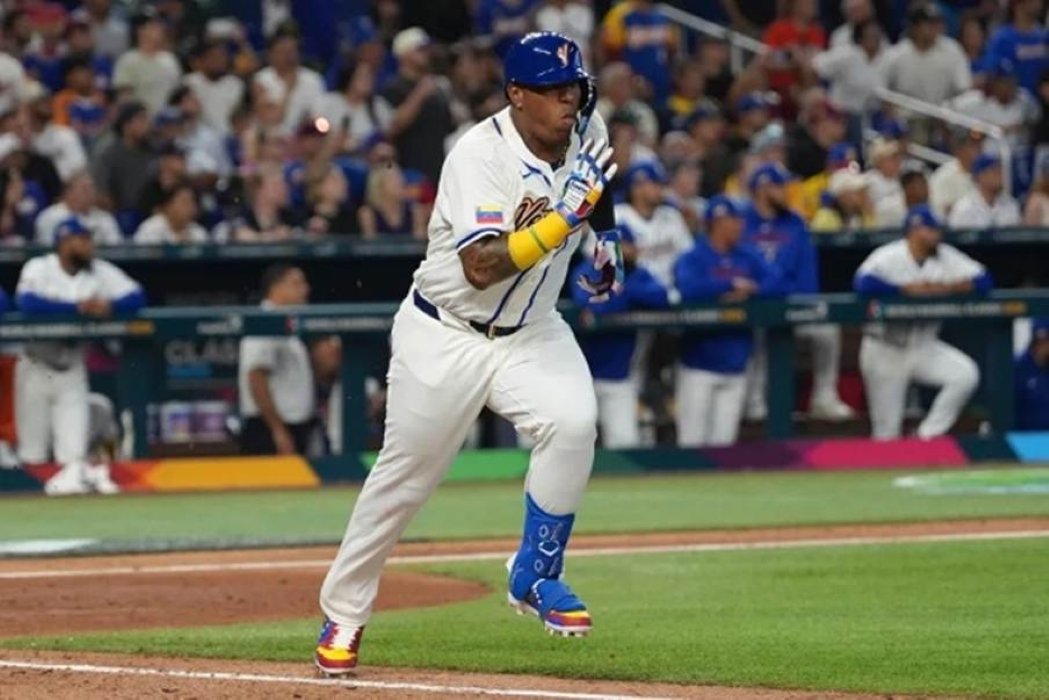
Salvador Pérez’s 311th home run ties Iván Rodríguez for the most by a Latino catcher in MLB history, turning one Venezuelan swing into a story about legacy, Kansas City pressure, and Latin America’s lasting baseball power.
A Swing Into Two Histories
The pitch did not need to be violent to become historic. A knuckle-curve drifted over the plate at 77 miles per hour, and Salvador Pérez sent it 393 feet into the left-field seats. It looked easy, almost casual, the kind of swing that hides the years behind it: the knees, the crouch, the foul tips, the innings caught, the long summers, the responsibility of carrying a franchise and a country’s baseball pride on the same back.
With that home run, the Venezuelan catcher reached 311 for his Major League Baseball career, tying Puerto Rican legend Iván Rodríguez as the Latino catcher with the most home runs in the history of the majors. The blast was also his eighth of the 2026 season, leaving “Salvy” one swing away from owning the record alone, one swing away from passing a Hall of Fame figure whose name once made the mark feel untouchable.
The comparison gives the achievement its weight. Rodríguez reached 311 home runs across 21 big-league seasons. Pérez reached the same number in his fifteenth. That does not diminish Rodríguez, one of the greatest catchers ever to wear the gear. It shows how unusual Pérez has become: a catcher with durability, power, leadership, and a long offensive peak in a position that usually consumes bodies before it allows monuments.
The home run came against the Boston Red Sox, and Pérez finished the day 3-for-4 with a run scored and an RBI, again carrying much of the Kansas City Royals’ offensive burden. That context matters. This was not a ceremonial milestone produced in isolation. It happened during a team problem. Kansas City has needed run production desperately, and Pérez, even when his offensive line looks modest, remains one of the hitters most responsible for making the lineup breathe.

Kansas City Needs More Than Memory
The Royals’ season has carried a difficult contradiction. Pérez is chasing immortality while Kansas City searches for rhythm. The team’s middle of the order has struggled, with the cleanup spot and the No. 3 spot ranking near the bottom of the American League in production. Pérez has occupied the cleanup role in all but a few games, while Vinnie Pasquantino has carried the No. 3 spot in most of the schedule.
The numbers reveal pressure more than simple failure. Pérez and Pasquantino have each stepped to the plate with runners in scoring position about 60 times, tied among the highest totals in the American League. They have at least 25 percent more run-producing opportunities than any other Royals hitters. That is what happens when they bat behind Bobby Witt Jr., one of the league’s most active hit producers. Kansas City’s problem is not finding chances. It is converting them.
That makes Pérez’s milestone feel double-edged. The record says permanence. The lineup says urgency. A catcher can be a franchise icon, a World Series hero, a nine-time All-Star, a five-time Silver Slugger, a Gold Glove winner, and still be asked what he can do tonight with a man on second and one out. Baseball has no respect for yesterday when the season is sliding away.
There has been debate around whether Kansas City should change the middle of the order, perhaps moving hotter bats behind Witt and giving Pérez and Pasquantino a less suffocating assignment. The counterargument is practical. The Royals are not overflowing with power options. For the lineup to become truly dangerous, Pérez and Pasquantino likely need to be part of the solution, whether they hit third, fourth, or somewhere else.
Still, the discussion shows how sports history is lived in real time. Legacy is not a museum. It happens while a player is slumping, adjusting, aging, carrying expectations, and trying to slow the game down. Pérez’s bat may not look as quick as it once did every night, but the power remains. And in a season defined by missed chances, one swing can still feel like a reminder of what made him indispensable.

Latin America’s Catcher Keeps Climbing
For Venezuela, Pérez’s climb sits inside a larger national baseball story. He continues to rise among the country’s all-time home run leaders. Miguel Cabrera remains far ahead with 511. Andrés Galarraga follows with 399. Eugenio Suárez, currently on the injured list, has 328. Magglio Ordóñez finished with 294. Pérez is now in that sacred Venezuelan register, a list built by hitters who carried the country into ballparks across North America and made Spanish surnames part of MLB’s power vocabulary.
His best home run season came in 2021, when he hit 48 in 161 games and tied the Royals’ single-season franchise record. In 2025, he showed his power had not disappeared, hitting 30 home runs, the second-highest total of his career. Now, with 311, he stands just seven behind George Brett’s Royals franchise record of 317. Brett’s mark has lived for decades as part of Kansas City scripture. Pérez is close enough to touch it.
If he keeps his recent pace, he could claim both records before the end of 2026: most home runs by a Latino catcher in MLB history and most home runs by any player in Royals history. One belongs to Latin American baseball memory. The other belongs to the city that watched him grow from a young catcher to a captain.
That dual belonging is the heart of the story. Pérez is Venezuelan and Royal, Caribbean and Midwestern, a product of Latin America’s baseball factory and the face of a Kansas City franchise. His career shows how Latin American athletes often serve as cultural bridges without ever having to announce themselves as diplomats. They carry accent, discipline, family, country, and local loyalty into a league that has long depended on Latin talent while not always understanding its full cultural weight.
For Latin America, Pérez’s record chase is more than a sports note. Baseball remains one of the region’s strongest forms of soft power, especially in Venezuela, the Dominican Republic, Puerto Rico, Cuba, Mexico, Colombia, and Panama. At a time when Venezuela is often reduced in international headlines to crisis, migration, sanctions, oil, blackouts, and political uncertainty, Pérez offers another image: endurance, excellence, humor, leadership, and the slow accumulation of greatness.
That does not erase the country’s pain. It does something different. It reminds the world that nations are never only their governments or emergencies. They are also their catchers, their songs, their food, their mothers watching late games, their children copying batting stances in dusty fields, their flags tucked into stadium seats far from home.
Salvador Pérez is one home run from passing Iván Rodríguez and seven from passing George Brett. But the deeper record is already visible. He has turned the most punishing position in baseball into a stage for Venezuelan permanence. And with every swing, he keeps proving that legacy can be built from crouch, bruise, patience, and thunder.
Also Read:
Brazilian King Pelé Returns to Guadalajara as World Cup Memory