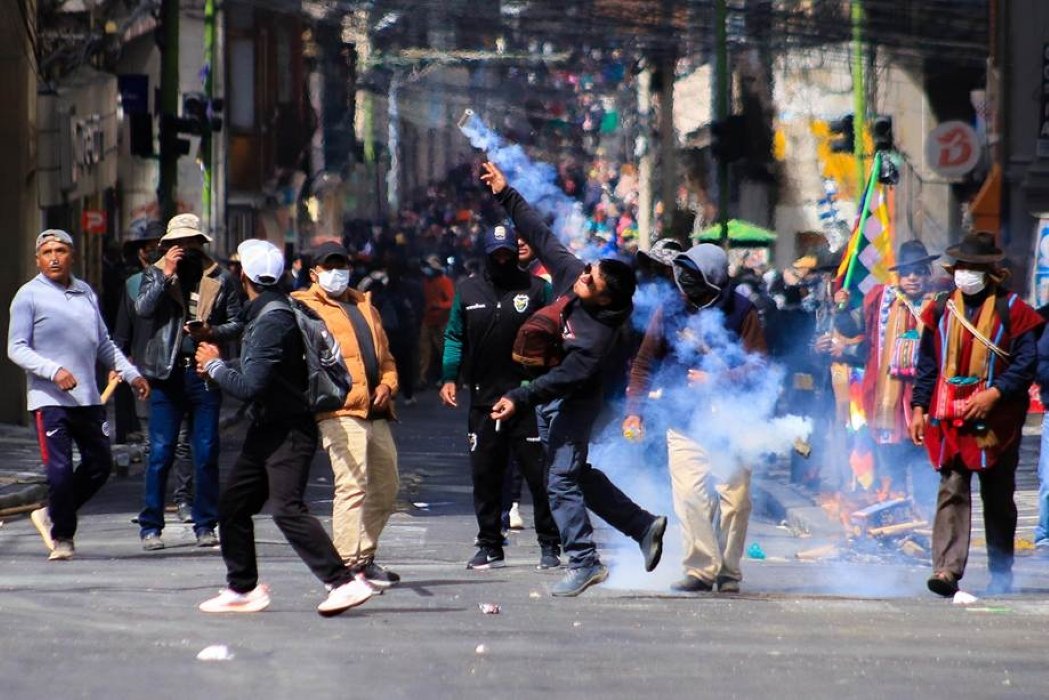
Bolivia’s widening roadblock crisis has stranded trucks, raised food prices, and exposed Rodrigo Paz’s fragile authority, as Aymara campesinos, unions, Evo Morales loyalists, and U.S. aid reshape the geopolitics of Andean unrest for Latin America today and beyond its borders.
A Nation Cut Across Its Arteries
Bolivia woke on Sunday with its roads turned into political borders. Fifty-nine blockades had been installed across six of the country’s nine regions, mostly in the Andean zone, after a second police and military operation failed to clear a strategic highway occupied for 19 days by campesinos demanding the resignation of President Rodrigo Paz, according to reports and interviews credited to EFE.
The Bolivian Highway Administration published a map showing cuts in La Paz, Oruro, Potosí, Chuquisaca, Cochabamba, and Santa Cruz. Only the Amazonian departments of Beni and Pando, and the southern department of Tarija, remained without roadblocks. On paper, it was a logistics crisis. In practice, it was a national X-ray.
Bolivia is a country where roads are not just roads. They are lifelines through altitude, valleys, mines, markets, borders, and capital. Block a highway in the altiplano, and the pressure travels fast. Food becomes expensive. Fuel becomes uncertain. Hospitals begin calculating stock. Truck drivers sleep beside cargo that no longer moves. Families in La Paz and El Alto feel politics arrive not as speeches, but as shortages.
The failed operation had a name that sounded almost ceremonial: “Humanitarian corridor with white flags.” Its purpose was to open the 227-kilometer highway between La Paz and Oruro, free hundreds of stranded trucks, and allow food, fuel, and medical supplies into some of the country’s most pressured cities. But the convoy met resistance. Protesters confronted police and soldiers with dynamite charges and stones launched by slings. After tractors helped clear parts of the route, campesinos returned and once again filled the road with rocks, dirt, and logs.
The image is old and new at once. In Bolivia, the roadblock has long been a language of popular power. It is the parliament of those who feel unheard. It says: if the state will not listen, the country will stop moving.

Dialogue Meets Dynamite
Public Works Minister Mauricio Zamora said the operation stopped halfway after demonstrators ambushed the caravan with dynamite and stones. His own convoy had to return to La Paz by alternate roads, arriving around 2 A.M. after what his office described as three ambushes. In one, stones smashed the rear window of his vehicle.
“Ya me encuentro en La Paz, después de esta tercera emboscada en mi contra,” Zamora said, adding that he had managed to pass and reach the city around two in the morning. Earlier, speaking from an alternate dirt road after losing phone contact in areas with no signal, he told Red Uno that the convoy had been trapped, unable to move forward or back. He said the decision to retreat was made to protect Bolivian lives.
That sentence captures the government’s dilemma. Paz says he wants dialogue. Zamora said he was willing to speak personally with protesters at every blockade point. But dialogue escorted by police, soldiers, tractors, and tear gas already arrives under suspicion. To the state, the corridor was humanitarian. To protesters, it looked like force.
The crisis began earlier this month over wage demands, fuel shortages, poor fuel quality, and rejection of reforms. It has since hardened into a demand for Paz’s resignation, pushed by Aymara campesinos from the highlands, the Central Obrera Boliviana, and sectors aligned with former President Evo Morales. Paz has been in office just over six months. Already, he faces the kind of pressure that has broken Bolivian governments before.
He has promised to make every effort to engage in dialogue. But he has also warned that “everything has a limit” and noted that the Constitution allows measures such as a state of exception. In Bolivia, that phrase does not fall lightly. It touches memories of repression, uprisings, military interventions, and governments caught between street legitimacy and formal authority.
The presidency’s spokesman, José Luis Gálvez, also denounced what he called a campaign of “fake news” meant to provoke public anger, especially in the provinces, including reports of alleged deaths during the operation. He said only tear gas was used and claimed many accounts spreading such content were outside Bolivia, part of a destabilizing scheme to break constitutional order.
That may be true in part. Digital manipulation has become a regional weapon. But governments in crisis often reach for the language of destabilization when anger also has local roots. In Bolivia, those roots are not imaginary. They run through fuel, wages, Indigenous power, regional grievance, and the still-unresolved shadow of Morales.

An Andean Crisis with Foreign Echoes
The United States has now entered the scene, providing food assistance, medical supplies, and logistical support to the Paz government. The State Department’s Western Hemisphere office said Donald Trump’s administration is backing La Paz as it confronts shortages, incidents, and roadblocks.
This support may help ease pressure in La Paz and El Alto. It may also complicate the politics of the crisis. In the Andean highlands, U.S. assistance can be framed by opponents as interference, especially when protesters include sectors loyal to Morales, whose political identity was built partly on anti-U.S. nationalism and Indigenous sovereignty.
For Latin America, Bolivia’s crisis is a warning about the fragile balance between democracy, scarcity, protest, and foreign backing. A government may be constitutionally legitimate and still lose control of the road. A protest may express real hardship and still create humanitarian damage. International aid may alleviate shortages while still feeding narratives of dependency.
The country’s geography heightens the stakes. The La Paz-Oruro route connects to corridors toward Chile, Peru, the center, and the east. Bolivia’s landlocked economy depends on movement. Its lithium ambitions, mining routes, agricultural flows, fuel supply, and urban food networks all rely on roads that can become bargaining chips overnight.
This is why the blockades matter beyond Bolivia. Across Latin America, states are confronting the same painful equation: social demands intensified by economic strain, political systems weakened by mistrust, and protest movements capable of paralyzing infrastructure faster than governments can rebuild legitimacy. Peru has seen it. Ecuador has seen it. Colombia has seen it. Bolivia knows it almost by instinct.
The question now is whether Paz can avoid turning a logistical crisis into a legitimacy crisis. A state of exception might reopen roads, but it could also deepen rupture. Endless dialogue without results could make the government look powerless. Protesters, meanwhile, risk losing sympathy if shortages punish the very public they claim to defend.
For now, the highways speak louder than the palace. They say Bolivia is not merely blocked. It is divided over who has the right to move the country forward, and who can stop it when they believe the road no longer belongs to them.
Also Read:
Mexico Drowns in Trash as Circular Economy Test Begins Now