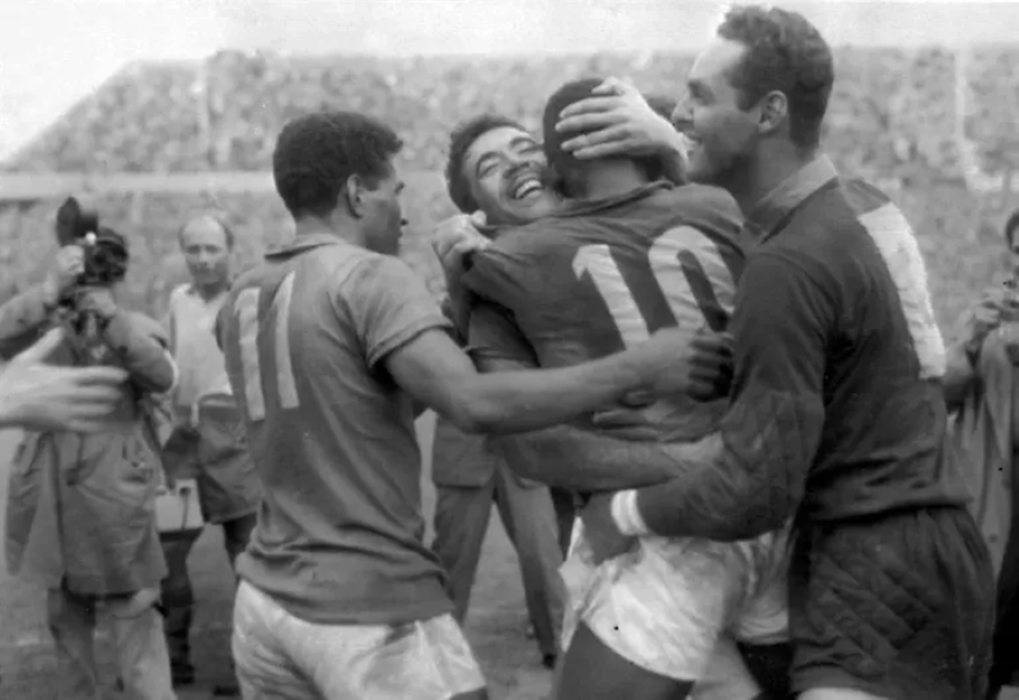
Brazil and Germany’s shared eighteen-match World Cup scoring streak will survive 2026. Still, the record says more than statistics, revealing how football power, memory, expansion, and Latin America’s attacking mythology still shape the tournament’s deepest imagination.
A Record That Refuses to Fall
Some World Cup records live in plain sight, celebrated every four years with slow-motion goals and golden boots. Others hide inside the tournament’s bloodstream, waiting for someone to notice their stubbornness. Brazil and Germany, the two most successful and most frequent powers in World Cup history, share one of those records: eighteen consecutive matches scoring at least once.
It is a strangely elegant number. Eighteen games. Eighteen ruptures of the net. Eighteen moments in which a defense, however organized, could not hold. For countries whose football identities are often reduced to style, Brazil as beauty and Germany as machinery, the shared record becomes a bridge between two different mythologies. One did it with samba, improvisation, and invention. The other with structure, pressure, and repetition. The result was the same: the ball crossed the line again and again.
The mark will not fall in 2026. Argentina, the reigning world champion, enters the North American tournament with the longest active scoring streak, nine consecutive World Cup matches with at least one goal. That run includes its final two games in Russia 2018 and all seven matches in Qatar 2022. Even if Lionel Scaloni’s team reaches the final in the expanded 2026 format and scores in all eight matches, Argentina would finish in 17th place, still one short of Brazil and Germany.
That mathematical fact gives the old record fresh life. It says the past is not as easy to outrun as modern football sometimes pretends. Expanded tournaments, deeper squads, sports science, video analysis, and globalized academies have changed the game. However, the ghosts of older World Cups still hold ground.
The Brazil streak began with the country’s first match in World Cup history, at the 1930 World Cup, and lasted through the 1954 World Cup. It ended only with a dull 0-0 draw against England in the group stage of the 1958 World Cup, the very tournament where a teenage Pelé would soon help turn Brazil into football’s eternal theater. Germany reached the same eighteen-game mark twice: first from Italy 1934 to its opening match in Chile 1962, halted by a scoreless draw against Italy, and again from Mexico 1986 to France 1998, ending shockingly in a 3-0 quarterfinal defeat against Croatia.

The Net as National Memory
A scoring streak is not only an offensive statistic. It is a record of continuity. It tells us that for long stretches of World Cup history, Brazil and Germany could be wounded, pressured, surprised, even beaten, but rarely silenced.
For Brazil, that matters because goals are tied to national self-image. The Seleção is not merely expected to win. It is expected to reveal something. From Leônidas to Pelé, from Jairzinho to Rivaldo, from Ronaldo to Neymar, Brazil’s World Cup identity has been built on the idea that scoring is not only a result, but a public art. The country’s eighteen-match streak began before the myth was fully formed, but it helped prepare the ground for it.
Germany’s streaks speak differently. They are monuments to persistence. German teams have not always been loved by neutrals, but they have often been feared for one reason above all: they keep finding a way into the game. A German goal can feel less like lightning than weather. It arrives because pressure accumulates. It arrives because systems bend probability.
That is why the shared record is so revealing. World Cups are usually remembered through single images: Pelé lifted by fans, Maradona facing Belgian defenders, Baggio with hands on his hips, Zidane walking past the trophy, Messi holding the cup in Qatar. But streaks belong to deeper time. They show institutional football culture, not just individual genius.
The individual streaks add another layer. France’s Just Fontaine in Sweden 1958 and Brazil’s Jairzinho in Mexico 1970 both scored in all six matches they played in their tournaments. That record is mathematically vulnerable in 2026 because the new format allows a champion to play up to 8 matches. Lionel Messi currently holds a four-game scoring streak after goals against Australia, the Netherlands, Croatia, and France in Qatar 2022. Kylian Mbappé, Erling Haaland (if Norway qualifies), and other elite attackers will chase their own version of immortality.
But the collective mark remains safer. It takes not just one hot striker, but generations of attacking reliability. It requires tournaments, squads, coaches, injuries, tactical shifts, political eras, and pressure moments all lining up across years. That is why eighteen still feels heavy.

Latin America’s Claim on the Game
For Latin America, the record carries greater significance. The World Cup was born in Uruguay, shaped by Brazil’s global beauty, haunted by Argentina’s genius, and enriched by players from Peru, Colombia, Chile, Mexico, Paraguay, Ecuador, and beyond. Yet football power has never been evenly distributed. European wealth, club infrastructure, and modern tactical systems have increasingly shaped the global game.
Still, Latin America keeps returning to memory. Brazil’s half of the record is not merely Brazilian property. It fits into a broader continental argument that football from the Global South has always been more than entertainment. It is cultural diplomacy, class mobility, racial history, street intelligence, and national storytelling compressed into ninety minutes.
The presence of names like Jairzinho, Rivaldo, James Rodríguez, Teófilo Cubillas, Leônidas, and Eusébio in the scoring-streak conversation reminds us that the World Cup’s attacking mythology was never built only in Europe. James Rodríguez’s 2014 run, including his famous strike against Uruguay, gave Colombia a brief but unforgettable place in that lineage. Cubillas did the same for Peru. Eusébio, born in Mozambique and playing for Portugal, complicates the map even further, showing how colonial histories moved bodies and talent into European shirts.
The 2026 expansion to forty-eight teams will test what this legacy means now. More countries will enter. More attackers will have more games. More records will become vulnerable. But expansion also risks turning scarcity into spectacle. The older World Cups were cruel because they offered fewer chances. That cruelty created pressure. Pressure created memory.
Brazil and Germany’s records survive precisely because they were built under older constraints. No eight-match path. No expanded field. No safety net for giants who start slowly. To score for eighteen straight games across those eras was to impose yourself on the tournament’s imagination.
In the end, the record is less about domination than presence. Brazil and Germany kept scoring goals. Argentina may continue its chase. France may threaten through Mbappé. New powers may rise from the expanded field. But until at least 2030, the old double crown remains untouched.
The net remembers. So does Latin America. And in World Cup history, memory often defends its records better than any goalkeeper.
* This is an adapted version from EFE’s “A 18 días del Mundial 2026: El registro goleador de Brasil y Alemania que permanecerá inalcanzable” by EFE writer Juan David Mosos: https://efe.com/deportes/2026-05-24/18-dias-copa-mundial-futbol-2026-rachas-goles-consecutivos-selecciones-jugadores/
Also Read:
Brazilian King Pelé Returns to Guadalajara as World Cup Memory