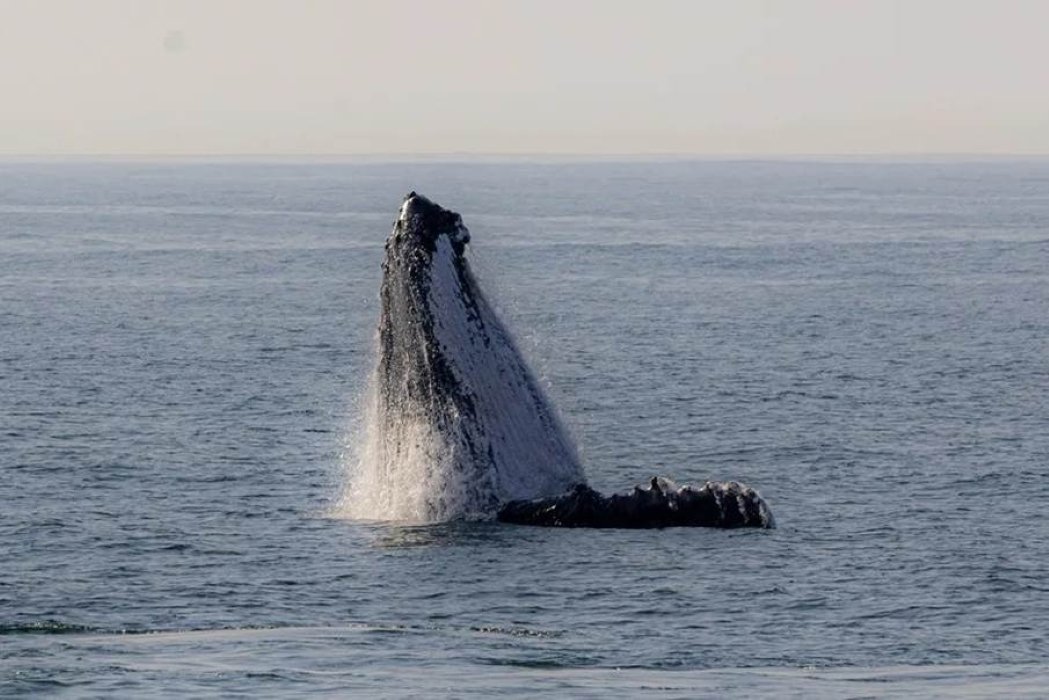
Two humpback whales crossed more than 14,000 kilometers between breeding grounds in Australia and Brazil, a rare discovery that turns citizen photography, climate uncertainty, genetic exchange, and Latin American marine science into a new map of ocean change.
A Migration That Should Not Happen
The whale does not carry a passport, but its tail remembers. Underneath each humpback’s fluke, there is a pattern of pigmentation and scars so distinct that scientists compare it to a fingerprint. In that dark-and-white code, researchers have now found one of the most astonishing ocean journeys ever documented: two humpback whales moving more than 14,000 kilometers across open sea between breeding areas in eastern Australia and Brazil.
Ecuadorian biologist Cristina Castro, of Pacific Whale Foundation Ecuador, told EFE the finding is “a unique sighting in the world.” Castro, who has spent more than 27 years studying whales and dolphins, led the study with Australian researcher Stephanie Stack of Griffith University, alongside scientists from Australia, Brazil, Ecuador, and the United States. Their work points to a mystery that is both beautiful and unsettling: animals famous for loyalty to their breeding grounds are breaking the map.
“These two animals should migrate toward their feeding areas and return to their breeding areas,” Castro explained to EFE. Instead, they moved from a breeding area in Australia toward two different breeding points in Brazil. That is not normal whale behavior. It is not a simple detour. It is a biological question written across the planet.
The whales carried no tracking devices. No satellite tag told researchers where they went. The discovery came through Happywhale, a global platform that uses algorithms to compare thousands of whale-tail photographs taken around the world. In this case, the study analyzed 19,283 images collected between 1984 and 2025 in eastern Australia and Brazil, contributed by scientists, collaborators, and ordinary observers.
That detail matters almost as much as the migration itself. A tourist photo, a researcher’s catalog, a boat trip, and a camera pointed at the right second all became part of a scientific archive. “It is impressive how citizen science, the usual tourist, can support these scientific research processes,” Castro told EFE, noting that each photograph expands knowledge of whale biology and, in this case, helped reveal “one of the most extraordinary movements ever recorded.”

The Ocean Is Changing Its Memory
One whale was first photographed in Hervey Bay, Australia, in 2007, seen there again in 2013, and later identified off the coast of São Paulo, Brazil, in 2019. Those breeding areas are separated by roughly 14,200 kilometers in a straight line, about the distance between Sydney and London. The second whale was first photographed in 2003 at Abrolhos Bank, Brazil’s main humpback breeding and nursery area off the coast of Bahia, alongside nine adults. Twenty-two years later, it appeared in Hervey Bay. Those sighting points are separated by about 15,100 kilometers.
The numbers are almost too large to feel intimate, but the intimacy is the point. These are not abstract dots on a map. They are individual animals, recognized by their tails, moving between oceans in ways that challenge what scientists thought they knew about fidelity, migration, and population boundaries.
Humpback whales are usually highly faithful to their breeding areas. That is why the record is considered extremely rare. Castro said the cases represent only about 0.01 percent of registered individuals. Yet rarity does not mean irrelevance. In evolutionary terms, unusual movements can matter. A whale that crosses between distant breeding populations may carry genes, behavior, and even songs from one oceanic community to another.
That possibility gives the finding a deeper meaning. Whale songs are not only sounds. They are learned cultural patterns. They travel, change, and spread. Movement between far-apart breeding regions could help transmit songs across populations, while also supporting genetic diversity. In a warming and disrupted world, that kind of exchange could help long-term population health.
But the discovery also raises a darker question. Why are they moving this way?
“Something is happening in the world with climate change,” Castro told EFE. “Possibly, the distribution of food, we do not know why they are moving in this way.” She also noted that in 2025, a humpback migration was recorded from Colombia to Africa, covering about 13,000 kilometers.
The pattern may be rare, but the timing feels significant. Marine ecosystems are being altered by warming waters, shifting prey, acidification, shipping pressure, plastic pollution, noise, and changing currents. Whales follow food, temperature, memory, instinct, and ancient routes. If those routes begin to bend, it may be because the ocean itself is changing the instructions.

Latin America Enters the Whale Map
For Latin America, the finding is more than a marine biology curiosity. It places Ecuadorian and Brazilian science at the center of a planetary climate question. It also shows that the South Atlantic, the Pacific coast, and the Southern Ocean cannot be treated as separate ecological theaters. The whales are stitching them together.
The study supports the Southern Ocean Exchange hypothesis, which proposes that humpbacks from different breeding populations occasionally coincide in shared Antarctic feeding areas. If true, Antarctica becomes not only a feeding ground but a meeting zone. In these vast cold commons, populations from different ocean basins may cross paths before returning, or sometimes not returning, to expected breeding sites.
That matters geopolitically because ocean conservation is increasingly about corridors rather than isolated sanctuaries. Latin America’s Pacific and Atlantic coasts host crucial whale habitats, from Colombia and Ecuador to Brazil and the wider Southern Cone. Protecting these animals requires cooperation across national borders, shipping routes, fisheries, tourism zones, and climate policy. A whale that moves from Australia to Brazil does not recognize the administrative comfort of human jurisdictions.
Brazil’s Abrolhos Bank already carries enormous conservation value as a breeding and nursery area. Ecuador’s participation through Castro’s work demonstrates the regional expertise of Latin American marine scientists who have spent decades documenting whale populations, often with limited funding compared with institutions in the Global North. The fact that this study brought together researchers from Australia, Brazil, Ecuador, and the United States is itself a model of the ocean science Latin America needs: collaborative, data-rich, and open to citizen participation.
There is also an economic dimension. Whale watching is an important part of coastal tourism in several Latin American countries. But tourism becomes sustainable only when it contributes to science and protection rather than reducing whales to spectacle. The Happywhale model suggests one path: visitors can become witnesses whose photographs help build conservation knowledge.
The deeper Latin Lore lesson is older. The ocean is an archive, but not a quiet one. It keeps scars under its tail. It carries songs across darkness. It remembers where animals returned for generations, and then, suddenly, it records when they stop following the old road.
These two whales did not just cross the distance. They crossed scientific certainty. They turned Australia and Brazil into connected points on a living map and reminded Latin America that climate change is not arriving only through fires, droughts, floods, and heat. It is arriving through altered migrations, through animals appearing where they should not, through ancient instincts meeting a changed sea.
The tail rises. The camera clicks. Years later, the ocean confesses.
Also Read:
Central and South American Vipers Turn Speed Into Survival Power