Guadalajara will secure four World Cup matches with 18,000 personnel, robots, anti-drone tools, helicopters, and mobile courts, turning Mexico’s football celebration into a test of public safety, tourism confidence, cartel memory, and Latin America’s mega-event readiness under global scrutiny.
The City Builds a Shield
In Guadalajara, the World Cup is no longer only a promise of songs, flags, hotel rooms, jerseys, and strangers asking directions in several languages. It is also a security operation with robots, armored vehicles, anti-drone guns, mobile command centers, helicopters, courts, prosecutors, and thousands of uniforms spread across a city that knows celebration and fear can sometimes share the same street.
Approximately 18,000 state, federal, municipal, and private security personnel will be deployed to protect teams, fans, tourists, executives, hotels, base camps, stadium zones, and public gathering areas during the four World Cup matches scheduled for Guadalajara. The scale alone tells a story. The tournament is arriving not as a simple sporting event, but as a logistical and political test for Jalisco, Mexico, and a region where global spectacle must increasingly be defended like critical infrastructure.
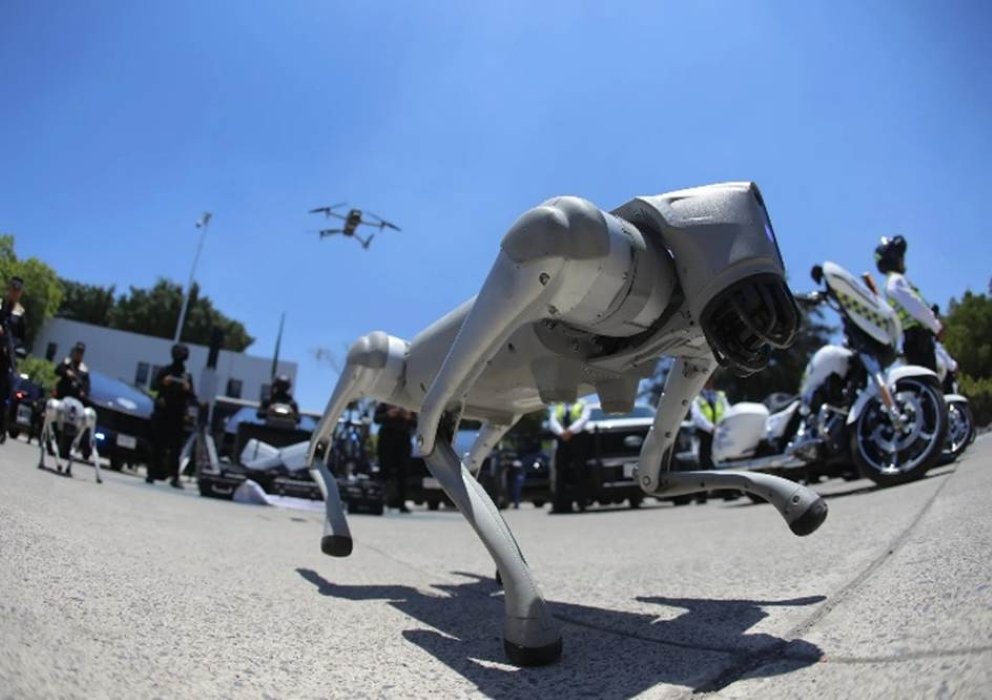
Juan Pablo Hernández, Jalisco’s secretary of public security, told EFE that the technology used to secure the city will include humanoid robots and robotic dogs capable of responding to potential explosive threats. Authorities will also use radars and anti-drone guns. Around 500 units, including patrol cars, armored vehicles, and motorcycles, will be part of the operation, along with four helicopters.
The image is almost cinematic: football fans in green, red, sky blue, or yellow passing near a security perimeter watched by machines built for a more suspicious age. A sport born in streets and fields now requires counter-drone systems. The same World Cup that sells itself as joy also reveals the architecture of twenty-first-century anxiety.
Hernández said state police will deploy three Cybertruck patrols that can convert into mobile command centers, allowing officers to transmit voice and data, monitor urban cameras, and consult interconnected platforms with other countries for alerts such as Interpol red notices. The message is clear: Guadalajara will not rely only on street presence. It wants intelligence, mobility, and international coordination.
That is the modern security formula for mega-events. The stadium is only one point on the map. The real perimeter includes airports, hotels, fan zones, traffic routes, digital systems, tourist corridors, team movements, social media rumors, and the invisible possibility that someone, somewhere, may try to turn celebration into crisis.

The operation is taking shape in a state whose name carries global recognition for more than football. Jalisco is also associated with one of Mexico’s most powerful criminal organizations, the Jalisco New Generation Cartel. In February, the state became the epicenter of a wave of violence after the arrest of drug trafficker Nemesio Oceguera, the cartel’s leader, forcing the cancellation of mass events such as the 2026 Diving World Cup.
That recent memory sits beneath every security announcement. It does not mean the World Cup will be unsafe. It means authorities understand the event cannot be treated as routine. Guadalajara will receive global attention, and global attention magnifies every failure. A delayed ambulance, a drone incident, a clash near a fan zone, an organized robbery, an explosive false alarm, or a traffic breakdown could travel across the world within minutes.
The security plan reflects that pressure. Municipal and state police officers have received training from national police forces from Colombia, France, Argentina, and the FBI in explosives, crowd control, shooting, and high-impact interventions. Spain’s National Police have trained the Explosive Ordnance Disposal team to neutralize possible threats.
This international training is not just technical. It shows how security knowledge now circulates across borders in Latin America and beyond. Colombia brings decades of experience in conflict, urban operations, and event protection, in a country still shaped by armed groups. Argentina and France bring lessons from football crowds and global events. The FBI and Spanish police bring counterterror and explosive-response expertise. Guadalajara becomes a meeting point for security doctrines as much as for football cultures.
Around 10,000 public personnel, including municipal and state police, National Guard members, Army personnel, civil protection staff, firefighters, and medical personnel, will protect the city and tourist sites across Jalisco. Another 8,000 private security members will patrol a one-mile radius around Guadalajara Stadium. In contrast, others will guard teams, base camps, and the three-kilometer corridor connecting the stadium, the FIFA Fan Fest, hotels, and tourist areas.
The numbers show how much the World Cup depends on the private-public security machine. The state protects sovereignty and order. Private firms protect access, perimeters, gates, and commercial spaces. The tournament itself becomes a city within the city, with layered authority and overlapping jurisdictions.

A Mega-Event With Regional Stakes
Guadalajara will host four group-stage matches, including Mexico against South Korea on June 18 and Uruguay against Spain on June 26. These are not minor fixtures. Mexico’s game will bring national emotional intensity, while Uruguay versus Spain carries historical, linguistic, and football weight across the Atlantic. Each match will bring different fan cultures, travel patterns, policing needs, and symbolic pressure.
Candelario Hernández, police commissioner-in-chief of Zapopan, told EFE that a mobile court, a Public Ministry office, and Jalisco prosecutor’s personnel will be available at Guadalajara Stadium to process potential vandalism cases. He said the court near the stadium will allow the swift arraignment of people who behave improperly or commit crimes.
That detail is revealing. Authorities are preparing not only to prevent major threats, but to quell disorder quickly. Vandalism, fights, drunken incidents, theft, and public disturbances can seem small compared with cartel violence or explosive threats. Still, during a World Cup, they become part of the visitor experience and the host city’s international reputation.
For Latin America, Guadalajara’s security plan raises a larger question: can the region host global joy without being defined by the security measures required to protect it? Mexico has the stadiums, fan culture, tourism infrastructure, and football history. But it also carries the burden of proving that violence will not write the story.
This is the dilemma of Latin American mega-events. They are opportunities for tourism, investment, urban branding, and diplomatic projection. They can showcase a country’s music, food, architecture, warmth, and organizational capacity. But they also expose inequality, crime, militarization, surveillance, and the nervous relationship between public celebration and public control.
Guadalajara’s robots and anti-drone systems are therefore not gadgets. They are symbols of a new era in which safety has become part of the spectacle. Fans may come for football, but the state will be performing too, showing that it can manage risk, protect visitors, and maintain order under cameras from every continent.
The success of the operation will not be measured only by arrests or incidents avoided. It will be measured by whether ordinary people can move through the city without feeling trapped inside a fortress. A good World Cup security plan should be visible enough to reassure and restrained enough not to suffocate the celebration.
Guadalajara is preparing for both applause and scrutiny. The city wants the world to remember goals, chants, plazas, mariachi echoes, and the rush of fans moving toward the stadium. But behind that memory will stand 18,000 people, four helicopters, robotic dogs, mobile courts, and a country determined not to let fear steal the tournament’s light.
Also Read:
Australia and Brazil Whale Journey Reveals the Ocean Mystery Map