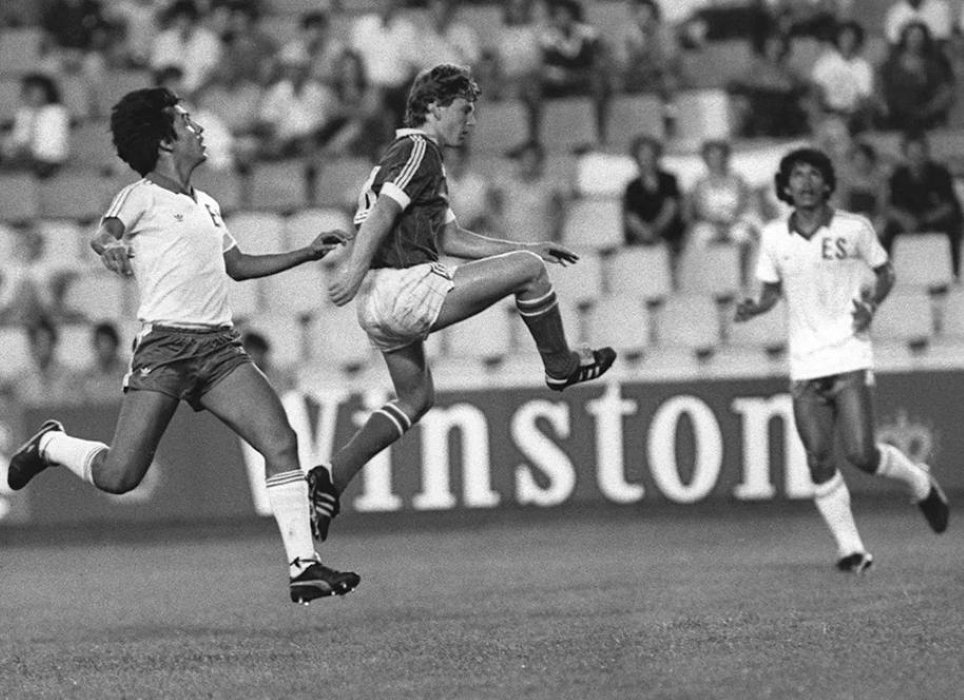
El Salvador’s 10-1 defeat to Hungary in 1982 remains the World Cup’s most brutal scoreline, a record that exposes football’s unequal stages, Latin America’s fragile football dreams, and the risks awaiting smaller nations in the expanded 2026 tournament.
The Night Elche Became a Wound
The World Cup has a way of preserving glory in bright colors and humiliation in permanent ink. Italy’s 1982 title still belongs to Paolo Rossi in the popular imagination, to that sudden resurrection of a striker who turned a tournament into personal myth. But buried inside the same Spanish summer is another image, harsher and less revisited: June 15, 1982, Elche, Hungary 10, El Salvador 1.
No scoreline in World Cup history has gone beyond it. Not Germany’s 7-1 against Brazil in 2014. Not Yugoslavia’s 9-0 against Zaire in 1974. Not Hungary’s own 9-0 demolition of South Korea in 1954. That night in the Nuevo Estadio remains the outer border of football’s cruelty, the place where a dream country met a machine, and the scoreboard became a historical scar.
El Salvador did score. Luis Baltazar Ramírez found the net, giving the Central American nation its only World Cup goal. But even that moment, which should have been lived as a celebration, was swallowed by the avalanche. The final number was too large. One goal became a footnote inside the ten.
The Hungarian storm also produced an individual record that still feels almost unreal. László Kiss came off the bench and scored the fastest hat trick in World Cup history, completing it in seven minutes and 42 seconds. He did not merely add to a victory. He accelerated a humiliation that was already moving beyond recovery. Hungary became the only team ever to reach double digits in a World Cup match.
EFE’s archival imagery from that day, showing Salvadoran supporters unfurling a banner greeting the city of Elche, reminds us that these blowouts are never only sporting statistics. Fans traveled with pride. Players arrived wearing the shirt of a country that had endured violence and instability. A national team does not walk into a World Cup as an abstract opponent. It carries neighborhoods, radio voices, family rooms, and a small nation’s hope of being seen.

The largest defeats in World Cup history are often remembered as curiosities, but they reveal the tournament’s deeper inequality. Hungary’s 10-1 was not a random accident detached from football structure. It belonged to a long pattern in which newer, poorer, or less internationally tested teams meet highly organized football powers in a setting that forgives nothing.
Hungary knew something about overwhelming opponents. In 1954, the legendary “Magical Magyars,” led by Ferenc Puskás, crushed South Korea 9-0. Twenty years later, in West Germany 1974, Yugoslavia inflicted the same score on Zaire, now the Democratic Republic of Congo. In 1938, France beat Sweden 8-0 In the quarterfinals, it was still the heaviest defeat in a knockout round.
Germany has also lived on both sides of the World Cup memory. In 2002, it delivered the biggest victory of the twenty-first century, beating Saudi Arabia 8-0 In Sapporo, a young Miroslav Klose announced himself with a hat-trick of headers. In 2014, Germany delivered the modern era’s most emotionally devastating rout, beating Brazil 7-1 in Belo Horizonte. That score did not surpass El Salvador’s record. Still, its shock was greater because Brazil was the host, the five-time champion, the spiritual home of football beauty.
That distinction matters. The same scoreboard can mean different things to different people. When a smaller nation loses badly, the world often treats the defeat as evidence of inferiority. When a giant collapses, the world calls it a tragedy. El Salvador’s loss was filed as a record. Brazil’s loss became trauma.
For Latin America, this imbalance is familiar beyond football. The region knows what it means to enter global arenas with uneven resources and then be judged by a scoreboard that ignores history. Small federations are told to compete with countries that have deeper professional systems, richer leagues, better preparation, larger pools, stronger sports science, and more international exposure. The World Cup sells equality because every match begins 0-0. But the road to that kickoff is not equal.
El Salvador’s 1982 team was not simply outplayed. It was placed under the most merciless light in sport, where structural gaps become visible in ninety minutes and then stay attached to a country for generations.

The Expanded Cup Raises Old Questions
The coming 2026 World Cup will expand to 48 teams, opening the door to nations with less tournament experience and smaller football infrastructures. That expansion carries real beauty. More countries will feel the astonishment of qualifying. More flags will appear in stadiums. More children in places long excluded from the tournament will see their anthem played on the world’s largest football stage.
But the expansion also revives an uncomfortable question: will more inclusion produce more opportunity, or more mismatches?
Football has changed since 1982. Many smaller nations now have players in European leagues, better scouting, improved coaching, stronger fitness systems, and more competitive international calendars. A debutant today is not automatically a victim. Morocco’s run to the 2022 semifinals showed how old hierarchies can be broken. Costa Rica’s 2014 campaign showed that a smaller Latin American nation can survive a group of former world champions and make the world look foolish.
Still, risk remains. With 48 teams, the range between the strongest and weakest squads may widen. The tournament will include more nations whose football dreams are real, but whose depth may be fragile. One injury, one early goal, one tactical collapse, one emotional freeze under global pressure can turn representation into exposure.
This is why El Salvador’s record still matters. It should not be used to mock a country. It should be used to ask what football owes the nations it invites to the stage. Preparation matters. Federation investment matters. Regional competition matters. Youth development matters. So does respect.
Latin America has always lived between grandeur and wounds at the World Cup. Uruguay invented the tournament’s first glory. Brazil gave it Pelé, Garrincha, Ronaldo, and impossible beauty. Argentina gave it Maradona and Messi. Colombia, Peru, Chile, Costa Rica, Mexico, Ecuador, Paraguay, and others have added chapters of joy and heartbreak. El Salvador’s 10-1 is part of that same history, uncomfortable but real.
A blowout can erase the dignity of the losing side if the story is told badly. But told honestly, it can reveal something larger: how cruel the global game can be, how long memory lasts, and how difficult it is for small nations to turn qualification into competitiveness.
On June 15, 1982, El Salvador suffered the World Cup’s harshest scoreline. More than four decades later, the record still stands. The danger for 2026 is not only that someone might break it. The danger is forgetting what it meant.
Also Read: Brazil and Germany Guard the World Cup Record, Argentina Can’t Catch Up