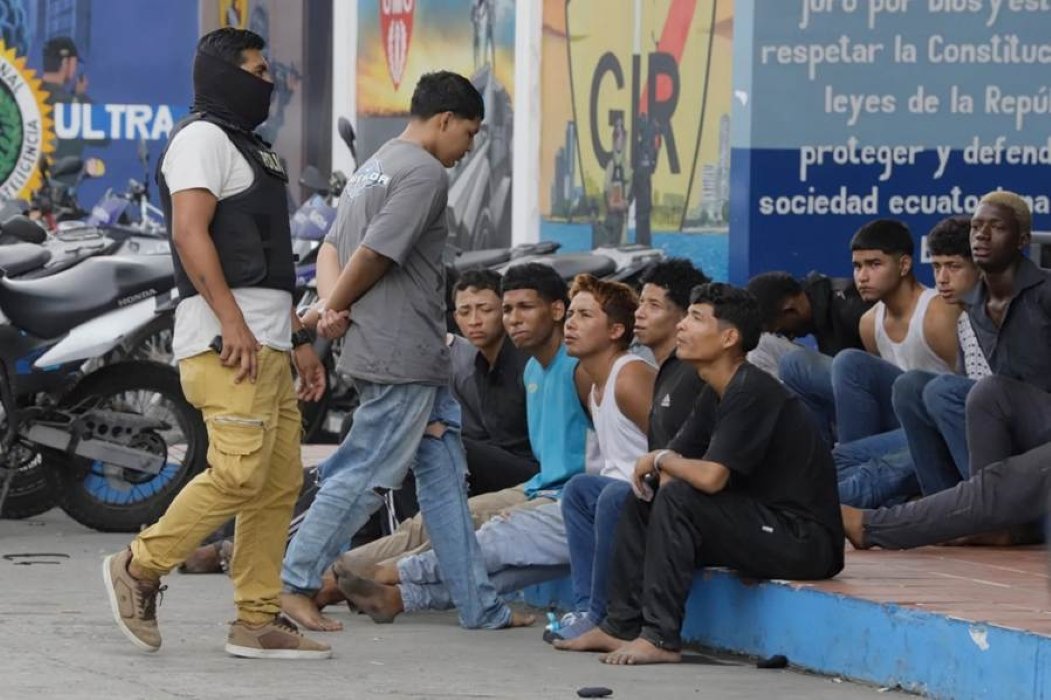
Chile, Argentina, Peru, Bolivia, and Ecuador signed the Santiago Commitment to coordinate against transnational crime. Still, the pact reveals a sharper regional shift, in which security, U.S. influence, border control, and development anxieties are now converging.
A Pact Born From Fear
The Santiago Commitment was announced with the language of urgency, and urgency is precisely what made it politically useful. Chile, Argentina, Peru, Bolivia, and Ecuador agreed Thursday to build a roadmap for deeper coordination against transnational organized crime and drug trafficking, a challenge their governments now describe not as a domestic problem, but as a borderless threat eating into the region’s stability.
“We are going to confront crime united,” Chilean Foreign Minister Francisco Pérez Mackenna said, according to quotes and reporting credited to EFE. “We want to bring security and calm to our compatriots. Today, the Santiago Commitment is born.”
That phrase, security and calm, captures the promise being sold to citizens across much of South America. In countries where extortion spreads faster than institutions, where ports and border crossings have become corridors for cocaine, weapons, illegal mining money, and human smuggling, governments know that crime now shapes daily life as much as inflation or elections. It decides who opens a business, who closes before sunset, who pays protection, who migrates, and who stops trusting the state.
The agreement brings together foreign ministers and security officials from five countries that share overlapping vulnerabilities. Chile has watched organized crime become a central political obsession after years of feeling relatively insulated from the region’s worst criminal violence. Ecuador has become one of Latin America’s most alarming homicide laboratories, with gangs tied to ports, prisons, and drug routes. Peru is trapped between political fragility and illicit economies. Bolivia, in the midst of a social and political crisis, sits on critical corridors and informal markets. Argentina faces its own anxieties over narcotrafficking, especially around urban hubs and financial networks.
Pérez Mackenna argued that because crime is transnational, national efforts are insufficient and must be complemented by greater political cooperation, technical coordination, and information sharing. That is true. It is also the easy part. Latin America has signed many declarations. The harder question is whether this one can survive the distance between communiqués and the roads, ports, prisons, border towns, and neighborhoods where criminal power actually governs.

The Price of Violence Is Development
The Santiago Commitment promises a joint action plan with “concrete actions and measurable and verifiable results.” The five countries plan to meet again in 180 days in Buenos Aires to assess progress. The agenda includes border coordination, institutional cooperation, information exchange, tracing illicit financial flows, and strengthening regional response mechanisms.
Those priorities show that the governments understand, at least on paper, that organized crime is not only men with guns. It is logistics, banking, corruption, transportation, legal businesses, political influence, customs gaps, prison networks, and digital systems. The most dangerous criminal organizations do not merely hide from the state. They learn to use parts of it.
The economic case is overwhelming. A study by the Inter-American Development Bank cited in the notes estimates that the direct costs of crime and violence reached 3.4 percent of Latin America’s GDP in 2022, a level similar to the previous measurement in 2017. The cost of crime equals 78 percent of public education budgets, twice public spending on social assistance, and twelve times public spending on research and development. Those figures make crime not just a security issue, but a development tax imposed by fear.
This is the deeper meaning of the pact. Crime is stealing more than lives. It is stealing schools, innovation, investment, health, public trust, and the future capacity of states. When businesses pay extortion, when families avoid public spaces, when governments divert money from classrooms to armored vehicles, the region loses twice: first to violence, then to the policies required to contain violence.
Argentine Foreign Minister Pablo Quirno said the region is in a moment that demands “institutional courage,” adding that societies need states capable of closing impunity gaps and responding faster and with greater coordination than criminal organizations. Bolivia’s Foreign Minister Fernando Aramayo put it more bluntly: crime is taking away development, limiting freedoms, and weakening the state’s ability to give citizens certainty.
That word, certainty, may be the real prize. Latin America’s citizens are not only asking for safety. They are asking for predictability. The right to move without being robbed. The right to trade without being extorted. The right to vote without armed intimidation. The right to believe that state borders mean something.

Security Meets Geopolitics
The Santiago meeting was inaugurated by Chile’s attorney general, Ángel Valencia, in a closed-door session on international cooperation, and by Chilean President José Antonio Kast. “These five countries got tired of watching organized crime kill our young people, dominate our neighborhoods, buy wills,” Kast said, according to EFE.
The sentence reflects real public anger. It also reveals the pact’s political direction. Except for Peru, which is immersed in a long electoral process, the participating countries are governed by right-wing or far-right presidents aligned with the “Shield of the Americas” initiative launched in March by U.S. President Donald Trump to fight international crime and counter China’s influence in the Western Hemisphere.
That detail matters. The Santiago Commitment is not only a crime-fighting agreement. It is part of a regional security realignment. Washington is again framing Latin America through a strategic lens: crime, influence, borders, China, and control of hemispheric space. For governments under pressure from voters frightened by crime, U.S. support can look like resources, intelligence, legitimacy, and speed. But Latin America knows the cost of importing security frameworks that blur the lines between policing, geopolitics, and sovereignty.
The risk is not cooperation itself. Regional coordination is necessary. The risk is allowing the fight against crime to become a new ideological border, where governments define legitimacy by alignment with Washington and treat critics as obstacles to security. If the pact becomes a platform for intelligence sharing, financial tracing, and border coordination under democratic oversight, it could matter. If it becomes another stage for militarized rhetoric and geopolitical loyalty tests, it may deepen polarization while criminals adapt.
The China reference is also revealing. Organized crime must be confronted, but tying crime policy to great-power rivalry can distort priorities. Ports, telecommunications, infrastructure, mining, and trade routes are all relevant to security. Still, Latin America should not allow its violence crisis to become merely an excuse for external powers to compete for influence.
The strongest version of the Santiago Commitment would be practical and transparent: shared databases, joint investigations, anti-money-laundering cooperation, professional border units, protection for prosecutors, prison intelligence reform, safeguards against corruption, and measurable public reporting. The weakest version would be slogans, photo opportunities, and emergency politics.
Latin America is at a dangerous hinge moment. Citizens are tired, and tired societies often accept harder states. But harder does not always mean stronger. A strong state investigates, coordinates, prosecutes, protects rights, and follows the money. A weak state only sends more uniforms to the same streets.
The Santiago Commitment begins with a correct diagnosis: crime has outgrown national borders. Now it must avoid the oldest regional mistake, believing that force alone can replace institutions. The criminals are already coordinated. The test is whether democracies can coordinate without becoming what they claim to fight.
Also Read:
Colombia’s Debate-Free Election Turns Silence Into a Democratic Stress Test