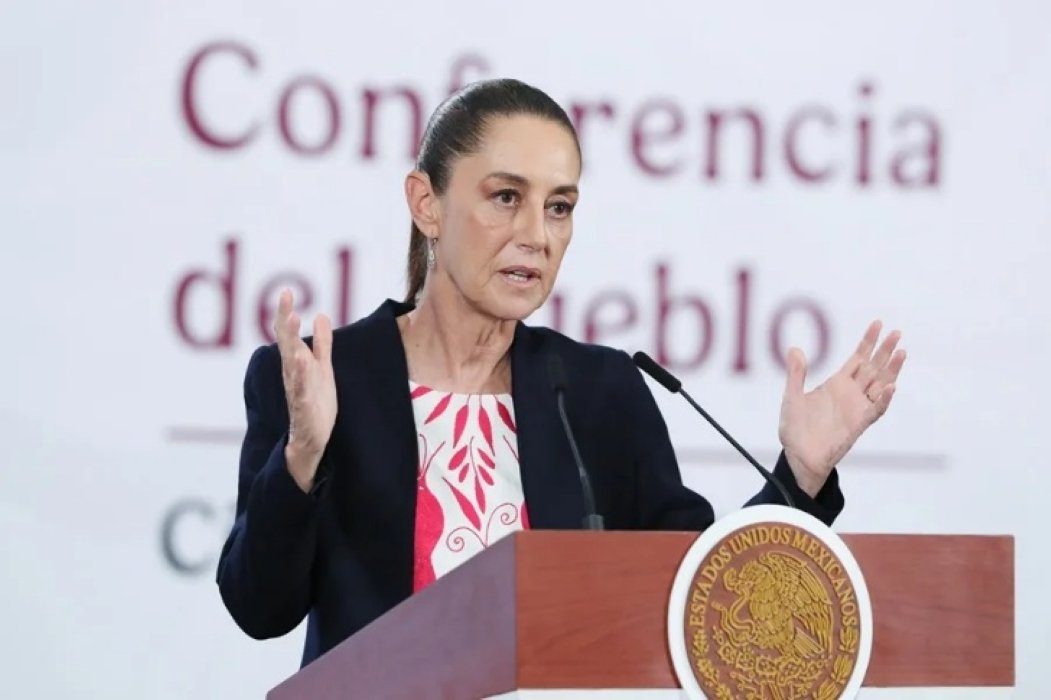
Mexico’s president says foreign money could taint elections. Still, the harder question is who decides when sovereignty is being defended and when power is being protected in a Latin American region already wary of outside hands.
A Sovereignty Fight With Old Shadows
In Mexico, the word sovereignty does not sit quietly. It carries the dust of invasions, oil expropriation, debt crises, intelligence operations, and the long memory of a country that has spent two centuries living beside the most powerful nation on Earth.
So when President Claudia Sheinbaum said Thursday during her presidential press conference that “yes, yes, there can be a risk of foreign intervention in elections in Mexico,” she was not speaking into empty air. She was touching one of the country’s deepest political nerves.
Her comments came as Mexico debates a constitutional reform that would allow foreign intervention to serve as grounds for annulment of elections. The measure has triggered sharp criticism from opposition parties, which say the ruling Morena movement is building another legal shield around its political dominance. Sheinbaum rejected that charge outright.
“There is nothing more false than that,” she said, according to the presidential press conference.
The president framed the reform as a matter of national defense, not partisan advantage. She pointed to past accusations involving Mexicanos Contra la Corrupción y la Impunidad, an anti-corruption group that her government and former President Andrés Manuel López Obrador’s administration have accused of receiving international funding with political effects.
Her argument is simple on the surface. Mexican elections, she says, must be decided by Mexicans. The complication begins the moment the state tries to define what counts as foreign interference.

The Dangerous Weight of Proof
Sheinbaum appeared aware of the trap. “The issue is how you show that there was in fact foreign intervention in an election,” she said, adding that this must be written into law “very clearly.”
That sentence may become the real heart of the reform. Not the patriotic language. Not the applause line about defending Mexico. The proof.
Latin America knows the damage caused by foreign meddling. Washington’s Cold War footprint across the region is not folklore. It shaped governments, militaries, media systems, business elites, and oppositional movements. But Latin America also knows another danger, just as intimate: governments that invoke sovereignty to silence critics, weaken watchdogs, or treat civil society as enemy terrain.
That is why the Mexican case matters beyond Mexico. Across the region, foreign funding is often tangled with legitimate advocacy, journalism, human rights monitoring, election observation, anti-corruption work, and political organizing. In weaker democracies, outside money can distort public life. In stronger democracies, outside support can help expose abuses that local institutions refuse to touch.
The line is not always clean. That is precisely the problem.
If the reform produces rigorous standards, transparent evidence rules, judicial independence, and equal application to all parties, it could become a serious tool against covert influence. If it creates vague categories, selective enforcement, or a political shortcut for annulling uncomfortable results, it could become something else entirely.
Sheinbaum’s insistence that “all Mexicans should agree” that there must be no foreign interference sounds obvious. Few voters want embassies, foundations, governments, or foreign-linked networks shaping their ballots. But democracy is tested less by easy agreement than by uncomfortable details.
Who investigates? What evidence counts? Does foreign funding to a civic group equal electoral intervention? What if the group criticizes corruption but never endorses a candidate? What if foreign-linked money flows through consultants, digital platforms, religious networks, influencers, or business chambers? What if it benefits the ruling party?
A law that cannot answer those questions evenly will not protect sovereignty. It will only rename suspicion as justice.

A Regional Warning from Mexico
For Latin America, the stakes are higher than a single constitutional clause. The region is entering an era in which election interference no longer looks like just old embassy cables or suitcases of cash. It can move through social media, diaspora networks, nonprofit grants, security partnerships, religious campaigns, artificial intelligence, and private data firms. Influence is faster now, less visible, more deniable.
Mexico’s debate is therefore a preview. Other governments will watch. Some may see a model for defending elections. Others may see a convenient script.
That is where Sheinbaum’s challenge becomes historic. She governs a country with enormous democratic weight, a country whose elections influence migration, energy, trade, security, and the political imagination of the hemisphere. If Mexico builds a careful legal standard, it could help Latin America think seriously about sovereignty in the digital age. If it builds a blunt instrument, it could encourage the region’s more authoritarian instincts.
The human stakes are easy to lose inside constitutional language. They belong to the voter in Ciudad de México standing in line under the sun. To the journalist trying to investigate public money without being accused of serving a foreign agenda. To the activist receiving an international grant, because local power has closed every domestic door. To the opposition candidate, wondering whether a future defeat or victory might be challenged not on ballots but on allegations.
Sovereignty is not just the state’s possession. It also belongs to citizens. It lives in their right to know, to organize, to criticize, to vote, and to remove a government without fear that the rules will shift afterward.
Sheinbaum’s warning deserves to be taken seriously. Foreign influence is real. Latin America has paid dearly for pretending otherwise. But the opposition’s fear also deserves scrutiny, because ruling parties in the region have too often discovered that the language of national dignity can be useful when accountability becomes uncomfortable.
The president says the law must prevent subjectivity. That is the promise on which the reform should be judged.
Mexico is not merely deciding whether foreign intervention can annul an election. It is deciding whether the defense of democracy can be written with enough precision to avoid becoming a weapon against democracy itself. In Latin America, that distinction has always mattered. Now it may matter even more.
Also Read:
Colombia May Fail Girls as Female Genital Mutilation Bill Stalls