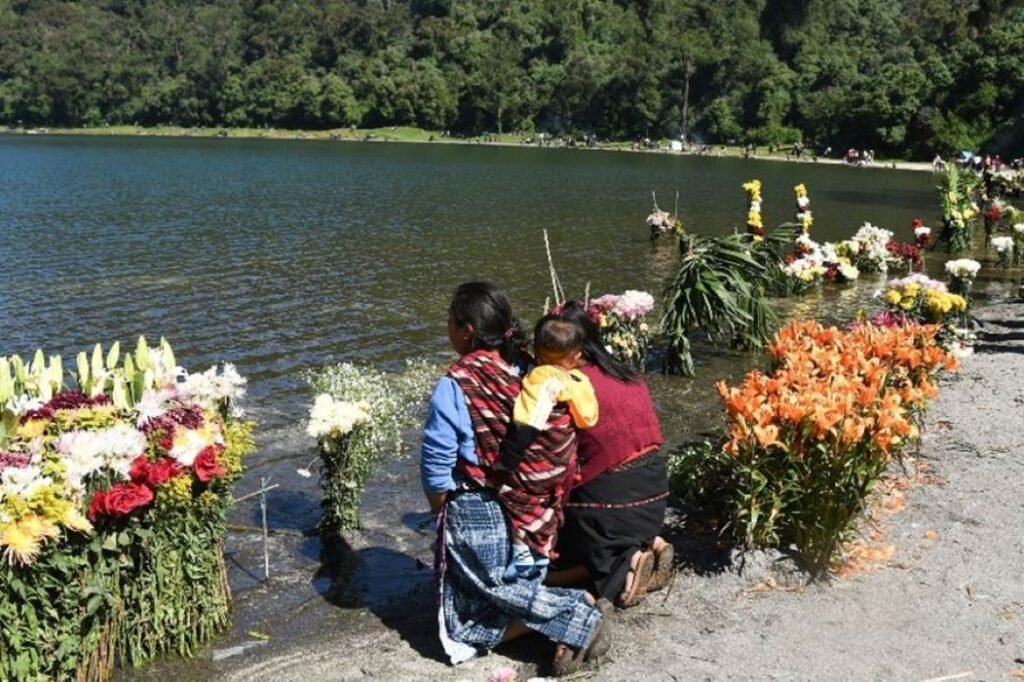
At a sacred volcanic lagoon, Maya Mam families ask for rain as drought threatens crops, turning an ancestral ceremony into a climate warning for Guatemala and Latin America, where Indigenous memory increasingly confronts hunger, development, and a warming world.
Where Clouds Come Down to Drink
The climb begins before the prayer. Families from western Guatemala walk uphill through the cold green slopes of Chicabal volcano, carrying candles, flowers, food, fatigue, and the kind of hope that appears only when the soil is beginning to fail. At nearly 2,000 meters above sea level, inside the crater, the sacred lagoon waits in silence.
Every year, guided by a spiritual calendar that marks exactly 40 days after Holy Week, hundreds of Indigenous Maya Mam people ascend to the lagoon in San Martín Sacatepéquez, Quetzaltenango, to ask for rain. The ceremony blends Maya spirituality and Catholic devotion, but this year its urgency belongs to the fields. Drought is threatening crops in communities that depend on rain-fed family agriculture, where a late cloud can mean hunger and a dry season can become debt.
“We come with great devotion, as every year, to hold a ceremony here for life and for the whole world,” Alma López, a devotee from San Juan Ostuncalco, told EFE after traveling for hours with her community. Her words are soft, but the request is not small. “We ask for water, we ask for rain, we ask for life for each one of us,” she said, also praying for the sick and for the many problems of the world.
For López, the health of the earth is not a metaphor. It is potato, carrot, cabbage, broad bean, bean, and sacred corn. It is the pantry and the market. It is the survival of families whose labor depends on the old agreement between human hands and seasonal rain.
Around the lagoon, about 40 pre-Hispanic altars mark the sacred geography of the place. Worshippers leave offerings, light candles, and speak to what cannot be reduced to folklore. In the Maya Mam worldview, Chicabal is where the clouds descend to gather the vital liquid. The water is not scenery. It is a living presence.
The lagoon is fiercely protected by community rules. Swimming is forbidden. Pollution is forbidden. The belief is that if its purity is violated, the water dome could hide itself. To outsiders, that may sound mystical. In a century of poisoned rivers, drained wetlands, and commodified watersheds, it also sounds like environmental law expressed through ancestral language.

Faith at the Edge of Drought
To reach the lagoon, pilgrims walk about five kilometers uphill from the entrance and control area, then descend the steps toward the water mirror inside the crater. The physical effort is part of the ritual. It turns prayer into movement, need into discipline, memory into breath.
“We lack rain, those of us who plant corn and beans,” Wilson García, a community leader from San Juan Ostuncalco, told EFE. “The planting is already drying, so we come to ask rain from Mother Nature, from the Creator Father, from the spirit of the world, especially here at Chicabal lagoon.”
That sentence carries the full tension of the moment. Climate change may be discussed at summits and in reports. Through emissions targets, but in the Guatemalan highlands, it first appears in a farmer’s field. The crop dries. The family calculates. The ceremony becomes both a spiritual act and a climate response.
Guatemala is one of Latin America’s most vulnerable countries to climate disruption because poverty, deforestation, water stress, weak rural infrastructure, and dependence on small-scale agriculture overlap. The Maya Mam ceremony at Chicabal does not replace meteorology or public policy. It exposes what public policy often forgets: climate change is not experienced equally. It strikes hardest where people already live close to the edge of subsistence.
The pilgrimage also resists the idea that Indigenous practices belong only to the past. García rejected that reading directly. “This is not a religion, this is the spirituality of the people,” he said. “They invaded us, but we are the future left to us by our grandparents. We continue resistance in spirituality.”
His words place the ceremony inside a longer history. Indigenous communities in Guatemala survived conquest, forced conversion, land dispossession, racism, civil war, state violence, and cultural pressure. To gather at Chicabal is not only to ask for rain. It is to say that Maya ways of knowing the land have not disappeared. They remain organized, disciplined, and alive.

Latin America’s Climate Memory
Mash, a political activist with the Council of the Maya People, told EFE that the gathering brings together more than farmers. Merchants, academics, and others also come, all bound by a concern for restoring ecological balance. “Today we speak of climate change, which is a phenomenon in which life is questioned, and life is put at risk,” Mash said. “So it is an invitation for us to return to our essence as human beings.”
That invitation carries geopolitical meaning for Latin America. The region holds immense biodiversity, forests, water systems, Indigenous knowledge, agricultural communities, and extractive economies pulling in opposite directions. Governments speak of development, mining, energy, exports, tourism, and infrastructure. But ceremonies like Chicabal ask a harder question: development for whom, if the rain no longer comes?
Indigenous climate knowledge has often been dismissed as symbolic. At the same time, modern systems produced the crisis now threatening food, water, and territory. Latin America cannot afford that arrogance anymore. The future will require satellites and sacred sites, climate science and community governance, public investment, and ancestral restraint. Chicabal’s prohibition against contaminating the lagoon may be spiritual in nature. Still, it also expresses what many national policies fail to enforce: water must be protected before it becomes an emergency.
Each year, according to local municipal records and the association of spiritual guides, between 2,000 and 3,000 people climb to the summit to close this rain petition. The flow of pilgrims has remained steady over the past decade, consolidating Chicabal as one of the most important spiritual and tourist sites in the Guatemalan highlands.
Tourism may bring income, but it also brings risk. Sacred places can be consumed, photographed, and simplified. Chicabal’s strength depends on remaining under community care, not being converted into a scenic backdrop emptied of meaning. Latin America knows too well how Indigenous culture is marketed while Indigenous demands for land, water, and dignity are ignored.
The ceremony at Chicabal is not a curiosity. It is a warning. It says that climate change is already entering rituals, markets, kitchens, and fields. It says the old guardians of water may understand the crisis more clearly than many ministries. It says that when communities climb a volcano to ask for rain, the rest of the region should listen.
At the crater’s edge, flowers and candles face the water. Below, the crops wait.
Also Read:
Latin American Crime Pact Tests Borders as Right Tightens Security