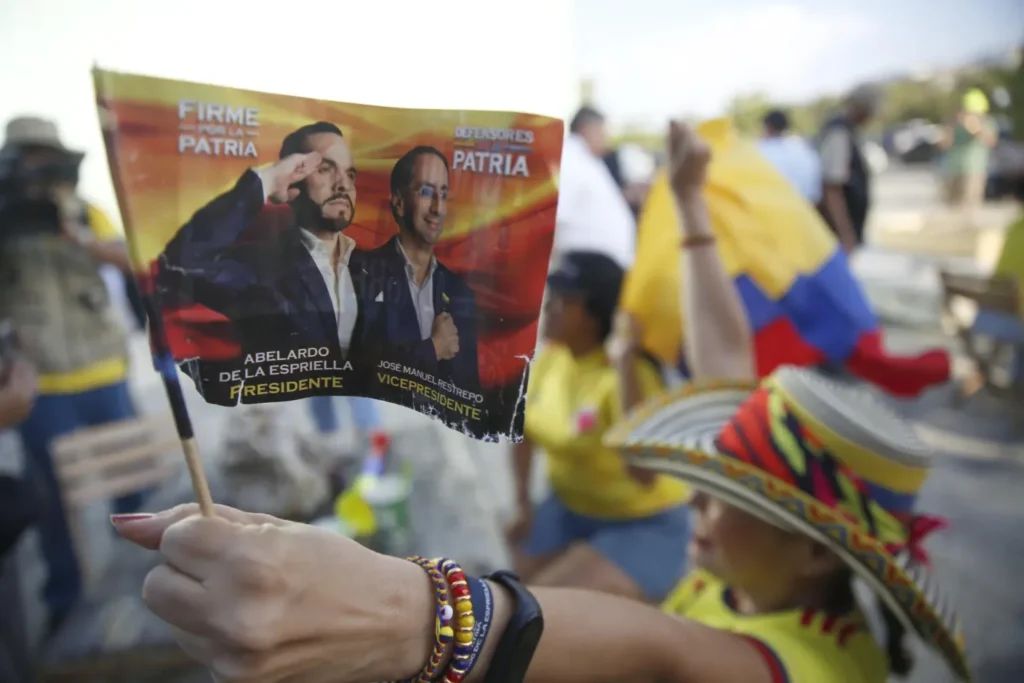
Abelardo de la Espriella’s first-round surge and Iván Cepeda’s resilient leftist vote have pushed Colombia into a stark June 21 runoff, testing security fears, Petro’s legacy, and Latin America’s widening argument over democracy, crime, markets, historical memory, and regional power balances.
A Runoff Born of Weariness
Colombia’s first round did not merely choose two finalists. It exposed a country voting with one eye on the ballot and the other on the road home, where extortion, armed groups, and old grief still crowd the public imagination. With 99.8% of polling stations counted, De la Espriella, the far-right candidate of Defensores de la Patria, topped 10 million votes, or 43.73%. At the same time, Cepeda, of the governing Pacto Histórico, followed with 9.6 million, or 40.91%, according the National Registry. Neither reached the required half plus one.
De la Espriella smashed a polling narrative that had placed him behind Cepeda, then absorbed much of the anti-left lane that establishment conservatism believed it still owned. Paloma Valencia, the Centro Democrático senator, landed in third with 1.6 million votes, or 6.92%, far below the 3.2 million votes she drew in the March 8 center-right primary. Sergio Fajardo took 4.25%. Claudia López fell under 1%, behind the blank vote.
That collapse of the middle is the election’s underreported thunderclap. A blank vote of 406,830 ballots, or 1.71%, surpassed six candidates. In a normal cycle, that might be civic irritation. Here it reads like exhaustion with the managerial center, which once promised decency and technocratic calm. Voters clustered around two emotionally legible camps: punishment and memory, order and repair, the fist and the wound.

Two Biographies, One Old Wound
De la Espriella arrives as a made-for-camera outsider, a 47-year-old criminal defense attorney and entrepreneur who has represented controversial clients including Alex Saab and David Murcia Guzmán. In EFE’s reporting and interview material, the quotes that stick are theatrical: an “iron fist,” Elon Musk as “compadre,” Colombia remade into a country of entrepreneurs. He admires Donald Trump, echoes Nayib Bukele, and wraps his campaign in salutes, family values, and anti-abortion politics. He is a law, a brand, a tenor album, a rum label, and a social media myth all at once.
In Latin America, where institutions often arrive late and violence arrives early, political style is not an accessory. It is a promise of substituted statehood. Bukele’s regional appeal was never only about homicide rates. It was about visible command, the spectacle of a leader imposing order on chaos. De la Espriella is offering a Colombian translation: less technocrat, more avenger; less party machine, more patriarch with a microphone. For Colombians tired of Petro’s unfinished “total peace,” that performance can feel less like ideology than shelter.
Cepeda’s biography pulls the other way, toward the dead who never left the room. A philosopher trained in international humanitarian law, he has described himself, in EFE’s words, as a “survivor of political genocide,” formed by exile and by the 1994 assassination of his father, Unión Patriótica Senator Manuel Cepeda Vargas. His public life grew from his advocacy for victims, Movice,, and congressional debates on paramilitarism, which made him Uribismo’s persistent antagonist.
Cepeda is not just Petro’s continuity candidate. However, his ticket with Indigenous leader Aída Quilcué defends agrarian reform, energy transition, and negotiations with armed groups. He is the wager that Colombia can govern from memory without being trapped inside it. His role in the 2016 FARC agreement and ELN dialogues gives him negotiating credentials, but leaves him exposed to the central accusation against the left: that talks have become time bought by armed actors rather than peace delivered to citizens.

Latin America Watches the Security Pendulum
The runoff now becomes a referendum on Petro, but also on the Latin American cycle that followed the pandemic: hope in social reform, disappointment in delivery, and the return of security as the bluntest political language. Reuters reported turnout around 58%, leaving both campaigns room to hunt abstainers before June 21. It also noted that right-leaning voters may consolidate behind De la Espriella after the first round scattered conservative and centrist support.
For the region, a De la Espriella victory would announce that the Bukele model is no longer a Central American exception but a portable Andean temptation. Colombia is not El Salvador. It is larger, more decentralized, tied to cocaine routes, Venezuelan instability, Pacific ports, and Caribbean corridors. A hard turn toward mega-prisons, military offensives, and closer ideological alignment with Trump-era Washington would ripple through neighbors where publics demand safety while courts, prisons, and human rights systems strain.
A Cepeda victory would send a different message: that the post-Petro left can survive if it speaks not only of redistribution but also of territorial control. His agenda of land, victims’ rights, and energy transition touches the region’s deepest fault lines, from extractive dependence to Indigenous sovereignty. Yet the data shows he cannot win by moral inheritance alone. Forty percent is sturdy. It is not enough. The left must persuade Colombians that peace is not permissiveness, that reform is not drift, and that memory can protect the living as well as honor the dead.
In Bogotá, Barranquilla, and towns where the state is still a rumor with a seal, the second round feels less like a choice between programs than a choice between fears. Fear of authoritarian cure. Fear of criminal impunity. Fear that Petro’s promise ran out of road. Fear that the old right returns wearing newer clothes.
Also Read:
Colombia Campaign Violence Turns Right-Wing Split Into Democracy’s Hardest Test