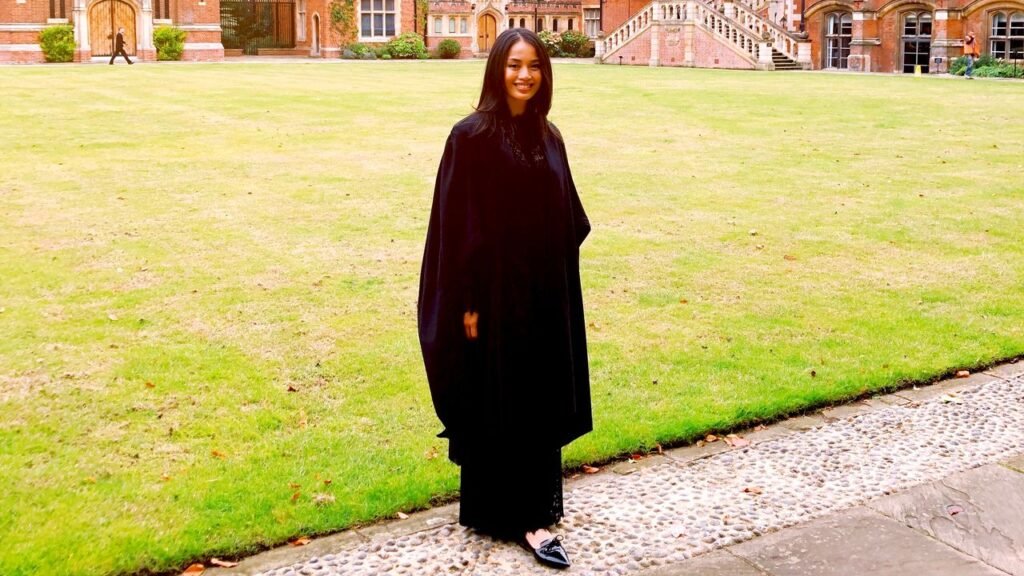
In the beginning, Cambridge seemed nice enough. On the cool, overcast October day of my matriculation into the university in 2019, my classmates and I walked onto Selwyn College’s Old Court, excited and taking pictures of each other in our traditional robes. As we strolled around, I observed a pair of dons nearby, also in their black robes, watching us. Their eyes took in our group of eight, which included a Black Zambian-Swiss woman, one Black American woman, one Filipino American woman (me), and one British Indian man.
One of the dons, an old white man, leaned over to his colleague, another old white man, and theatrically ruffled his robes, whispering as we passed:
“These must be the creative writing students.”
“Rather,” said his colleague.
The formal dinner that followed, held in Selwyn’s high-ceilinged, candlelit hall, was an exercise in incredulity.
“I’ll be studying indigenous tribes in Peru for my PhD, a bit like Jane Goodall, you know,” said the white woman across the table from me, smiling at her own cleverness. “And you? What brings you here?”
The South Asian professor to my left, also new to the college, heard it. We traded looks—Did you catch that? Yes, I did—and continued as though nothing happened.
“I’m here for the master’s in creative writing,” I said.
Ah, the white woman’s nod seemed to say. Over plates of beef and gravy, glasses of prosecco and slices of chocolate cake, she interrogated me:
“Where are you from? No, really from. Ah, the Philippines, of course. I had a Filipino nanny growing up, you know. Where did you grow up? Where did you go for your undergraduate studies? No undergraduate studies? Goodness, why not? Undocumented? Oh, do you mean illegal? In America?”
I could write a second memoir solely on the racism I experienced at Cambridge University as a master’s and PhD student. The contours of my stories would be familiar to any brown or Black student across classes: a lecturer targeting me for “resting bitch face” and expecting a smile, then targeting a Black classmate for refusing to recite Hamlet when commanded to (he was fired not long after); being “portered” at college doors while our white classmates—or sometimes my white then-husband, whose only association with Cambridge was me—walked right through; the visible lack of brown and Black professors; the white author-heavy reading lists; the platforming of racist guests at the Union under the guise of “free speech”; that one time a lecturer told me to “not mention” my six-figure book deal to my creative writing classmates as “everyone might feel bad,” and then, an hour later, celebrated a white male classmate’s publication in a poetry magazine.
Photo: Jill Damatac