For years, Gulf leaders made a simple promise to Silicon Valley: Bring your data, your models, and your chips, and we will give you stability.
On Sunday, that promise ended in flames, after Iran’s retaliatory strikes in response to U.S.-Israeli assault set an Amazon data center in the United Arab Emirates on fire.
In a statement released following the incident, Amazon said “objects” struck the building, creating sparks and flames, declining to link the incident to Iran’s missile and drone attacks. Fire crews cut power to the entire site, and more than 24 hours later the facility remains offline, with the disruption spreading to other parts of Amazon’s UAE operation.
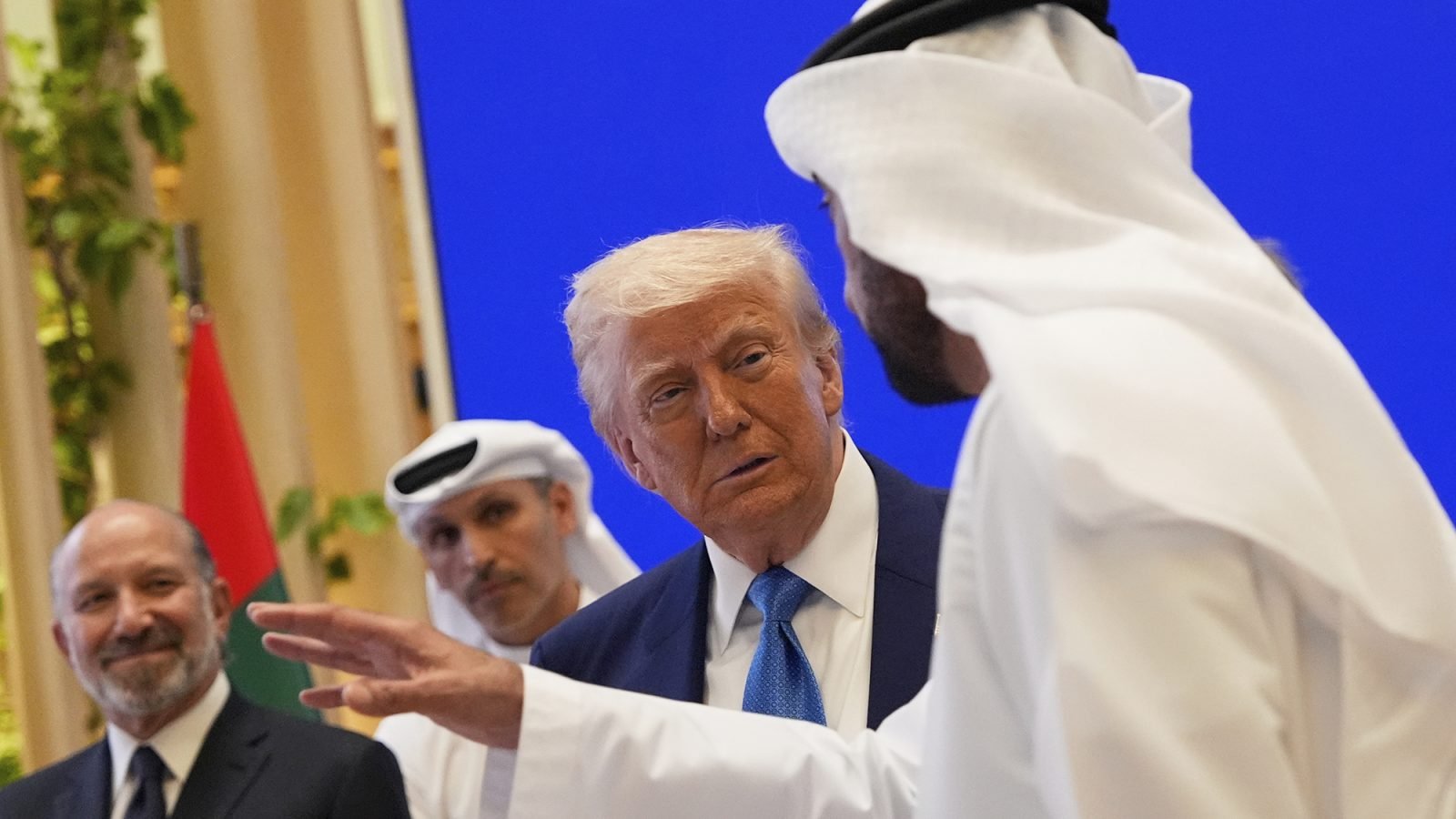
Less than a year ago, the Gulf was being celebrated as the next great frontier for artificial intelligence. U.S. President Donald Trump’s four-day tour of Saudi Arabia, Qatar, and the UAE last May produced more than $2 trillion in investment pledges, promising the region would become the third global center for AI alongside the U.S. and China. The entire premise, that the Gulf offers political alignment, capital and physical safety, is being tested in real time.
“A theoretical scenario has become a concrete precedent,” Kristian Alexander, a senior fellow at the Rabdan Security & Defence Institute in Abu Dhabi, told Rest of World. “This does not necessarily introduce a new risk so much as it validates what was already in every serious threat model.”
A theoretical scenario has become a concrete precedent.”
The security arrangements that surrounded those deals were designed around geopolitics — and for a completely different contingency. The January 2026 Pax Silica initiative brought the UAE and Qatar into a U.S.-led effort to keep advanced chips away from China. The partnership agreements focused on stopping technology from leaking to rivals. Not one of them contemplated the possibility that a regional adversary would launch missiles at the physical buildings where those chips were meant to run.
“The security frameworks behind the U.S.-UAE AI partnership were built for supply chain control and political alignment, not for protecting buildings during a military attack,” Ali Bakir, an assistant professor of international affairs, security, and defense at Qatar University, told Rest of World. “The physical security of strategic digital infrastructure may have been assumed to fall under broader national defense without ever being treated as a distinct vulnerability.”
Data centers are massive, power-heavy industrial complexes. Protecting them against a sustained wave of missiles and drones requires expensive, layered defenses that are difficult to maintain.
“It is cheaper to attack than to defend,” Bakir said.
Iran’s assault has underscored that asymmetry. The UAE military intercepted 165 ballistic missiles, two cruise missiles, and 541 drones over two days. Thirty-five drones and five projectiles still got through, striking airports, Jebel Ali Port, and the facade of the Burj Al Arab hotel. Three migrant workers were killed.
While the region’s core advantages remain intact for now, the trajectory depends heavily on how the conflict evolves, said Ryan Bohl, senior analyst for the Middle East and North Africa at RANE Network, a U.S.-based geopolitical risk intelligence firm. Companies are watching closely to see whether this was a contained episode or the start of a more sustained cycle of disruption that could reshape long-term assumptions about stability.
“As of now, the structural advantages have not yet changed, but the story of that is still being written,” Bohl told Rest of World. “If this conflict continues, there will increasingly be a greater and greater likelihood that major impacts will alter the perception of safety, efficacy, and value for the long term.”
Saudi Arabia had pledged $600 billion during Trump’s trip. The UAE committed $1.4 trillion targeting AI and chips. Qatar signed agreements worth $1.2 trillion. A significant share of that investment is earmarked for data centers and AI campuses.
It is cheaper to attack than to defend.”
A consortium led by OpenAI and Nvidia announced plans for Stargate UAE, envisioned as the largest outside the U.S. Amazon separately committed $5 billion to an AI hub in Riyadh with Saudi Arabia’s state-backed Humain.
To make it all work, the Trump administration eased restrictions on advanced chips sales to the Gulf, approving up to 500,000 cutting-edge Nvidia processors annually for the UAE and Saudi Arabia. In return, Abu Dhabi’s G42 cut ties with China’s Huawei, and Humain pledged not to buy Huawei equipment — effectively locking Beijing out of the region’s AI expansion.
Whether Sunday’s incident represents a system-wide failure or a contained disruption depends in part on how the companies built their architecture. According to Tahir Gok, lead senior analyst for the Middle East and North Africa at U.S.-based market intelligence firm dataceterHawk, businesses that spread their operations across multiple zones are far more protected than those running everything in one place.
“Hyperscaler regions are architected around multi-availability zone redundancy,” Gok told Rest of World. “The design assumption is that a single availability zone failure should not cause systemic regional collapse, provided customers have deployed workloads across multiple zones with active failover and tested business continuity plans.”
The Gulf’s cloud infrastructure doesn’t just serve regional clients. Amazon, Microsoft, and Google’s operations in the UAE and Dubai are the digital backbone for fintech platforms across Africa, logistics networks in South Asia, and media and health services in other emerging markets. OpenAI has said its planned UAE campus could eventually serve half the world’s population.
Major impacts will alter the perception of safety, efficacy, and value for the long term.”
For U.S. tech companies, the conversation has now shifted from political to war risk, Alexander said. Apart from storing commercial information, Gulf data centers support government surveillance, intelligence work, and military communications, making them more valuable and more likely to be deliberately targeted.
“U.S. tech firms can no longer assume that running civilian services in the region will keep them out of the target set,” he said.
By Monday, the ripple effects were visible. UAE stock markets remained shut — the first unscheduled closure since the death of President Sheikh Khalifa in 2022. Customers of Abu Dhabi Commercial Bank reported outages on its website and mobile app. Goldman Sachs, JPMorgan, and Citigroup all sent their UAE staff home.
The investments sunk into the Gulf’s AI architecture are too large to unwind. Tech companies, at least for now, are unlikely to retreat. Alexander believes the companies will reinforce buildings, move operations underground, and push customers to spread their data across multiple countries.
“I do not think it will reverse the broader strategic bet,” Alexander said. “But it will force a more openly militarized approach to protecting cloud infrastructure.”
For years, Gulf governments poured billions into defending against hackers and cyber-espionage. On Sunday, what brought the building down was not malicious code but heat, smoke, and a power cutoff.
“In a missile and drone environment,” Alexander said, “concrete, distance, and dispersion matter just as much as firewalls.”