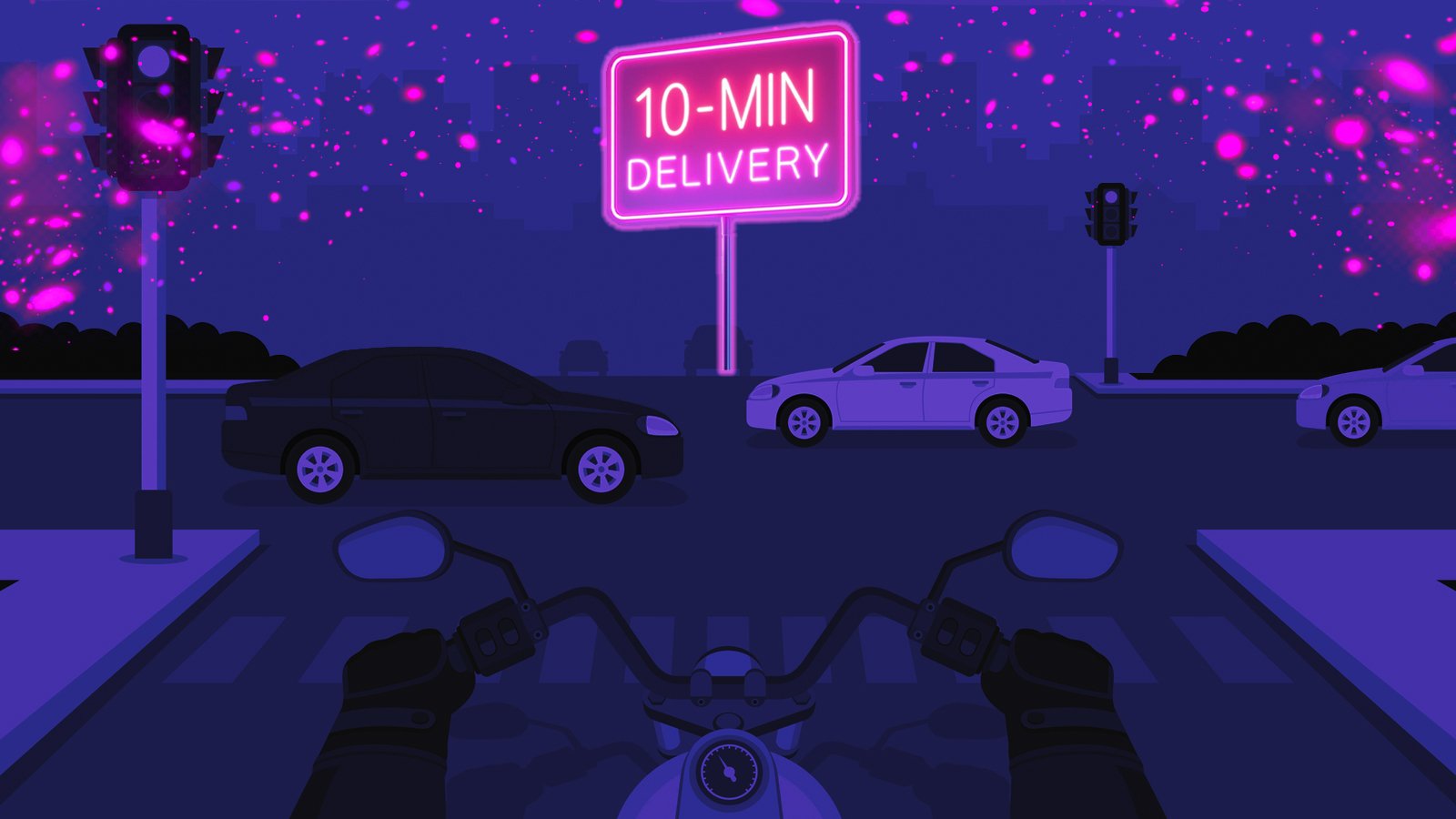
Amazon has placed its bet on a service that has struggled to thrive in the West.
On March 17, the company started testing a 30-minute delivery service in select locations across the U.S, alongside one- and three-hour delivery options across thousands of American cities.
The move marks a renewed push into quick commerce — a model that has struggled to take hold in Western markets.
Amazon hasn’t entered this experiment blind. It has been running a 10-minute delivery service in India since June 2025, and a 15-minute service in the United Arab Emirates since October. Those markets offer a glimpse into both the promise — and the pitfalls — of ultrafast delivery.
China has built the largest quick-commerce market in the world at $125 billion. Around one in four people in China use these services. Around 200 million workers, up to 40% of China’s urban workforce, rely on digital platforms for employment.
India is inundated with ultrafast delivery services, with standalone apps BlinkIt and Zepto leading the pack. The segment has been one of the most-funded tech startup sectors in the past few years.
Experts believe these platforms have managed to “manufacture” the need for ultrafast deliveries by offering deep discounts rather than solving a real problem.
Companies trained consumers to expect instant fulfillment, whether or not the need was truly urgent.”
“A large part of the category was also manufactured through aggressive subsidy, convenience marketing, and habit formation,” Kartik Hosanagar, a tech and marketing professor at the University of Pennsylvania’s Wharton School, told Rest of World. “Companies trained consumers to expect instant fulfillment, whether or not the need was truly urgent.”
Quick commerce accounts for just 1%–2% of all trade in India, even after massive cash burn to increase speed and offer deep discounts. Price discounting in quick commerce is 6%–9%, compared with 2%–5% for general trade, data from management consultancy Kearney shows. India’s quick-commerce market, currently less than a tenth of China’s, has just 12 million gig workers.
The convenience comes with several trade-offs, including the environmental impact of last-mile underfilled deliveries, the mounting packaging waste, and gig workers driving rashly to race against the clock or incurring penalties for being late.
Earlier this year, Indian gig workers held nationwide protests and strikes against the dangerous working conditions at quick-commerce companies, following which the government asked all platforms to stop promoting 10-minute deliveries.
Globally, funding for quick commerce has declined sharply. In 2025, the sector raised just $1.92 billion compared to its peak of $11.3 billion in 2021, according to data from Tracxn.
More than 40 quick-commerce companies have shuttered globally, and the pace of new players entering the market has slowed since 2021.
“This trajectory suggests that while the underlying need for convenience in urban environments is real, early growth was significantly accelerated by capital-driven expansion,” Neha Singh, co-founder of Tracxn, told Rest of World. “Its long-term sustainability will depend on balancing speed with unit economics, assortment strategy, and operational discipline.”
Experts also believe the U.S. is not the ideal market for the service.
In 2022, U.S. quick-commerce startups Gopuff, Fridge No More, and Buyk shut down due to unsustainable unit economics and high labor costs.
Quick commerce thrives in places with dense urban populations, short delivery distances, and fragmented or inconvenient traditional retail, according to Nir Eyal, author of the best-selling book Hooked: How to Build Habit-Forming Products and a former lecturer in marketing at Stanford University.
“India and China check all of these boxes. The U.S. and Europe check only some,” Eyal told Rest of World. “High-density cities like New York or London have the population, but labor costs make the unit economics brutal. Suburban America has neither the density nor the delivery infrastructure. … Western consumers already have well-stocked, accessible supermarkets. The ‘problem’ quick commerce solves feels less urgent when a 24-hour grocery is five minutes away.”
Still, Amazon is following the playbook of China’s quick-commerce success stories like giants Meituan, Alibaba, and JD.com — conglomerates that bleed in this sector to embed customers into their larger network of advertising, financial services, cloud, and logistics.
“The math looks terrible if you evaluate the delivery business in isolation. It looks very different when you account for everything else a returning customer touches,” Eyal said.