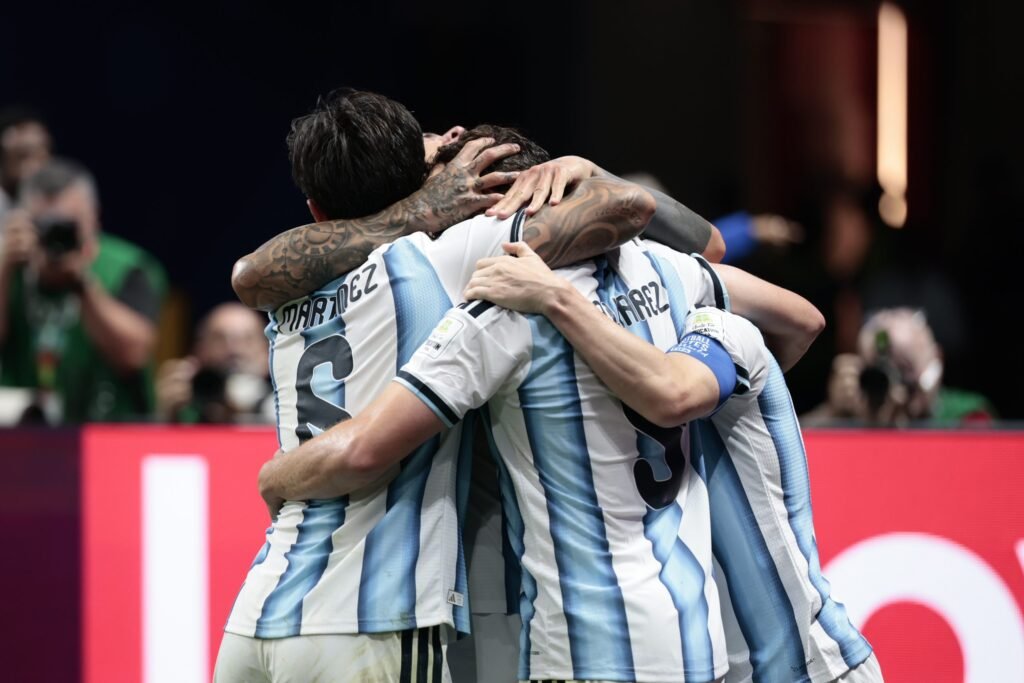
Perhaps no team in the 2026 World Cup has inspired stronger reactions than Argentina.
On the field, the defending champions have continued their march toward another title, currently scheduled for a semifinal showdown with England today on Wednesday, July 15. Off the field, however, they have become the focal point of a widening global debate, one in which supporters and critics alike project competing narratives about power, fairness and prestige in the modern game.
From allegations of favoritism and growing fatigue with Argentina’s success to historic rivalries, social media conspiracy theories and even financial investigations involving the Argentine Football Association (AFA), the Albiceleste have emerged as the most polarizing, and arguably most scrutinized football team of the year.
The champion effect
For supporters, the backlash is proof that the reigning champions have entered the sport’s highest tier, where sustained success inevitably attracts resentment.
Argentina has been a global football powerhouse since the early 20th century, and its dominance has only intensified in recent years. Currently led by Lionel Messi and manager Lionel Scaloni, the Albiceleste have won multiple Copa America titles alongside the 2022 World Cup, cementing their status as one of the strongest teams in international football.
History suggests that dominant teams rarely remain universally admired. As victories accumulate, even neutral fans often begin rooting for a new champion, and Argentina has increasingly become the target of that sentiment. The shift has been especially visible online since the team secured its place in the semifinals. Viral images and memes have circulated across social media depicting every country on the globe proudly bearing the English flag while Argentina stands alone, reinforcing the now familiar narrative of ‘Argentina against the world.’
Controversial calls
Several of the controversies surrounding Argentina have originated with decisions made by referees and VAR officials during key moments of several tournaments.
The first major incident occurred in the group stage against Algeria, when referee Szymon Marciniak granted Lionel Messi a yellow card after an infraction on defender Aïssa Mandi. Several analysts have argued that the tackle could have justified a red card, yet Messi was allowed to remain on the field.
Criticism intensified in the round of 16 against Egypt. After Egypt scored in the second half of the game, the VAR team reviewed the attacking sequence and determined that a foul had been committed on Lisandro Martínez earlier in the buildup. The referee disallowed the goal, and Argentina eventually completed a dramatic 3–2 comeback victory.
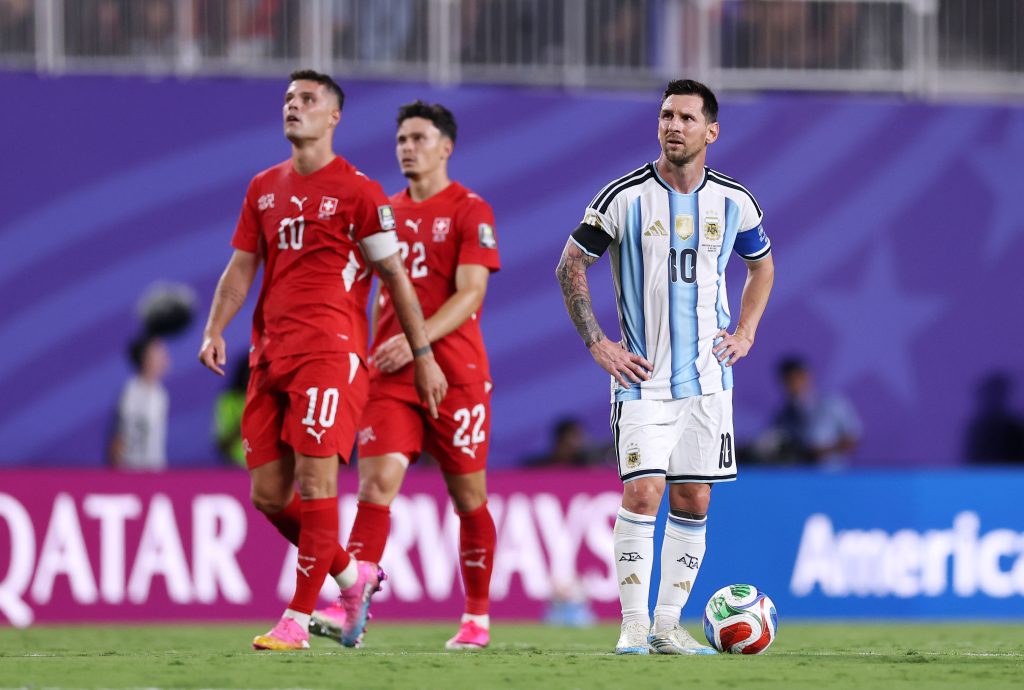
Another flashpoint came in the quarterfinal against Switzerland. After consulting with the VAR team, the referee ruled that Swiss forward Breel Embolo had simulated contact with Argentina midfielder Leandro Paredes. Because Embolo had already received a yellow card, the decision resulted in a second yellow and a red card, leaving Switzerland with ten men at a crucial stage of the match.
FIFA’s head of refereeing, Pierluigi Collina, later defended the VAR officials and stated that the decisions were consistent with the interpretation of the laws of the game.
The “VAR-gentina” phenomenon
Whether those decisions were correct or incorrect, they quickly became the foundation of a much larger public narrative.
Following the victory over Egypt, the term “VAR-gentina” spread rapidly across X, TikTok and Instagram, with users arguing that crucial refereeing and VAR decisions were repeatedly favoring the defending champions. For many critics, the pattern of close calls involving Messi and the rest of the team continue to suggest that football’s biggest star is guilty of receiving special treatment. Argentinian defenders, however, reject that interpretation, arguing instead that every decision involving Messi has been scrutinized far more intensely than it would be for any other player.
In that sense, “VAR-gentina” has become less a technical discussion and more a symbol of a broader perception, one that dictates that the team occupies a privileged place at the center of modern football.
A “favorable” path to the semifinals
Argentina’s route through the tournament is yet another key point of discussion.
Prior to facing England, the Albiceleste had not played a team ranked higher than 19th in the FIFA rankings. So far, the path has consisted of Algeria, Jordan, Austria, Cape Verde, Egypt and Switzerland.
This situation is partly the result of FIFA’s new seeding system, designed to keep the highest-ranked teams apart until the later stages of the competition. While FIFA argued that the change was intended to create competitive balance, many observers felt it benefited the tournament favorites.
The debate only intensified after comments made by FIFA president Gianni Infantino following Argentina’s victory over Cape Verde. During a brief post-match interview, Infantino acknowledged that he had felt nervous about the possibility of the defending champions being eliminated. Although he immediately clarified his remarks, adding that neutral observers were supporting both teams, the episode generated significant discussion on social media, where many users interpreted his declaration as evidence of personal sympathy toward Argentina and revived accusations that FIFA’s leadership favors the defending champions.
The off-field investigation
Beyond the field, recent reports reveal that the FBI and the U.S. Department of Justice are investigating financial operations connected to the Argentine Football Association (AFA), including transactions involving hundreds of millions of dollars that passed through the U.S. financial system.
The investigation does not accuse Argentina’s national team of wrongdoing, and AFA representatives have emphasized that an investigation is not proof of guilt. Still, the timing of the reports – emerging during another strong World Cup run – has added a new layer to public conversations.
For many online commentators, the investigation has become intertwined with broader suspicions about FIFA. The argument is not that the probe proves misconduct by Argentina’s national team, but that it reinforces a wider distrust of institutions connected to the World Cup.
Defenders of that narrative often point to four developments: debatable VAR decisions, a relatively favorable path created by FIFA’s seeding system, Infantino’s personal preferences, and the financial investigation into the AFA. By linking those events together, they argue that football’s governing structures are influenced by powerful political and financial networks rather than purely fair sporting considerations.
To date, however, no evidence has emerged connecting the FBI investigation to FIFA, referees or the organization of the tournament.
Messi’s influence and the perception of power
Mario Arregocés, a Colombian journalist, ex-footballer, and former sports commentator, acknowledged that events on the scale of a World Cup inevitably generate speculation about who may be pulling strings behind the scenes. He cautioned, however, against treating those suspicions as proof that Argentina’s campaign has been orchestrated.
“I can assure you that there are very powerful interests in sports, especially in football, that have the capacity to manipulate public opinion and to influence masses. I don’t reject the idea that a degree of corruption exists, but that is very different from asserting that there is solid evidence of a conspiracy to favor Argentina,” he told Latin American Reports.
He contends that many controversies involving the national team’s World Cup trajectory are interpreted through the lens of modern football’s most influential rivalry: Lionel Messi versus Cristiano Ronaldo.
In light of Portugal’s elimination and the Albiceleste’s continued comebacks and successes, tournament enthusiasts have revived speculative narratives about whether FIFA’S institutions are helping one superstar over the other strengthen his claim as the greatest player in history.
A web of global rivalries
Argentina’s place at the center of the World Cup conversation, Arregocés explains, is also tied to the extraordinary range of rivalries the country has built across the globe.
The rivalry with Brazil is the most famous, built on decades of competition for supremacy in South American football. Similarly, Argentina’s clashes with Uruguay draw on more than a century of opposition between the two neighbors, while tensions with other Latin American countries such as Chile, Colombia, Mexico, and Paraguay have become increasingly heated through recent World Cup qualifiers and regional tournaments.
Outside South America, the team’s rivalry with England is rooted in the controversial 1966 World Cup quarterfinal, Diego Maradona’s “Hand of God” goal in 1986 and the broader legacy of the Malvina/Falkland Islands conflict.
Combined with the country’s recent dominance, these rivalries help to explain why criticism has spread so quickly across different fan bases. Every controversial decision involving Argentina is viewed not only through the lens of a single match, but through years of sporting rivalry, national pride and historical memory.
The process behind success
Ultimately, amid growing global furor, judgement, and speculation, Arregocés argues that, though it is natural for certain field decisions and logistical advantages to spark talk among sports fanatics, Argentina’s recent success can best be explained as a result of the team’s commitment to continuity and long-term strategy.
“This national team has been following the same process for over four years. It is a well-oiled group that knows itself, that has excellent chemistry, and those factors, more than any supposed assistance, are what determine results.”
Arregocés also points to Argentine football culture as an additional key element, suggesting that youth development in the country places an unusually strong emphasis on winning first place and on cultivating a competitive mentality from an early age.
“Argentina focuses on building a player’s mentality from childhood before shaping the individual as a footballer. That, in my view, is what separates it from much of the rest of the world.”
As the team’s victories grow increasingly intertwined with questions about legacy, rivalry, history, finance, and politics, the debate surrounding Messi’s Argentina is likely to endure long after the World Cup’s final whistle, ensuring that the Albiceleste’s 2026 campaign will be remembered as much for the conversations it sparked as for the matches it won.
Featured image description: The Argentina team at the 2026 World Cup.
Featured image credit: @Argentina via X