A stadium insult from decades ago still echoes in today’s boardroom talk. When a Manchester United owner attacks immigration, Argentina and Uruguay in the squad turn from simple passport facts into a live argument about labor, identity, and who the club is allowed to be.
A Kung Fu Kick That Never Really Ended
The scene starts with language that is meant to shrink a person. A Crystal Palace fan hurls a vicious slur at Eric Cantona, telling him to go back to his country. Cantona answers by leaping the barrier at Selhurst Park and landing a kung fu kick. Years later, he would call it his best moment, and he accepted a nine-month punishment and community service for something he never regretted: hitting a racist.
Thirty-one years have passed since that day in South London. Still, the trouble is the argument behind it keeps resurfacing, just wearing different clothes. Back then, it was a man in the stands demanding belonging be policed with profanity. Now it is a billionaire executive voice, dressed up as economic concern, landing in the same place.
For a brief stretch, Manchester United fans felt hope, believing the team could rise again. The narrative softened, sparking pride and a sense of unity, as hope flickered for a better future.
Then Jim Ratcliffe, the billionaire who owns almost a third of the club, said Britain has been colonized and that it is costing a lot of money. He claimed immigration brought 12 million people over six years, but official statistics show only a 2 million increase since 2020. This discrepancy raises questions about the economic narratives used to justify anti-immigration sentiments and their impact on social cohesion.
It is tempting to dismiss this as a numbers mistake, but it reveals societal divisions. It reaches into a club whose identity has been shaped by outsiders, prompting reflection on societal divides.
Argentina and Uruguay Inside a Club Built by Outsiders
Look at the men’s first team, and the contradiction is not just theoretical. There are twenty immigrants in the squad, from Argentina, Uruguay, Belgium, Turkey, Brazil, and more. This diversity is a testament to the club’s success being rooted in global talent, which directly conflicts with Ratcliffe’s comments about immigration and club identity.
An everyday observation follows from that list, implied by the way modern football actually works. You cannot turn on a match without hearing accents collide, without seeing flags stitched into boots, without watching teammates translate each other’s urgency in real time. The dressing room is not a nation. It is a workplace. A workplace where people arrive because they are good at a job, and because someone paid to bring them.
Even ownership carries that truth. The Glazer family, which holds more than seventy percent of the club, comes from the United States. The club’s legends were often imported. Cristiano Ronaldo arrived from outside England. Cantona did too. Peter Schmeichel did too.
The notes do not treat these as trivia. They turn them into a ledger of how success was made. Who scored the goal that delivered the club’s second European Cup in 1999? A Norwegian, Ole Gunnar Solskjaer. He saved the penalties that helped deliver the third in 2008 and was named man of the match. A Dutchman, Edwin Van der Sar.
So the wager here is simple and brutal. When Ratcliffe attacks immigration, he is not just discussing policy; he is challenging the very identity of Manchester United, which has been historically built by outsiders and immigrants. This speaks directly to the club’s core values and how leadership’s rhetoric can threaten that legacy.
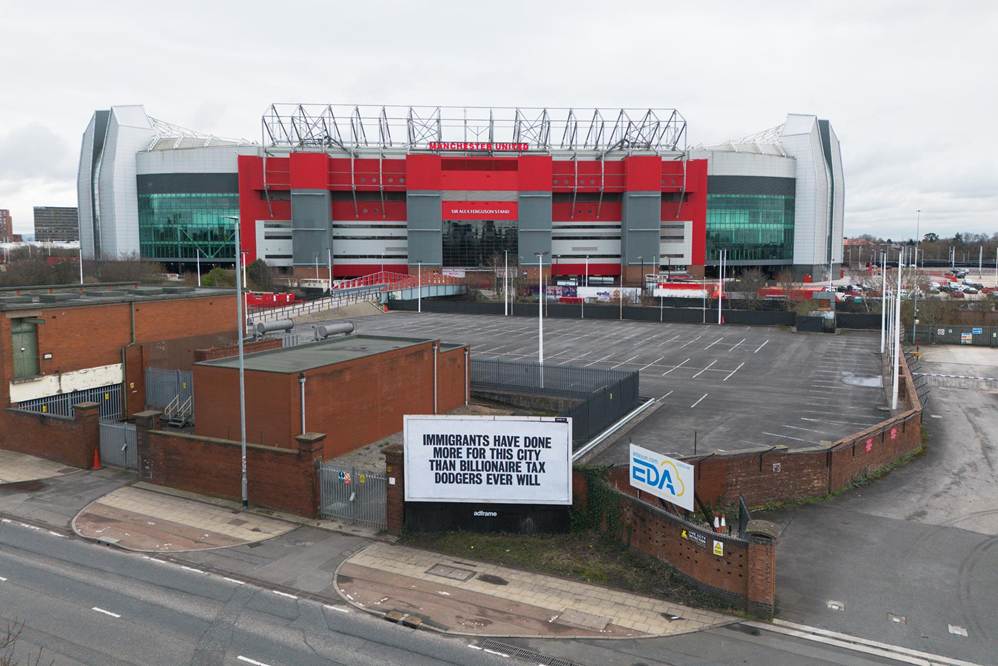
The Target Is the Poor, Not the Passport
Ratcliffe’s criticism, the notes argue plainly, is not aimed at immigrants as such. It is aimed at poor immigrants. He says you cannot have an economy with nine million people receiving aid and with high immigration. That figure, too, is described as untrue. The number of people receiving aid in the United Kingdom does not exceed two million.
This is where the language about colonization stops being merely inaccurate and becomes a sort of mechanism. A billionaire can say immigrant and mean a threat. But his own club depends on immigrants as a resource, a brand asset, a winning tool. The contradiction only resolves if you split immigrants into categories that need not be named. The celebrated ones who score and sell shirts, and the disposable ones who clean and serve and apply for benefits.
The notes bring that split down to the level of family story. Kobbie Mainoo is English, yes, but his parents are Ghanaian. Ayden Heaven, a central defender who appears regularly in first-team lineups despite being 19, has a Ghanaian grandfather. These are not exceptions. They are the shape of modern Britain and the shape of modern football at the same time.
The club’s official Muslim group emphasized that Manchester United is a global club built on diversity. They highlighted that our strength lies in inclusion, fostering pride and unity among fans.
Ratcliffe’s remarks, the notes say, are not new. They appear alongside a pattern in how he treats labor inside the club. He removed workers’ right to free meals at the training ground canteen and said no one ever gave him free food. In more than two years at United, he has fired more than 400 people while wasting millions on players who have not delivered. He removed pensions from club legends like Alex Ferguson. He eliminated worker privileges, including the right to travel to the FA Cup final.
So when he now attacks immigrants while taking cover in his role as an entrepreneur, he is also doing something else. The notes insist that he is forgetting he is a Manchester United representative. And he is stepping away from the core reason Cantona kicked a racist in the stands all those years ago.
Because the slur always comes back to the same sentence.
Go back to your country.
Also Read:
Brazil Wins First Winter Olympic Gold for South America