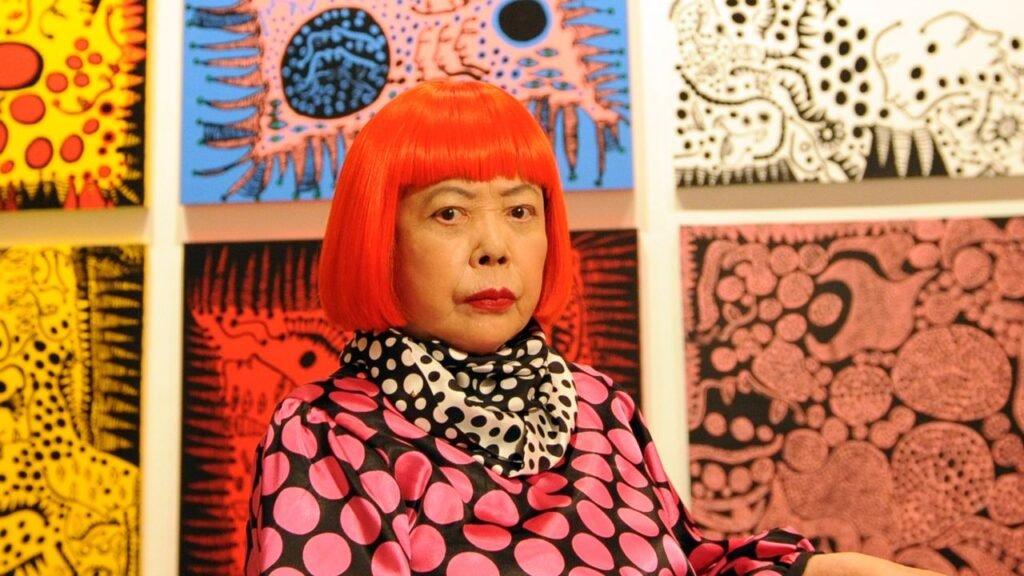
Renowned Japanese artist Yayoi Kusama died on Wednesday at a hospital in Tokyo, according to her gallery, David Zwirner. She was 97. Kusama’s work, with its fizzy pop-culture style and preponderance of polka dots, spanned painting, drawing, sculpture, and performance, as well as literature, fashion, and product design. Her artworks regularly fetched record-breaking prices at auction.
Born in Matsumoto City, Japan, in 1929, Kusama studied Nihonga, a formal style of Japanese painting, in Kyoto. She began painting at the age of 10, with her early works reflecting hallucinogenic visions that often took the form of dots. The motif—which she later described as representing the cosmos—would become her signature. “After all, well, the moon is a polka dot, the sun is a polka dot, and then, the Earth where we live is also a polka dot,” she told a journalist.
Kusama moved to New York in 1957, attracted by the city’s experimental art scene. Over the next decade, she became part of the New York avant-garde, first attracting notice with her Infinity Nets, a series of artworks featuring undulating, apparently endless patterns.
Kusama instinctively knew how to generate publicity through her work. In the 1960s, she became notorious for her “happenings”—spontaneous and provocative performances, often involving nudity, staged in places such as Central Park, the sculpture garden of the Museum of Modern Art, and the Brooklyn Bridge. Many were created as protests against the Vietnam War or as campaigns for gay rights and sexual liberation. (In the 1970s, she created orgy clothing intended to be worn by several people at the same time.) During this period, Kusama exhibited her work alongside Andy Warhol, Claes Oldenburg, and other prominent avant-garde artists. She was friends with Warhol in the early 1960s, but she later accused him of stealing her ideas.
In 1966, Japanese officials refused to let Kusama show in the Japanese pavilion at the Venice Biennale. She responded by covering the lawn adjacent to the pavilion with 1,500 mirrored orbs and dancing around them while wearing a leotard. (Unsurprisingly, the artwork, entitled Narcissus Garden, got more attention than the official exhibit.) Kusama created the first of her signature Infinity Mirror Rooms in 1965 with Phalli’s Field, a room filled with phallic sculptures. Her aim was to transform the seemingly infinite repetition of her canvases into an immersive experience. The rooms later reached unprecedented popularity in the era of the selfie.