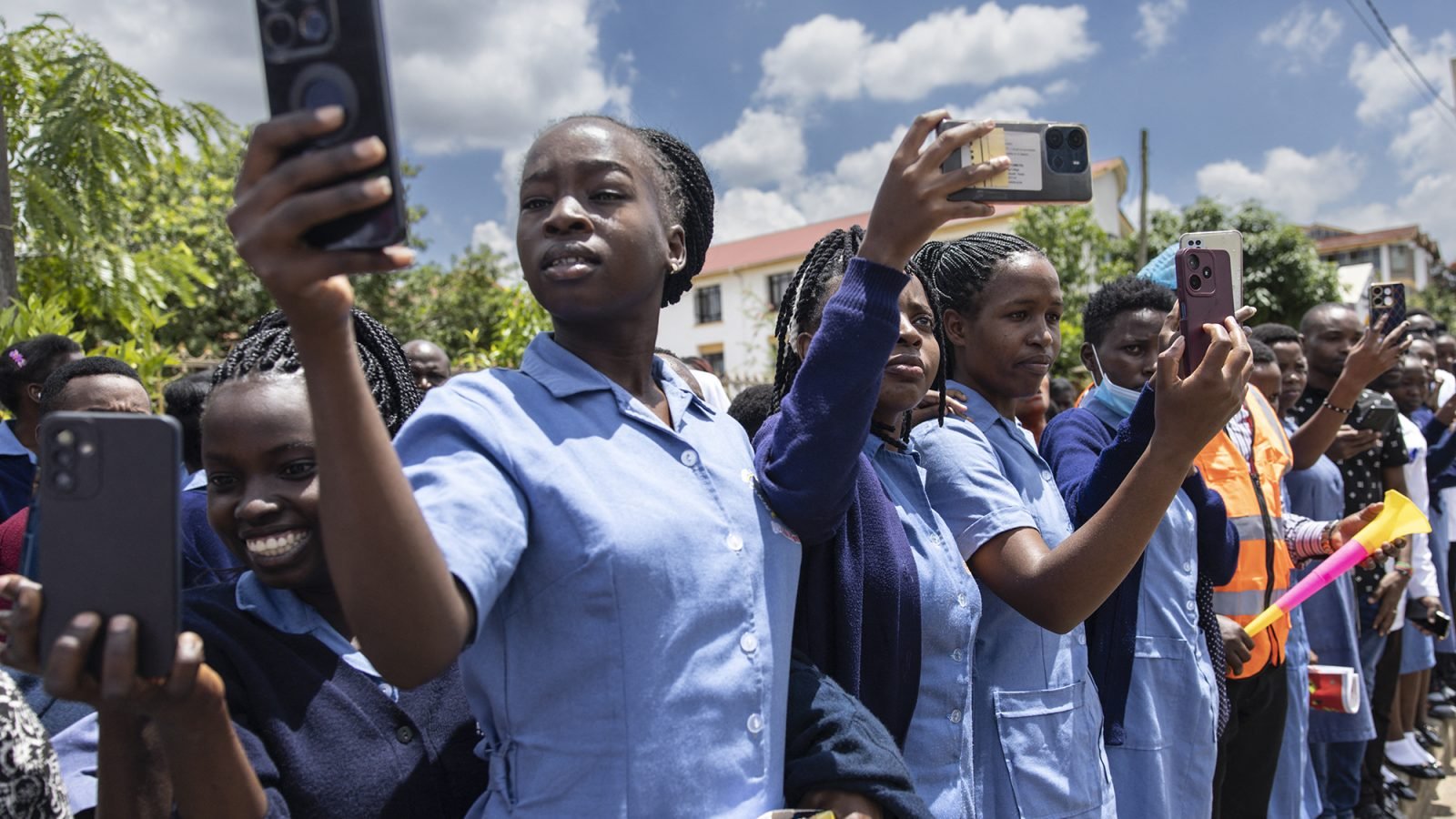
When I first embarked on the project to write about the encounters between Chinese digital capital and Nairobi’s booming innovation scene, I imagined myself rubbing shoulders with software developers, venture capitalists, coworking hosts, and business analysts. That happened, eventually. But my first encounter with digital Global China in Kenya was of a completely different kind. I had just landed in Nairobi, in fall 2021, when I realized that I needed a burner phone to use mobile money. I was already familiar with the fact that Chinese manufacturers of affordable handsets dominated smartphone sales in Kenya — and in Africa at large. But I had not realized how crucial cheap Chinese mobiles were to the multiple value chains that linked Kenya’s Silicon Savannah and China’s going-out digital capital. It was when I found myself on Moi Avenue, looking for a burner phone, that I understood how the ubiquity of affordable Chinese hardware was my first glimpse into the story.
Busy and loud, Moi Avenue separated quieter, leafy uptown Nairobi, with its highly guarded government buildings and brutalist corporate offices, from the hustle and bustle of downtown. A colleague and friend had told me to notice how even the two sides of the avenue itself felt different. The uptown side, with its grander and better-kept buildings and more airy awnings, seemed spacious and neat. The downtown side, with its smaller arcades cluttered with all sorts of signs, appeared crowded and rowdy. Both sides of the avenue, in the section that leads to the statue of Tom Mboya, one of the revolutionary founding fathers of postcolonial Kenya, are dotted with dozens of electronics stores. Some of these are branded with global corporate logos, like those of Samsung, LG, Sony, Oppo, Nokia, XiaomiXiaomiXiaomi is a Chinese consumer electronics company that leads the country in smartphone manufacturing and sales.READ MORE, and Huawei. Others bear the logos of China’s best-selling manufacturers of affordable hardware that only exist in Africa and Southeast Asia: Infinix, Tecno, Itel, Realme, Oraimo, and Zanco. Most shops, however, boisterously combine multiple labels — their windows covered with stickers and decorated by custom-printed packaging tape featuring various technology manufacturers.
Where Moi Avenue bends, at the National Archives, one can walk past the colonial building and step onto Luthuli Avenue, which hosts even more tech stores along a colorful stretch of LED lights, billboards, and hoardings. Here, along a span of less than half a kilometer, dozens of electronics stores sell, buy, repair, and refurbish tech hardware, mostly from China. And it was here, between the sampled beats of Nigerian hip-hop and the tooting of motorcycles, that many ordinary Nairobians, I would later learn, had first witnessed the repercussions and possibilities of China’s technological ascendancy.
Mobile phones are the unsung material commodities without which Kenya’s ambitious programs would have faltered.”
Not even a week after buying my cheap Tecno phone on Moi Avenue, I sat down for a friendly conversation with Jerotich, a local business journalist who would in time become a friend. She worked for the African chapter of CGTN, the controversial Chinese TV channel that covers African news stories. Throughout her career, she had been an observer — and critic — of Kenya’s economic ties with China. “If you want to understand the mobile money revolution and all that’s happened in Nairobi since then,” Jerotich told me, “you need to look at the moment when phones became ubiquitous. We called them chinku. They were cheap copies of established brands like Nokia and Motorola.” Chinku, as its sound suggests, was the slightly derogatory term for Chinese counterfeited products in Sheng, the ever-changing creole spoken by young Nairobians. Chinese knock-offs were so common, Jerotich explained, that another vernacular for fake, imbo, literally meant “imported.” And while chinku and imbo had initially referred to anything fake, they had come to epitomize cheap handsets.
Jerotich’s hint to begin with affordable phones to tell the story of Nairobi as a crucible of made-in-Africa innovation is a very different starting point from the one that I developed, in which I traced how the Kenyan state spent a good part of the first two decades of the new millennium seeking to engineer its blossoming tech economy through both strategic and less carefully orchestrated moves. But in a way, mobile phones are the unsung material commodities without which Kenya’s ambitious programs would have faltered. Undersea broadband connectivity or experiments with USSD-enabled mobile money could have done very little to the country’s economy without a diffused, capillary infrastructure, namely, the terminals through which data are accessed, conveyed, and recorded. After all, as media anthropologists remind us, phones are a strange kind of commodity: one that at once circulates and createsCirculations — of information, money, and more. So too are mobile phones the mundane ends of large ecosystems of data that from our hands operate at an increasingly planetary scale. But what do phones tell us about Nairobi, and what does Nairobi tell us about the making of phones, specifically, the affordable Chinese handsets that now dominate African markets?
To answer these questions, as Jerotich suggested, one needs to go back to the moment when these devices appeared on the streets of Nairobi, at the turn of the first decade of the century and early 2010s initiated a period of fast technological change for Kenya, which quickly garnered a reputation as one of Africa’s cradles of digital innovation. Without a doubt, it was mobile money, M-Pesa, that more than anything else sealed Nairobi’s international reputation as a Silicon Savannah. The success of M-Pesa had depended on many material systems: from the existing financial infrastructures that were used to collateralize mobile money to the haphazard kiosks and precarious human labor that enabled its diffusion. In turn, mobile money had created the data ledgers on which new digital applications could be envisioned and built: lending wallets, pay-go kits, gig-work platforms, and so on. But this shift had also been made possible by another transition: the replacement of Motorola and Nokia cell phones with more sophisticated yet more affordable Chinese devices.
However quotidian and unremarkable, chinku handsets narrate the rise of the Silicon Savannah and its data interfaces with Chinese techno-capital. More specifically, Chinese phones in Nairobi are behind the increasing datafication of urban life at the so-called frontiers, or frontier markets, of techno-capital. Mobile phones tell a story of China in Africa, of innovation from below and from above, of copycat and ingenuity, and of the role that African cities like Nairobi play in the mutating techno-politics of digital platforms.