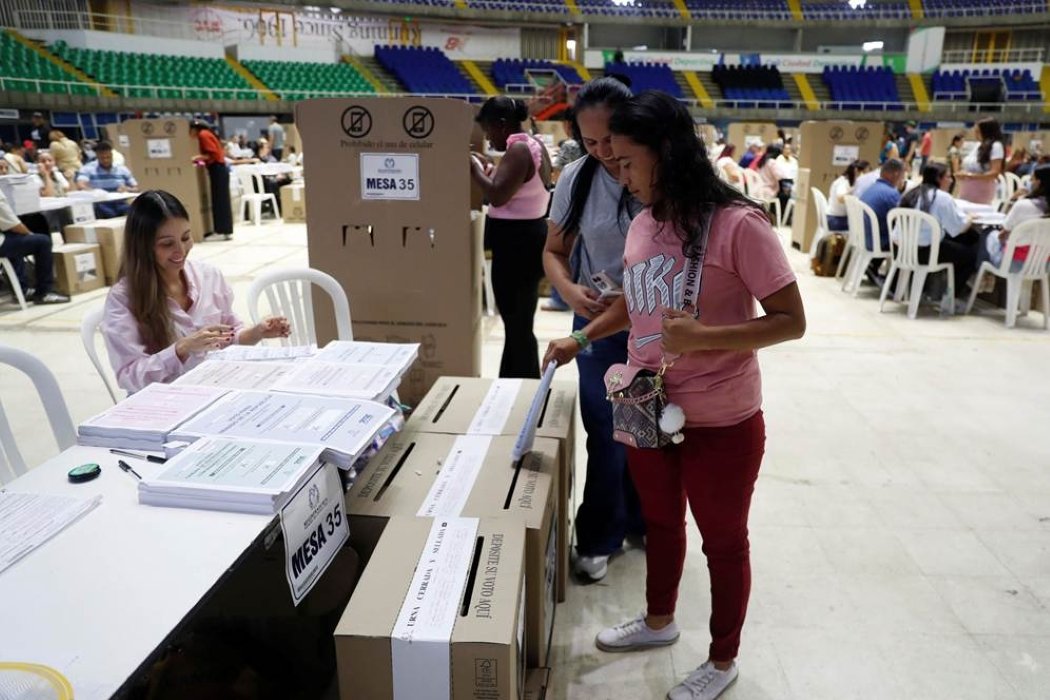
Colombia’s latest vote did not choose a president, but it exposed the battlefield ahead: a strengthened left, a revived right, and a splintered center, all heading toward a tense runoff season that could define how governable the country remains afterward.
The Vote Clarifies the Battlefield
Sunday’s election did something deceptively modest. It did not settle who will succeed Gustavo Petro, and it did not suddenly give the country a clean ideological map. What it did was narrower and, in some ways, more revealing. It showed which camps have muscle, which ones have noise, and which ones still confuse motion for momentum. Colombia now heads into the presidential stretch with a bicameral Congress that will again be fragmented, with no absolute majority in sight, and with a field of candidates that looks broad on paper but much narrower in practice.
Three readings emerge from the day. The first is that Petro’s Pacto Histórico has consolidated itself as the country’s largest legislative force. The second is that whoever reaches the Casa de Nariño will face the same basic curse that has stalked Petro himself: a Congress too divided to obey, too polarized to cooperate easily, and too fragmented to make sweeping reform anything like simple. The third is that, even with a dozen presidential hopefuls still floating across the ballot, the race is beginning to compress around a smaller set of names.
That compression matters because Colombian elections often begin as crowded carnivals and end as hard, emotional referendums. The center usually talks about moderation, the left about change, and the right about order. But once the country starts smelling a runoff, politics becomes less philosophical and more tribal. This vote suggests Colombia is moving into that harder phase now.
For the next president, that means power will almost certainly arrive already reduced. This is not a landscape built for grand majorities or easy governing coalitions. It is a landscape of bargaining, obstruction, temporary alliances, and legislative exhaustion. Now, no matter who wins, they will face a polarized Congress with difficult governability.” That line may be the truest forecast in the whole race.
Cepeda Leads but Cannot Escape Congress
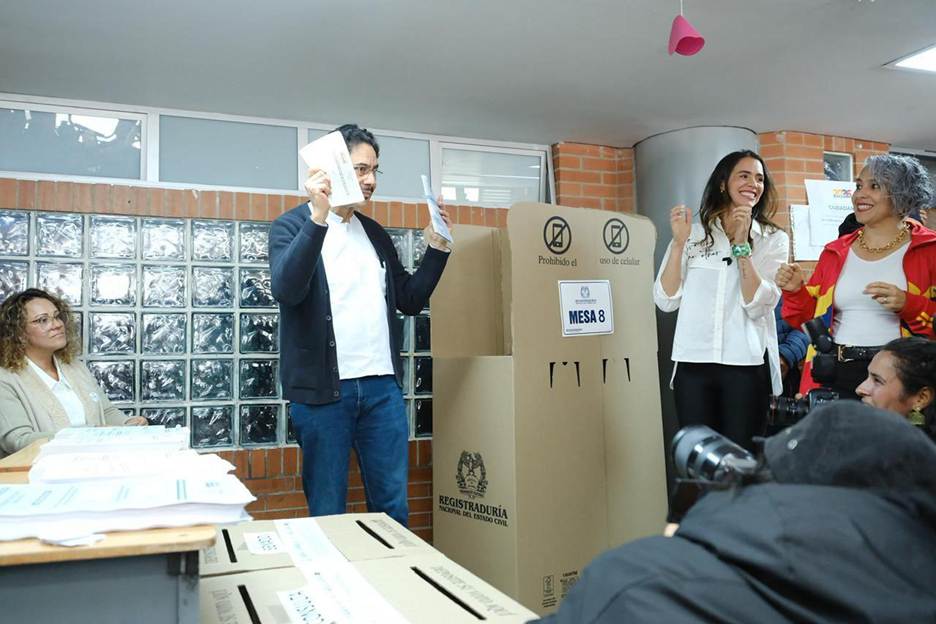
If there is one candidate who leaves this moment looking most structurally comfortable, it is Iván Cepeda. He represents continuity with Petro’s project, but not merely in the shallow way campaign consultants like to describe continuity. His image is rooted in the peace talks with the Farc, in human rights advocacy, and in a biography marked by political violence, including the killing of his father, Manuel Cepeda. He is running not as an outsider to the current government’s ambitions, but as one of the clearest inheritors of their moral and political vocabulary.
That gives him advantages. The notes place him first in several polls, with support ranging from about 30% to 37%, well ahead of the threshold needed to lead the first round, but still far from the 51% required to avoid a second. In other words, Cepeda looks less like a man on the verge of immediate victory than like the candidate best positioned to arrive first at the next gate. That distinction matters in Colombia, where leading in May is not the same as governing in June.
He is also helped by what happened on his own flank. Roy Barreras, long seen by some as a more moderate and alliance-friendly figure for progressive voters, performed poorly in the interparty consultation. The day corrected downward the idea that the left was still searching for a better standard-bearer than Cepeda. What happened yesterday was a success for them. In plain terms, the vote strengthened the sense that the left will enter the decisive phase of the campaign with one real front-runner rather than a serious internal rivalry.
Still, being the front-runner inside a bloc is not the same as being safe in the country. The problem for Cepeda is the same problem facing any Petro-adjacent candidate. He can inherit the left’s organizational coherence without inheriting a workable majority. He can inherit the symbolism of reform without inheriting the power to pass it. Petro himself managed to push through tax, pension, and labor reforms, but only after repeated tension, drawn-out debates, and constant legislative trench warfare. There is little in these results to suggest that dynamic will suddenly disappear.
So what would a Cepeda presidency mean? Most likely, a government with the strongest first-round claim and a limited governing mandate from day one. He looks today like the likeliest candidate to top the first ballot. He does not yet look like a politician who can spare himself the old Colombian ritual of runoff bargaining, congressional horse-trading, and national fatigue.
The Right’s Real Fight Starts Now
If the left got confirmation, the right got something more combustible: proof of energy, but not yet of unity. Abelardo de la Espriella still enters the decisive phase as one of the two candidates with the strongest polling numbers. His hardline message on security and corruption, paired with his defense of free enterprise, God, and family, has given him a powerful lane. He speaks to the part of Colombia that sees Petro not merely as a disappointing president, but as a warning.
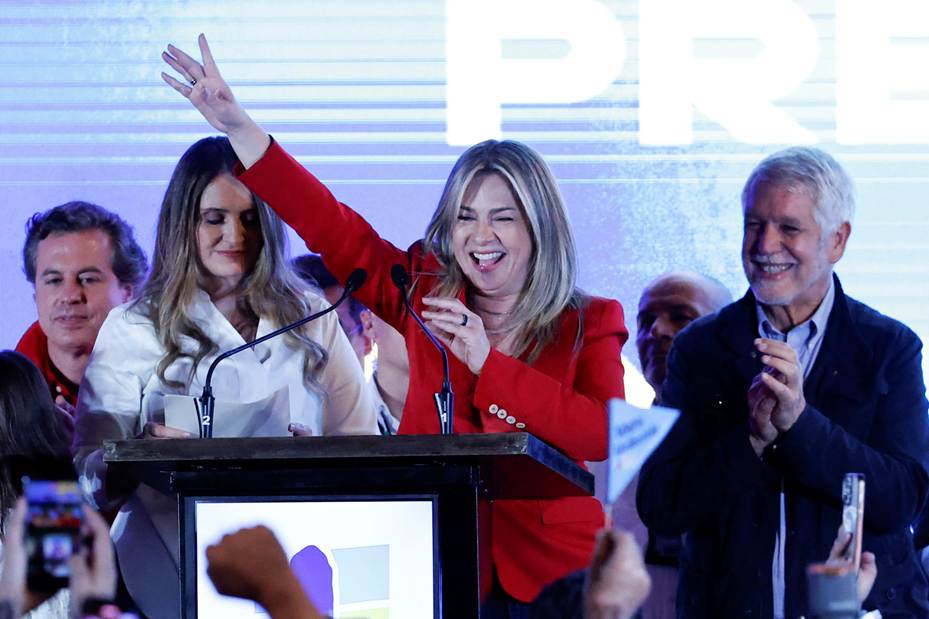
Yet Sunday also produced Paloma Valencia, and that changes the choreography. Her victory in the conservative consultation, backed by millions of votes and by the strongest participation of the three consultations, turned her into more than a secondary contender. It made her the freshest and most organized threat on the right. It remains to be seen whether she can displace De la Espriella on the right.
That is now the core question of the race. Not whether the right exists as a force. Sunday answered that. The real question is whether it can stop dividing itself long enough to make the runoff a straightforward referendum against the left. If De la Espriella and Valencia wound each other, Cepeda benefits. If one of them emerges as the clear anti-Petro vessel, the race tightens fast.
The center, meanwhile, still looks like a conversation rather than a path to power. Claudia López won her consultation and will battle Sergio Fajardo for centrist space, but both still appear to be operating in a political country that has moved elsewhere. Colombia may still say it wants moderation. Its electoral machinery increasingly rewards sharper identities.
So who is most likely to win? The cleanest reading from these notes is that Cepeda is the likeliest first-round winner and, for now, the single most plausible next president. But that conclusion comes with an asterisk large enough to be a campaign. He is better positioned than anyone else to reach the runoff, not necessarily to dominate it. The strongest counterforce may not be De la Espriella alone, but the possibility that Valencia’s consultation victory helps reorganize the right into something broader, calmer, and more electable.
That is why Sunday mattered. It did not tell Colombia who its next president will be. It told the country what kind of president it is preparing to choose: one likely elected without a majority behind them, forced into alliances they do not fully trust, and destined to govern a Congress that can wound any ambition before it becomes law. In that sense, the next election is not only about who wins. It is about who can survive winning.
Also Read:
Ecuador Becomes Washington’s New Front in Latin America’s Drug War