Hundreds of women in Havana rallied against the U.S. energy embargo, but the scene says more than that. It shows how Cuban women, and by extension many Latin American women, are still asked to absorb scarcity, defend dignity, and perform national endurance in public.
When Women Carry the Nation’s Anger
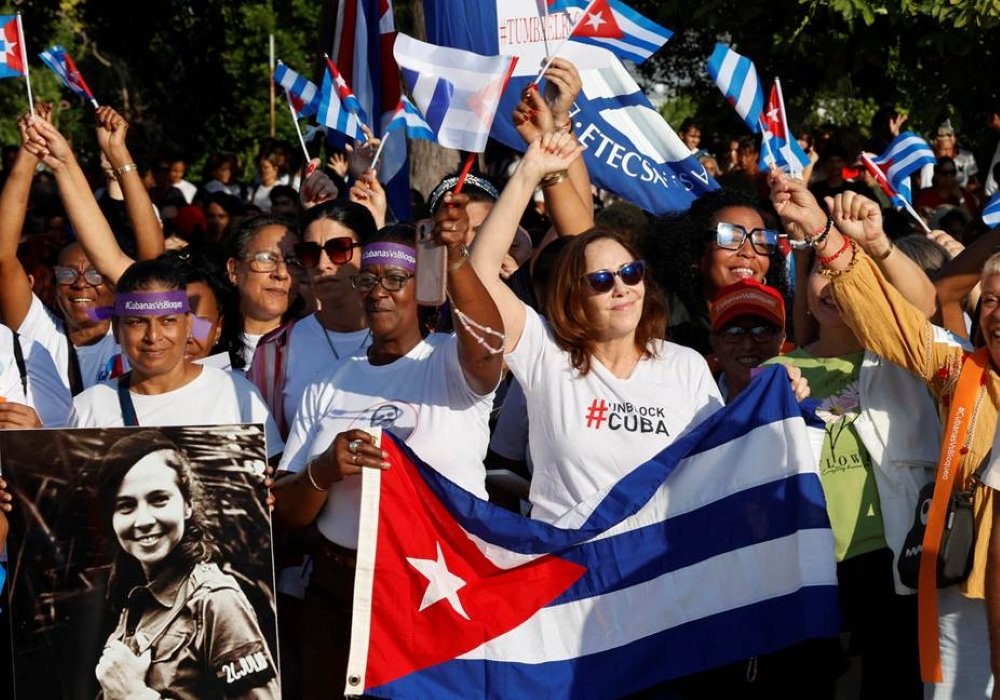
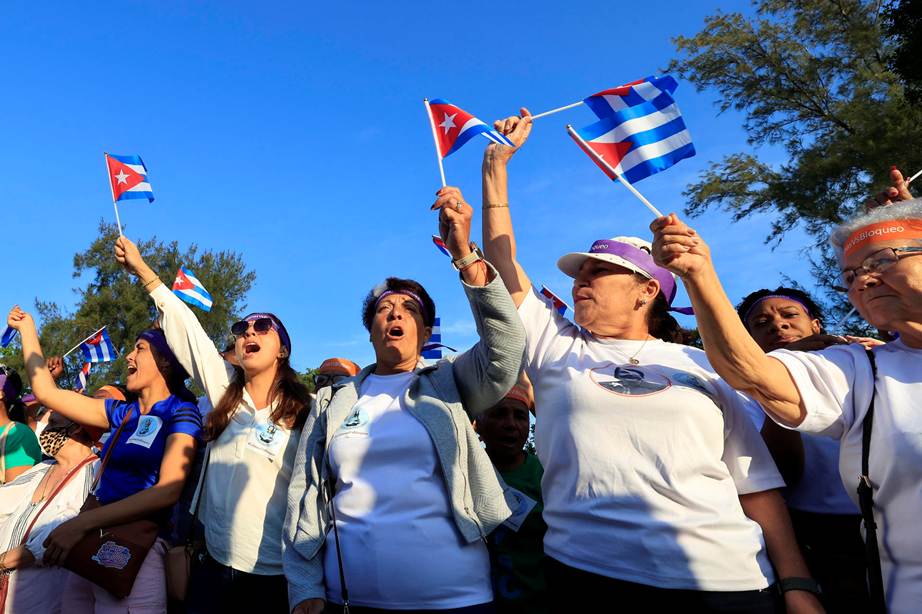
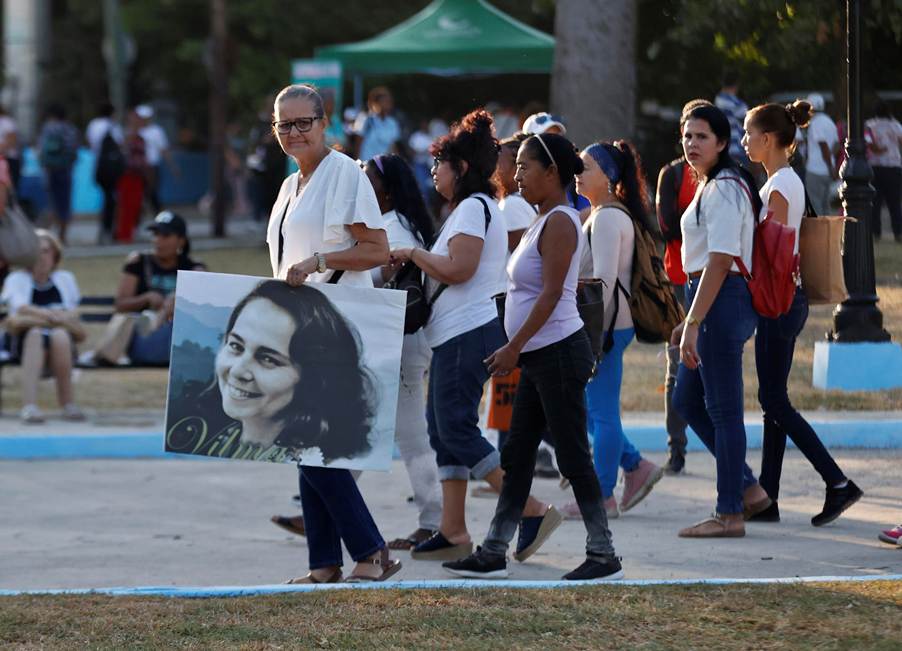
Hundreds of Cuban women gathered Tuesday in Havana to denounce a U.S. energy embargo and other measures imposed by President Donald Trump that, in the language of the protest, are strangling the island. The images were unmistakable. Cuban flags in the air. Signs reading “Down with the Blockade.” Pictures of Fidel Castro and Vilma Espín held close like political memory made portable. The rally, organized by the Federation of Cuban Women, was meant to honor Espín, the group’s founder, a guerrilla fighter and the wife of Raúl Castro. But the event also revealed something larger and more enduring about women in Latin America. When pressure tightens around a country, women are often pushed into the spotlight to embody both suffering and resistance.
That is what gives this gathering its force. It was not only a demonstration against Washington. It was also a demonstration about who carries a nation’s moral argument when daily life starts breaking down. Deputy Prime Minister Inés María Chapman and Deputy Foreign Minister Josefina Vidal led the march along with Mariela Castro, Espín’s daughter and the daughter of former President Raúl Castro. The women at the front were not incidental. They were the message. The state, the revolutionary lineage, and the public face of endurance were fused together in one scene.
Vidal told The Associated Press that “this policy of abuse has to stop,” adding that the Cuban people do not deserve what she described as the most comprehensive, all-encompassing, and longest-running system of coercive measures ever imposed against an entire country. She added that it amounted to collective punishment recognized as such under international law. She said they could not fail to be there. The choice of language matters. Collective punishment is not only a diplomatic accusation. It is a social description. It means punishment is not confined to leaders, ministries, or military structures. It spills into kitchens, clinics, buses, and households.
For Latin American women, that distinction matters deeply. The crisis described in the text is national, but its effects are intimate. Cuba produces only forty percent of the fuel it consumes. The shortage has paralyzed the island, affecting its health system, public transportation, and the production of goods and services, while deepening an economic crisis that has already lasted five years. That is where the politics stops being abstract. Energy scarcity becomes time lost, mobility reduced, care work harder, medicine harder to access, food distribution more fragile, and ordinary routines more exhausting. Even without romanticizing women’s roles, the political meaning is hard to miss. When systems begin to fail, women are often the ones expected to keep life stitched together anyway.
A Familiar Latin American Burden
What happened in Havana is Cuban, but it is not only Cuban. Across Latin America, women have long been called to occupy a difficult civic space. They are asked to appear as conscience, as sacrifice, as continuity, and as proof that the nation remains morally intact. Sometimes that appearance is spontaneous. Sometimes it is organized from above. Often it is both. Here, the Federation of Cuban Women, a massive organization with close ties to the government and the Communist Party, convened the rally in a park named after a nineteenth-century independence hero. That choice of setting was not neutral. It placed women inside a national story of liberation, sovereignty, and historical grievance.
That symbolism is powerful, but it also raises a harder question. What does it mean when women become the most visible face of a crisis whose daily costs are already landing inside homes, hospitals, transport routes, and the wider economy? It means the burden is doubled. Women are not only living through the shortage. They are also being asked to publicly narrate it and politically contain it.
The source text offers several clues about why this moment feels so sharp. In early January, the United States attacked Venezuela and arrested its then-leader, disrupting critical oil shipments to Cuba. Later that month, Trump threatened tariffs against any country that sells or supplies oil to the island. Then came the partial exception: a Russian tanker carrying seven hundred thirty thousand barrels of crude oil arrived in Cuba last week, the island’s first oil shipment in three months, and Russia said it would send a second tanker. The result is a society left to function inside an unstable corridor of scarcity, diplomacy, threat, and temporary relief.
That is the sort of instability women in Latin America know too well, even when the national circumstances differ. It is the instability of never being sure whether the next shipment, the next policy reversal, or the next political negotiation will restore normal life or simply prolong uncertainty. In that atmosphere, women are often treated as the human cushion between the state and social collapse.
The Cuban case makes that visible because the women are not hidden. They are marching. They are speaking. They are placed in lineage with a founder like Espín, whose image helps connect present-day hardship to an older revolutionary vocabulary. That can be read as political choreography, and it surely is. But it can also be read as an admission. The state knows that women still carry unmatched symbolic authority when the issue is national survival.
Between Resistance and Instrument
That is why this rally has a complicated meaning for Latin American women. It is neither a simple story of empowerment nor of manipulation. It is both more human and more uneasy than that.
On one hand, the women in Havana are asserting political presence. They are not passive scenery in a crisis shaped by men in presidential palaces and foreign ministries. They are naming the sanctions, denouncing the embargo, and insisting that the punishment imposed on Cuba has crossed into something intolerable. On the other hand, the scene also shows how readily women’s bodies, voices, and historical legitimacy are drawn into state narratives when legitimacy itself is under strain.
That tension is not a flaw in the story. It is the story. Latin American women have often had to act politically within structures that do not fully belong to them, while also bearing consequences imposed on them far above their station. In Havana, that takes the form of women marching under revolutionary symbols while an energy shortage disrupts the health system, transportation, and the production of goods and services. They are visible at the level of rhetoric and indispensable at the level of survival.
The final uncertainty in the text deepens that feeling. Trump has pressed for regime change in Cuba and threatened to take over the island. At the same time, Secretary of State Marco Rubio has demanded the release of political prisoners and liberal economic reforms. At the same time, the U.S. and Cuban governments have confirmed they are holding talks, though the extent of those talks remains unclear. So the women in Havana are demonstrating in a political landscape that is neither settled nor stable, and not fully legible even to those living through it.
That is what this means for Latin American women in the clearest sense. It means they remain the first witnesses to crisis and the most reliable public language through which nations explain pain to themselves. In Cuba, as in so much of the region, women are still being asked to turn endurance into ceremony. The tragedy is that they know how to do it. The warning is that they are asked far too often.
Also Read:
Chile’s Long Shadow Reaches Australia in a Pinochet Extradition Case