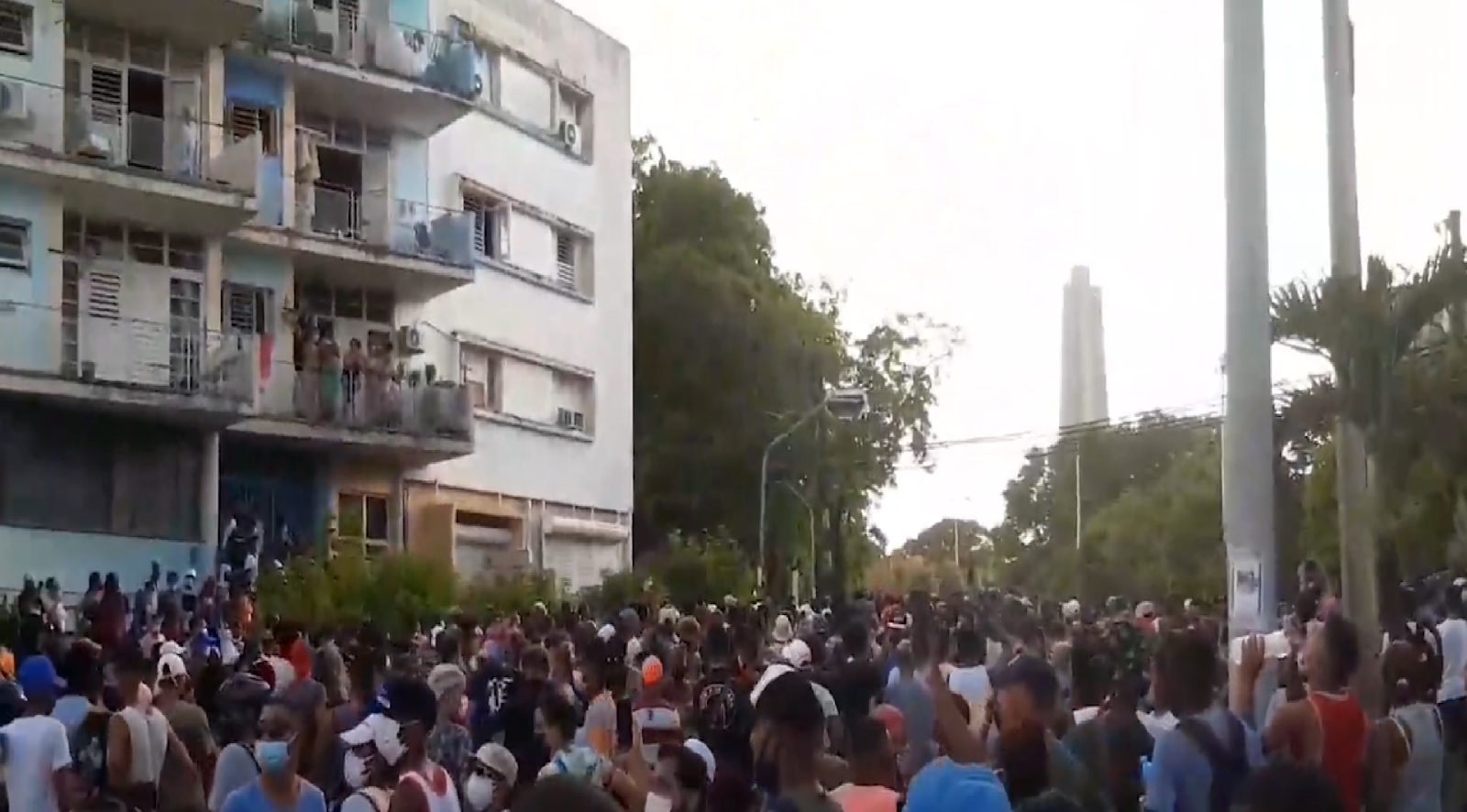
Ongoing power outages, which began on Wednesday, have triggered protests in the Cuban cities of Havana and Matanzas. Videos shared on social media show Cubans on the streets banging pots and pans in the darkness to demonstrate their frustration with the current situation.
This form of protest, which has often occurred as a direct response to a power cut, has been used on various occasions in the last few years as the economic situation on the island has deteriorated.
The current sanctions-induced crisis, caused by a U.S. blockade of oil imports to the island, is worsening; the healthcare and education systems are gradually crumbling as poverty and crime increase.
Protests on the island are a historical rarity but have steadily increased in frequency since the so-called 11J demonstrations, large-scale protests which broke out across the island in July 2021 in which Cubans expressed their anger at the economic situation, shortages of medicine, the COVID-19 response and governmental restriction of freedoms.
Some of the videos of the current protests in Havana include captions such as “Enough Already! Down with it all!” and “Freedom, down with the dictatorship!”, indicating that there is a political dimension to the shortage-induced frustration.
Explicitly anti-government Cuban protestors tend to face considerable risk. The 11J protests resulted in the detention of 1,500 protestors and the NGO Prisoners Defenders reported in January 2026 that the number of political prisoners in Cuba had reached a record high of 1,207, with 18 more incarcerated in January alone.
An entrepreneur from Havana who requested anonymity for their safety, told Latin America Reports that protests were “totally valid” given that many people had been without power for over 24 hours.
The protestors, the entrepreneur explained, “went out at night with their faces covered to avoid being detained for the day”. He also suggested that, in spite of the aforementioned reports from NGOs, the Cuban state’s capacity to suppress protest is dwindling.
“To repress people you need an active military, fuel and money … nobody wants to be a soldier anymore, it comes with a high social price … everyone is against you and they pay you badly”, he added.
Despite the entrepreneur’s speculation about the diminishing coercive power of the state, the intensification of U.S. sanctions against the island and American threats of regime change have caused concern about the potential for an increase in repression of anti-government dissent.
Abel Tablada, a professor at the Technological University of Havana, was reportedly banned from teaching earlier this month over a Facebook post in which he highlighted the difficulties university students and professors face in the country.
Tablada criticized the “cruel sanctions of the Trump administration” but also warned that Cuban resilience risked becoming a kind of acceptance of “conditions that should not be prolonged”.
Tablada explained the nature of those “conditions” in his post: “those professors that only survive with a salary of $10-15USD [a month] also have many more material problems at home, [be they related to] food, family or transportation”.
Tablada then shared in a Whatsapp message that his posts “had not been well received by the university administration” and implied that that disapproval had resulted in his dismissal.
Featured Image: The July 2021 protests in Havana
Image Credit: 14YMedio via Wikimedia Commons
License: Creative Commons Licenses